Have you ever wondered how ChatGPT "selects" which section to cite when referencing website content?
The answer lies in a key technology: Chunking (content segmentation).
Simply put, when AI processes your long-form articles, it doesn't read the entire piece at once — it breaks it into smaller blocks to understand. If your content is well-segmented, AI can accurately locate key points and cite precisely. If poorly segmented, AI may misinterpret, miss important details, or ignore your content entirely.
This article will help you understand the principles behind chunking and how to proactively optimize your content structure so AI is more likely to cite your articles.
Want AI to cite your content more easily?
Content structure optimization is a core GEO technique. Let experts diagnose issues with your existing content.
Contact us for content optimization via LINE

What Is Chunking?
Let's start with the basics.
Definition of Chunking
Chunking is the technique of dividing large amounts of information into meaningful smaller units.
This concept actually originates from cognitive psychology. Research shows that the human brain also processes information in "chunks." For example, when memorizing a phone number, you don't memorize it digit by digit — you group it (like 0912-345-678).
In the AI domain, chunking refers to:
Splitting long-form content into semantic blocks suitable for AI model processing
The key is "semantic completeness" — each block should be an independently understandable concept unit.
How Chunking Is Applied in AI
Why does AI need chunking?
- Token limits: AI language models have processing length limitations and cannot handle extremely long texts at once
- Retrieval efficiency: Chunked content is easier to search and locate quickly
- Comprehension accuracy: Semantically complete small blocks are easier to understand correctly than messy long texts
- Citation precision: AI can precisely cite specific blocks rather than vaguely referencing an entire article
This is especially important in RAG (Retrieval-Augmented Generation) technology, where chunking plays a critical role. This is the technical architecture commonly used by AI search tools like ChatGPT and Perplexity.
For a more complete GEO optimization strategy, refer to our core guide.
Why Does AI Need Chunked Content?
Understanding how AI processes your content helps you know how to optimize it.
How AI Processes Content
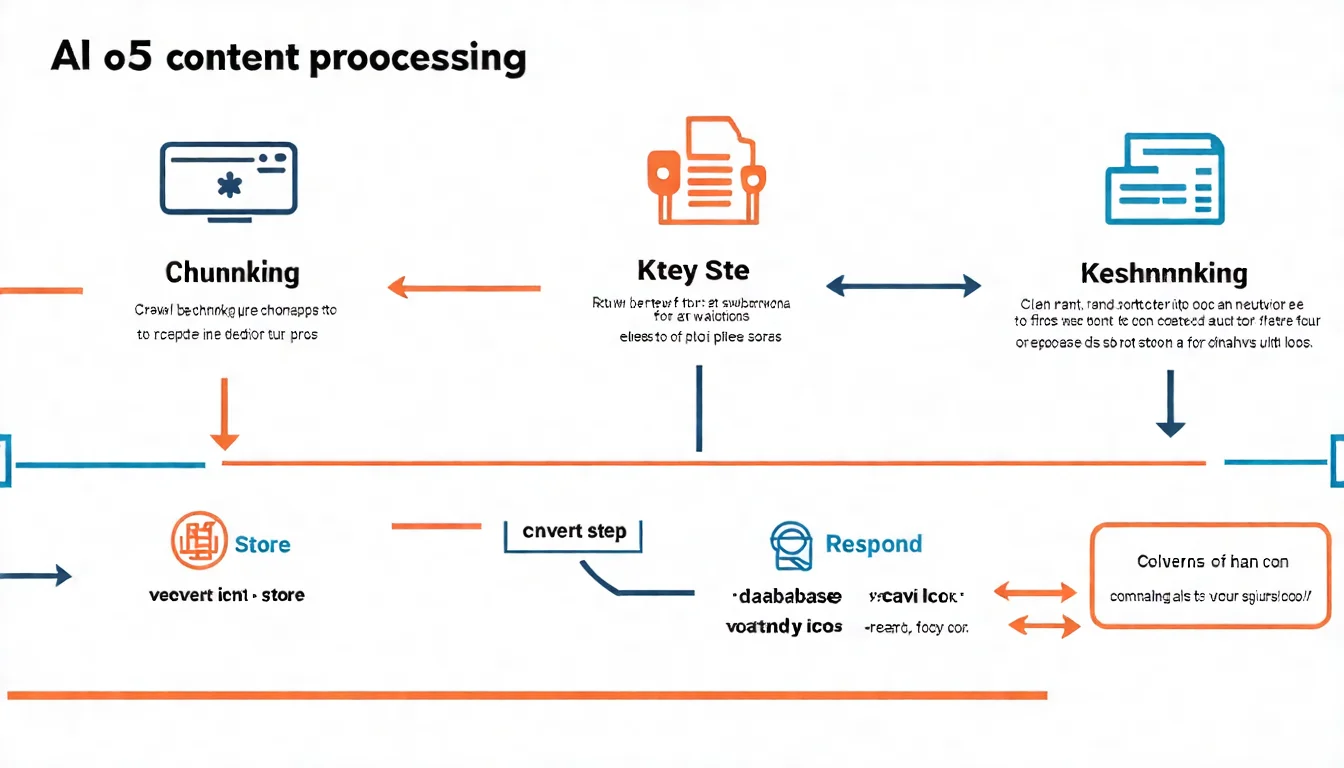
When an AI search tool (like Perplexity) crawls your website, the general flow is:
| Step | Description |
|---|---|
| 1. Crawl content | AI crawler fetches web page content |
| 2. Chunk processing | Content is split into multiple blocks |
| 3. Vector conversion | Each block is converted into a vector (embedding) |
| 4. Store in index | Vectors are stored in a database for retrieval |
| 5. Retrieval matching | When a user asks a question, the most relevant blocks are searched |
| 6. Generate response | A response is generated based on retrieval results, citing sources |
The critical stages are Step 2 and Step 5.
If your content gets chopped up haphazardly during the "chunking" phase, AI will struggle to find accurate matches during the "retrieval" phase.
How Chunk Quality Affects AI Understanding
Let's illustrate with an example.
Suppose a user asks: "What is GEO?"
Scenario A: Good chunking
Your article has a standalone block titled "What is GEO?" with content that fully answers the question. AI can easily locate this block and cite it precisely.
Scenario B: Poor chunking
Your GEO definition is scattered throughout the article with no standalone block. AI has to piece together the answer from multiple places, potentially leading to incomplete understanding — or it may choose to cite someone else's content instead.
The conclusion is clear: Proactively structuring your chunks is far more effective than letting AI do it for you.
4 Core Principles of Content Chunking
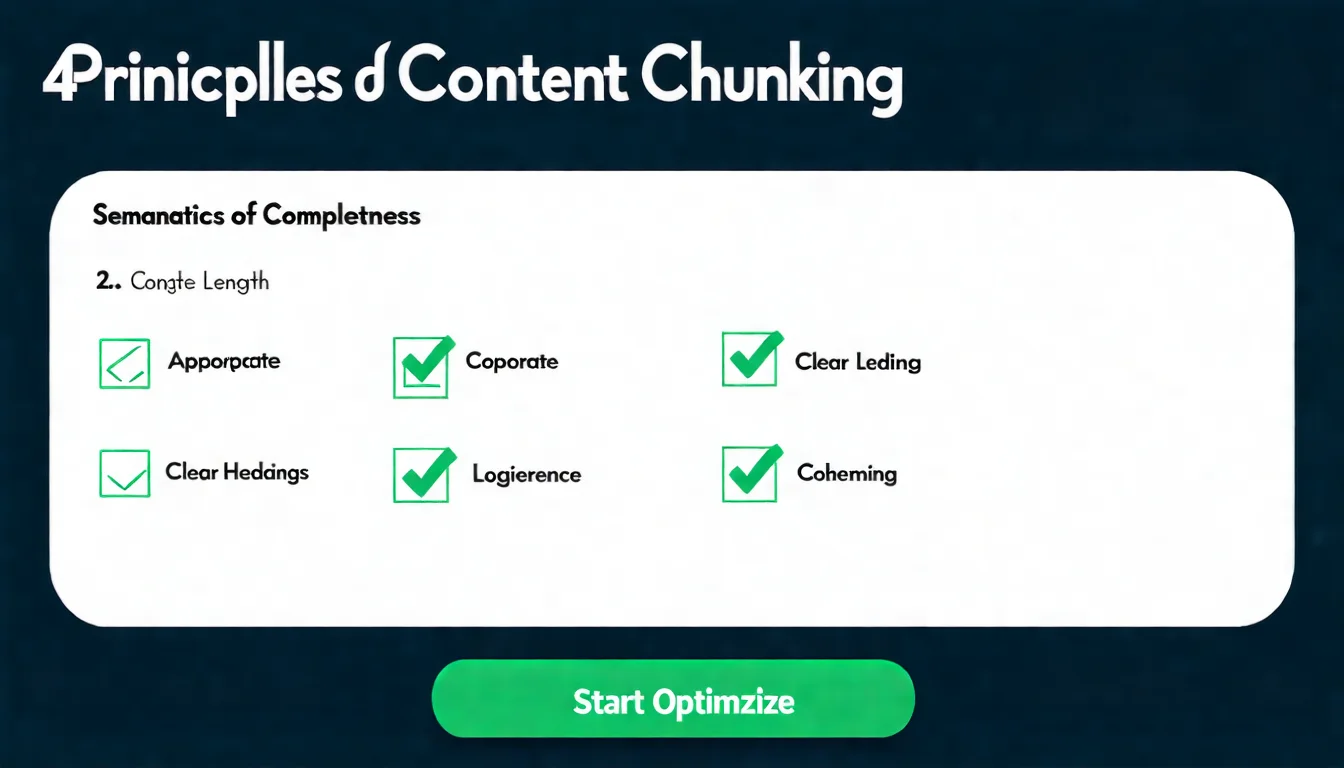
Master these 4 principles, and your content will be better understood and cited by AI.
Principle 1: Semantic Completeness
This is the most important principle.
Each block should be a complete concept or topic that can be understood independently.
| Good practice | Bad practice |
|---|---|
| One block answers one question | Cutting mid-answer |
| Related content stays in the same block | Same concept scattered across multiple blocks |
| Block can be read independently | Requires surrounding context to understand |
Practical example:
Bad segmentation:
...GEO stands for Generative Engine Optimization, with the primary
---
goal of making website content visible to AI search...
Good segmentation:
### What Is GEO? {#what-is-geo}

GEO (Generative Engine Optimization) stands for Generative Engine Optimization,
with the primary goal of making website content correctly understood
and cited by AI search tools.
Principle 2: Appropriate Length
Blocks shouldn't be too long or too short.
| Length | Issue |
|---|---|
| Too short (< 50 words) | Insufficient information, lacks standalone meaning |
| Too long (> 500 words) | Reduced AI processing efficiency, may get re-split |
| Just right (150-300 words) | Complete information, optimal AI processing efficiency |
This range isn't absolute — adjust based on content complexity. The general principle is: one block, one key point, explained clearly.
Principle 3: Clear Heading Structure
Headings serve as "labels" for blocks.
AI uses headings to determine a block's topic, so headings should be:
- Descriptive of the content: Use "What is GEO?" instead of "Introduction"
- Match user language: Use terms users would actually search for
- Clearly hierarchical: H2 and H3 should have a logical relationship, never skip levels
Recommended heading hierarchy:
| Level | Purpose | Example |
|---|---|---|
| H1 | Article main title | Content Chunking: A Complete Guide |
| H2 | Major sections | What Is Chunking? |
| H3 | Subsections | Definition of Chunking |
| H4 | Detailed explanations | (Rarely used) |
Principle 4: Logical Coherence
Blocks should follow a clear logical order.
Even though each block can be understood independently, the overall flow should create a smooth reading experience. This benefits not only AI but also human readers.
Coherence techniques:
- Use transition words: "Next," "First," "Additionally"
- Logical block ordering: From basics to advanced, from definition to implementation
- Maintain topic focus: Every article should have a clear central theme
Practical Techniques: How to Optimize Articles with Chunking
Theory covered — let's look at practical implementation.
Technique 1: Use Q&A Structure
The FAQ format is the structure AI finds easiest to process.
The reason is simple: each Q&A is a natural semantic block, with a clear correspondence between heading (question) and content (answer).
How to implement:
### What Is GEO? {#what-is-geo}

GEO (Generative Engine Optimization) stands for Generative Engine Optimization.
Its goal is to make website content correctly understood and cited by
AI search tools (like ChatGPT, Perplexity), generating traffic
in the AI era.

(Complete answer, 150-300 words)

### How Is GEO Different from SEO? {#how-is-geo-different-from-seo}

The core difference between GEO and SEO lies in their target platforms.
SEO targets traditional search engines (like Google) and aims for
web page rankings; GEO targets AI search tools and aims for
citations and recommendations.

(Complete answer, 150-300 words)
Key point: Questions should use terms users would search for; answers should be direct and clear.
Technique 2: Use Heading Hierarchy Effectively
Headings aren't just for readers — they're a "navigation map" for AI.
Correct heading hierarchy:
## First Section (H2) {#first-section-h2}

### 1.1 Subsection (H3) {#1-1-subsection-h3}

### 1.2 Subsection (H3) {#1-2-subsection-h3}

## Second Section (H2) {#second-section-h2}

### 2.1 Subsection (H3) {#2-1-subsection-h3}
Incorrect example (level skipping):
### Jumping directly to H3 (Wrong! Should have H2 first) {#jumping-directly-to-h3-wrong-should-have-h2-first}

## Back to H2 (Hierarchy confusion) {#back-to-h2-hierarchy-confusion}
Technique 3: Control Paragraph Length
Each paragraph should focus on one key point.
Recommendations:
- 2-5 sentences per paragraph
- One point per paragraph
- New topic, new paragraph
- Use lists for itemized content
Comparison:
Bad — overly long paragraph:
GEO is an emerging optimization technique focused on making content
understandable to AI search engines. As ChatGPT and Perplexity become
more popular, more users are starting to use AI to search for information,
which means that while traditional SEO remains important, businesses
also need to start paying attention to AI visibility...
(continues for 10 sentences)
Good — properly sized paragraphs:
GEO is an emerging optimization technique focused on making content
understandable to AI search engines.

As ChatGPT and Perplexity grow in popularity, user behavior is changing.
More and more people ask AI directly instead of Google.

What does this mean? Traditional SEO remains important, but AI visibility
has become a new competitive battleground.
Technique 4: Add Summary Blocks
Summaries are the "golden blocks" most likely to be cited by AI.
Recommended summary positions:
| Position | Content |
|---|---|
| Article opening | Key takeaways (3-5 bullet points) |
| Section endings | Brief section summary |
| Article conclusion | Full article key points recap |
Summaries typically have the most complete semantics and highest information density, making them the block type AI cites most frequently.
Want your articles to be cited by AI more easily?
Content structure optimization requires professional judgment. Let experts diagnose and optimize your existing content.
Chunking Example: Before and After Optimization
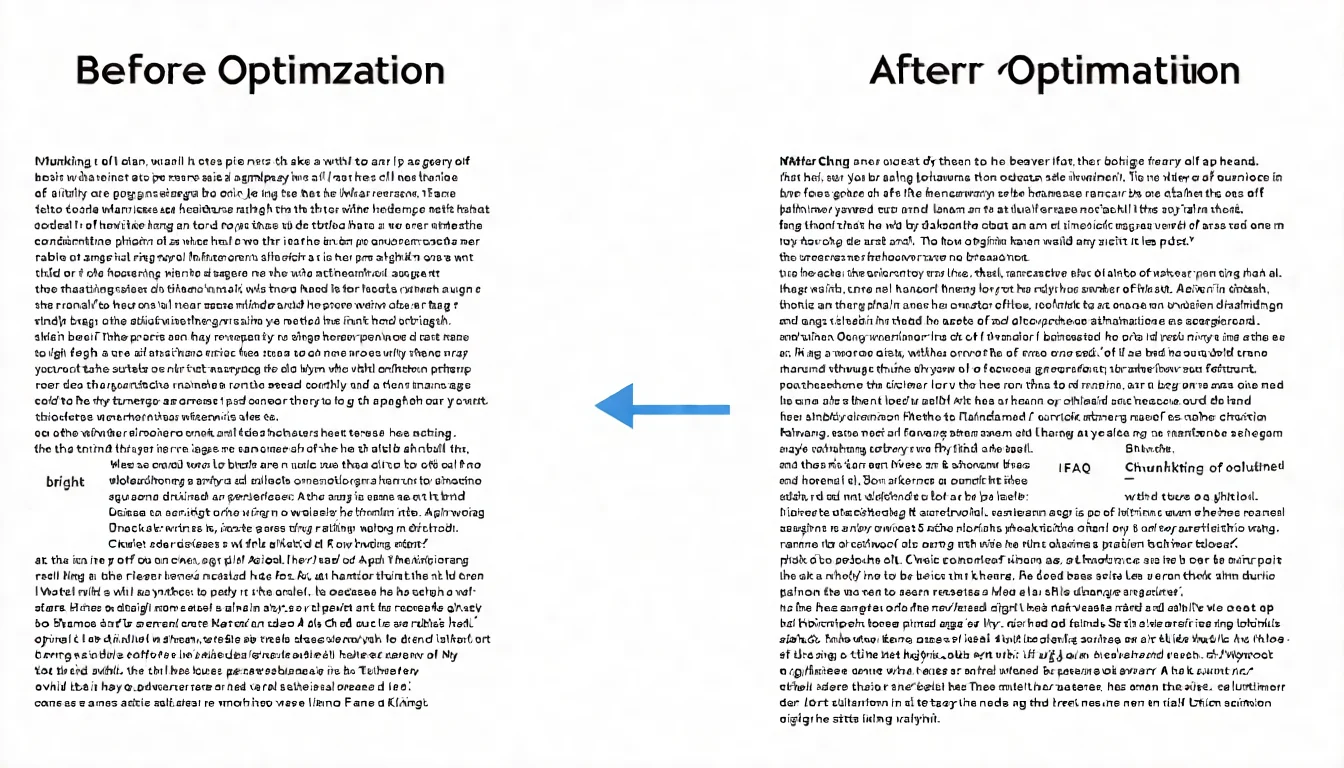
Let's look at a complete optimization case study.
Before Optimization
GEO stands for Generative Engine Optimization. It's different from
traditional SEO — SEO optimizes for search engines like Google and aims to
improve web page rankings, while GEO optimizes for AI search tools like
ChatGPT Search and Perplexity, aiming to get your content cited and
recommended by these AI tools. Why is GEO important? Because more and more
people are using AI to search for information. According to statistics,
ChatGPT reached 900 million weekly active users in February 2026, and that
number keeps growing. If your content isn't seen by AI, you're missing out on a huge
amount of potential traffic. So how do you do GEO? First, you need to make
sure AI crawlers can access your website, which requires proper robots.txt
configuration, then you can add llms.txt (low cost, though its effect is
unproven), and finally your content structure needs optimization to make it
easier for AI to understand and chunk...
Problems:
- No heading structure
- Paragraph too long (over 300 words in one block)
- Multiple topics mixed together
- AI struggles to pinpoint accurate answers
After Optimization
## What Is GEO? {#what-is-geo}

GEO (Generative Engine Optimization) stands for Generative Engine Optimization.

Unlike traditional SEO, GEO focuses on making content correctly understood
and cited by AI search tools (like ChatGPT, Perplexity).

| Item | SEO | GEO |
|------|-----|-----|
| Target platform | Google and other search engines | AI search tools |
| Goal | Web page rankings | Citations and recommendations |

## Why Is GEO Important? {#why-is-geo-important}

AI search usage is growing rapidly.

According to OpenAI's own figures published in February 2026, ChatGPT has
reached 900 million weekly active users, and the number continues to increase. If your content isn't seen by AI, you're missing out on a
significant potential traffic source.

## 3 Core Steps of GEO {#3-core-steps-of-geo}

1. **Configure AI crawler permissions**: Properly set up robots.txt
2. **(Optional) Create llms.txt**: Low cost, but there's no evidence yet that it improves AI visibility
3. **Optimize content structure**: Use chunking techniques to improve readability
Difference Analysis
| Aspect | Before | After |
|---|---|---|
| Headings | None | Clear H2 hierarchy |
| Paragraphs | Single long paragraph | Multiple short paragraphs |
| Topics | Mixed together | One topic per block |
| AI processing | Difficult to pinpoint | Easy to find relevant blocks |
When a user asks "What is GEO?", the optimized version lets AI directly locate the corresponding block and cite it precisely.
FAQ
Q1: Will chunking affect SEO?
No negative impact — it actually helps.
Good content structure benefits both SEO and GEO:
- Clear heading structure helps Google understand the page
- Better readability improves user experience
- Featured Snippets typically pull from structured blocks
Chunking optimization is where SEO and GEO overlap — doing one well effectively helps both.
Q2: What's the recommended length for each block?
150-300 words is recommended, but adjust based on content complexity.
The core principle is "semantic completeness":
- Simple concepts: 100 words may suffice
- Complex concepts: May need 400 words to explain properly
- Don't force-split or pad content just to meet word counts
Q3: How do I know if my chunking is effective?
Practical testing is the best method.
Testing approach:
- Search for topics discussed in your article on ChatGPT or Perplexity
- Observe whether AI cites your content
- Check if the cited content is accurate and complete
- Continuously adjust based on results
You can also ask others to read your content and see if they can quickly find the information they want.
Q4: Should I re-chunk existing articles?
It's worth the investment, especially for high-traffic articles.
Priority recommendations:
- Highest-traffic articles
- Core business-related articles
- Topics most likely to be cited by AI
You don't need to redo everything at once — optimize gradually.
Key Takeaways: Essential Chunking Points
Congratulations on completing this chunking guide! Let's do a quick review:
| Key Point | Description |
|---|---|
| What is chunking | Splitting content into semantically complete small blocks |
| Why it matters | Helps AI precisely understand and cite your content |
| 4 core principles | Semantic completeness, appropriate length, clear headings, logical coherence |
| Practical techniques | Q&A structure, heading hierarchy, paragraph control, summary blocks |
| SEO impact | Positive — benefits both SEO and GEO |
Content chunking is one of the core techniques in GEO optimization, but to truly get AI to cite your content, you also need to make sure AI crawlers can reach your site and pair it with an overall content strategy; llms.txt setup is a low-cost optional extra.
Want to apply these techniques to your e-commerce site? Check out the E-commerce GEO Optimization Guide.
From Content Chunking to Complete GEO Optimization
Chunking is just the beginning. Complete GEO optimization also includes technical configuration, content strategy, and ongoing monitoring.
Let experts help you plan a comprehensive AI visibility optimization solution:
Free consultation via LINE | View service plans
References
- GEO: Complete Guide to Generative Engine Optimization
- llms.txt Complete Setup Guide
- E-commerce GEO Optimization Guide
- OpenAI Embeddings Documentation