![E-commerce GEO Optimization Guide: Get AI Shopping Assistants to Recommend Your Products [2026]](/_next/image?url=%2Fblog%2Fimages%2Fgeo%2Fecommerce-geo-optimization-01.webp&w=3840&q=75)
"Recommend a camera for beginners." "Best air purifiers in 2026." "Gift ideas for my girlfriend."
More and more people are asking these questions directly to AI, not Google.
When consumers ask ChatGPT or Perplexity these kinds of questions, AI recommends products based on content it has "read." The question is: Is your product on AI's recommendation list?
If the answer is "I don't know" or "probably not," this article was written for you.
This guide covers e-commerce-specific GEO optimization strategies to give your products the best chance of becoming AI's top recommendations.
Want AI to recommend your products?
Don't let competitors steal the AI shopping assistant's recommendation spots. Learn about e-commerce GEO optimization strategies today.
Contact us for e-commerce content optimization via LINE
Why Does E-commerce Need GEO Optimization?
Before diving into specific strategies, let's understand why e-commerce especially needs to pay attention to GEO.
The Rise of AI Shopping Assistants
You may not have noticed yet, but a shopping revolution is underway.
Traditional shopping flow:
- Google "best robot vacuum"
- Click through various review articles and comparison sites
- Compare across multiple websites
- Spend 1-2 hours making a decision
AI-era shopping flow:
- Ask AI "I have a 300 sq ft home with a cat — what robot vacuum do you recommend?"
- AI gives 2-3 recommendations based on your needs
- Decision made within 5 minutes
See the difference? The decision-making process is drastically shortened, and AI's recommendation influence is dramatically increased.
The Value of Being Recommended by AI
When AI answers "what laptop should I buy?", it lists 2-5 products. The value of being on that list is enormous:
| Value | Description |
|---|---|
| Free exposure | Recommended without paying for ads |
| High trust | AI recommendations carry "expert advice" authority |
| Precise audience | People asking are already purchase-intent users |
| Competitive positioning | Only a few spots on the recommendation list |
Conversely, if your product isn't on AI's recommendation list, you directly miss an exposure opportunity — and that opportunity may go to a competitor.
For a more complete understanding of GEO fundamentals, refer to our core guide.
How AI Influences Consumer Purchase Decisions
To optimize e-commerce GEO, you must first understand how AI "decides" which products to recommend.
How AI Recommendations Work
When a consumer asks "recommend a camera for me," AI roughly does the following:
| Step | AI Action |
|---|---|
| 1. Understand the question | Determine what the user wants (camera, possibly a beginner, possibly budget-conscious) |
| 2. Search for information | Find relevant information from content it knows (product pages, reviews, discussions) |
| 3. Synthesize and analyze | Compare information from multiple sources, find consensus |
| 4. Generate recommendations | Organize into a recommendation list with explanations |
The key is Step 2: AI can only recommend from content it "knows".
If your product information:
- AI hasn't crawled it -> impossible to be recommended
- Information is incomplete -> low recommendation probability
- Structure is messy -> AI misunderstands
What Kind of Product Content AI Prefers to Cite
Based on observations, AI favors citing the following types of content:
| Content Feature | Why AI Likes It |
|---|---|
| Complete product specs | AI can accurately answer "How heavy is this?" |
| Clear pros and cons | AI can make balanced recommendations |
| Genuine user reviews | Increases recommendation credibility |
| Structured information (tables, lists) | Easy to parse and cite |
| FAQ format | Directly matches user questions |
Simply put: The better you organize your product information, the easier it is for AI to recommend you.
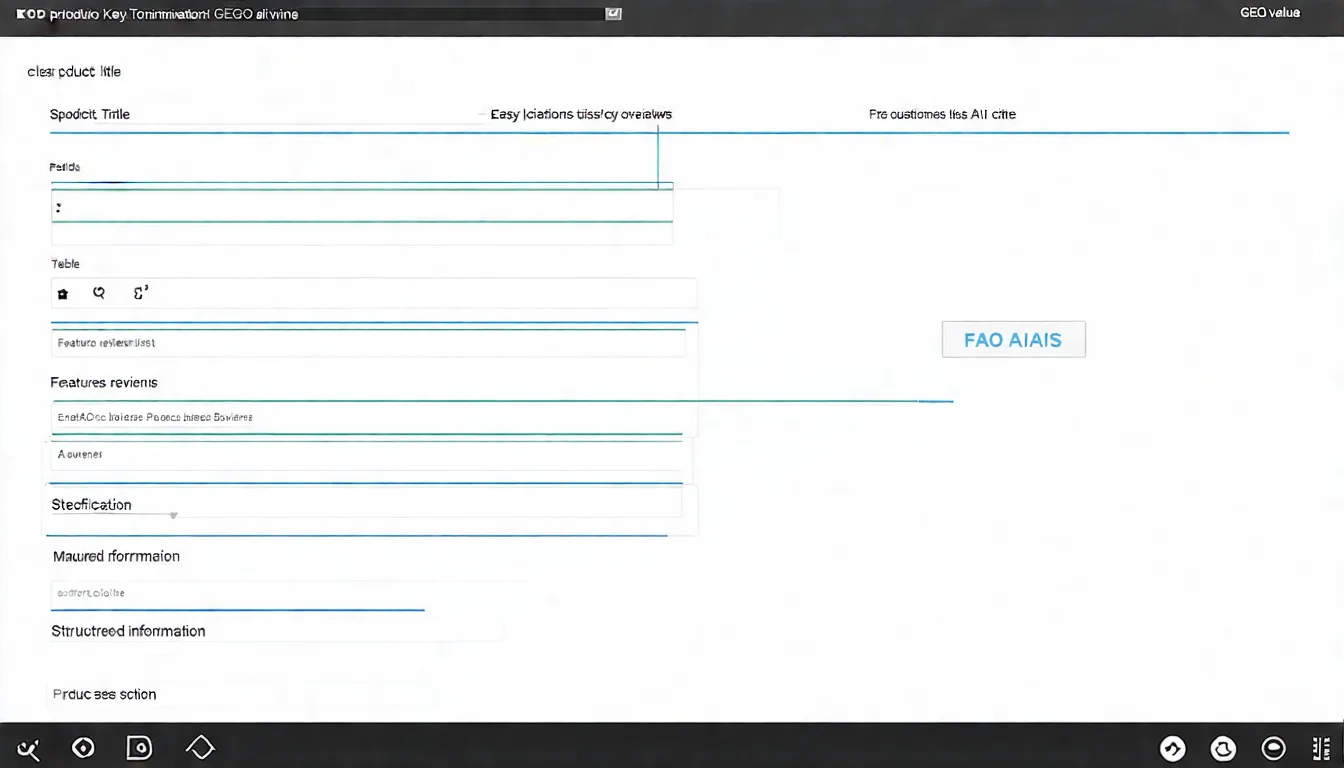
4 Key Areas of E-commerce GEO Optimization
Theory covered — let's look at practical implementation.
Area 1: Structured Product Descriptions
This is the foundation of e-commerce GEO.
Principle: Organize product information into formats AI can easily understand.
Specific approaches:
- Use clear heading hierarchy
## Product Features {#product-features}

### Lightweight Design {#lightweight-design}
Weighing only 1.2kg, 30% lighter than comparable products...

### Long Battery Life {#long-battery-life}
12-hour battery life meets all-day usage needs...
- Present features using lists
### Key Features {#key-features}

- **Lightweight design**: Only 1.2kg, easy to carry
- **Long battery life**: 12-hour battery
- **Fast charging**: 30 minutes to 50%
- **Eye protection display**: SGS low blue light certified
- Organize specs in tables
### Product Specifications {#product-specifications}

| Item | Spec |
|------|------|
| Dimensions | 32 x 22 x 1.5 cm |
| Weight | 1.2 kg |
| Display | 14-inch FHD IPS |
| Battery | 12-hour life |
| Processor | Intel Core i5 |
Important reminder: Avoid putting all information inside images. AI can now read text inside images, but official documentation warns it may misread non-Latin scripts such as Chinese and small text (OpenAI docs) — so ensure all key information has a text version.
Area 2: FAQ and Q&A Content
This is the format most easily cited by AI.
Why it works: Consumers use AI by "asking questions," and FAQ directly answers questions.
Recommended FAQ questions:
| Question Type | Example |
|---|---|
| Target audience | Who is this product best for? |
| Comparison | What advantages does it have over Brand X? |
| Practical | How long does it last? How durable is it? |
| Service | How long is the warranty? What about repairs? |
| Usage | Does it require special maintenance? |
Writing tips:
- Phrase questions the way consumers would search
- Answers should be direct and clear, with the first sentence answering the question
- Each FAQ should be suitable for AI chunking (150-300 words)
Example:
### Who is this robot vacuum best for? {#who-is-this-robot-vacuum-best-for}

This robot vacuum is especially well-suited for:

- **Small apartments (160-270 sq ft)**: Battery life and cleaning efficiency are ideal
- **Pet-owning households**: Excellent pet hair cleaning performance
- **Busy professionals**: App scheduling lets you come home to a clean floor

If your space exceeds 320 sq ft, consider our advanced model.
Area 3: Reviews and Social Proof
AI considers "what others think" when making recommendations.
Optimization focus:
| Element | Approach |
|---|---|
| Integrate customer reviews | Display genuine reviews on product pages |
| Show rating data | "4.8/5 stars based on 256 reviews" |
| Add structured data markup | Use Review Schema |
| Quote specific testimonials | "After 3 months, my pet hair problem is solved" |
Schema markup example:
{
  "@type": "Product",
  "name": "Smart Robot Vacuum X1",
  "aggregateRating": {
    "@type": "AggregateRating",
    "ratingValue": "4.8",
    "reviewCount": "256"
  }
}
Area 4: Technical Markup (Schema)
Schema markup makes it easier for AI to understand your product information.
Essential e-commerce Schema types:
| Schema Type | Purpose |
|---|---|
| Product Schema | Basic product info (name, description, price) |
| Review Schema | Review information (ratings, review count) |
| Offer Schema | Price and availability information |
FAQ Schema is now optional: Google stopped showing FAQ rich results on May 7, 2026, so FAQ markup no longer has a visible effect in Google Search.
For the detailed structured data implementation, see the Complete Schema Structured Data Guide. As for llms.txt, it is a lower-priority optional extra — see the llms.txt Setup Guide.
AI Visibility Optimization for B2B Websites
B2B e-commerce differs from B2C in some important ways.
GEO Differences Between B2B and B2C
| Aspect | B2C E-commerce | B2B E-commerce |
|---|---|---|
| Decision cycle | Short (impulse purchases common) | Long (requires evaluation) |
| Information needs | Concise, attractive | Detailed, professional, comprehensive |
| Question types | "Is this any good?" | "Do the specs meet our requirements?" |
| Trust building | Reviews, brand | Case studies, certifications, technical docs |
B2B Website GEO Optimization Focus
-
Detailed technical specifications
- Not just "high quality" — provide specific data
- Spec sheets should be complete and consistently formatted
-
Industry application case studies
- Explain how your product is used in different scenarios
- Describe specific customer types and problems solved
-
Technical white papers and knowledge articles
- Demonstrate expertise
- Help AI recognize your professional domain
-
B2B-specific FAQ
### What is the minimum order quantity? {#what-is-the-minimum-order-quantity}

The minimum order quantity for standard items is 100 units. For special
requirements, please contact our sales team. Volume purchases qualify
for tiered discounts.

### Do you offer customization services? {#do-you-offer-customization-services}

Yes. We offer the following customization options:
- Size customization (500+ units)
- Color customization (1,000+ units)
- Packaging customization (300+ units)

Custom orders require 4-6 weeks lead time.

### What is the typical lead time? {#what-is-the-typical-lead-time}

- Standard items: 7-14 business days
- Custom items: 4-6 weeks
- Rush orders available upon request (surcharge applies)

### Do you provide technical support? {#do-you-provide-technical-support}

Yes. We provide:
- Online technical consultation (weekdays 9:00-18:00)
- On-site technical service (by appointment)
- Complete technical documentation and installation guides
For more on enterprise GEO strategies, see Enterprise GEO Strategy.
E-commerce content optimization too time-consuming?
Too many products to optimize one by one? Let AI help you produce content that ranks.
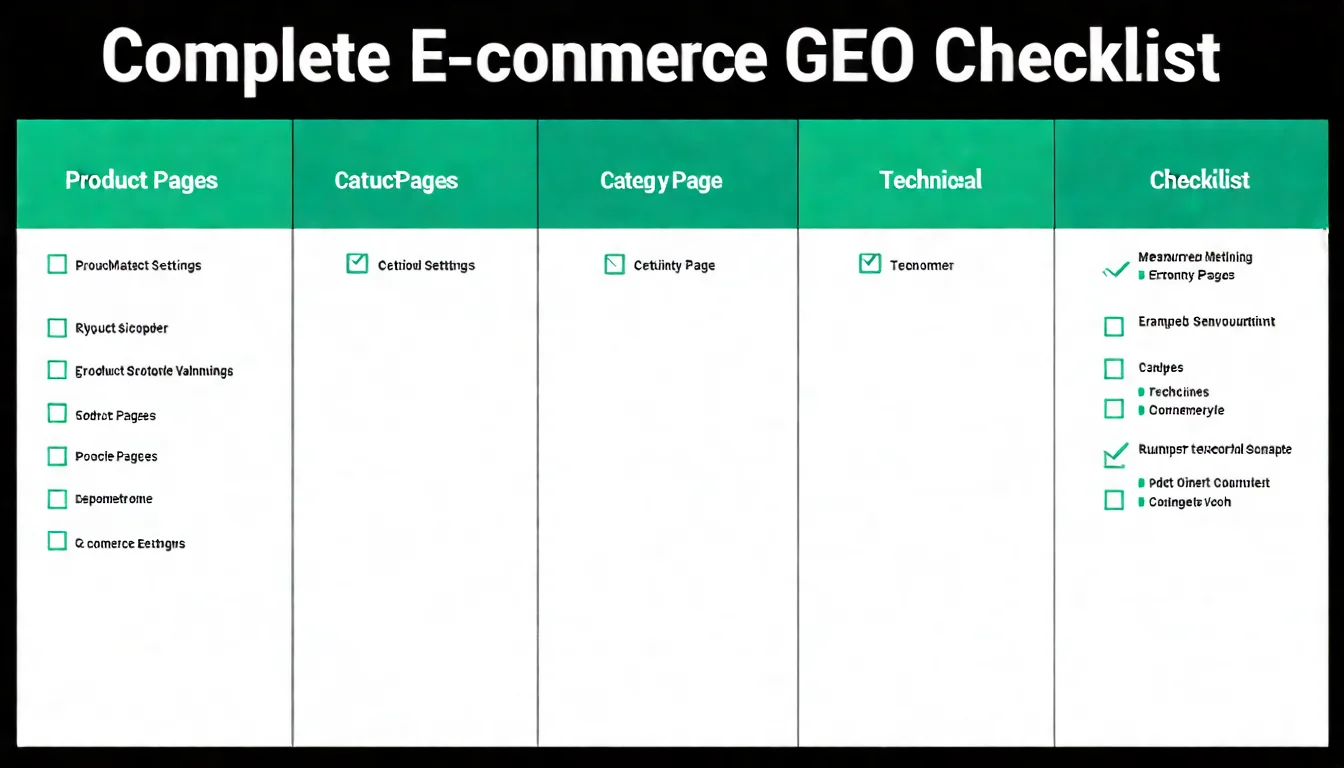
E-commerce GEO Checklist
Here's a practical checklist to ensure your e-commerce site is ready for the AI era.
Product Page Checklist
- Product title includes primary keywords (brand name, model number)
- Product description uses H2/H3 structured organization
- Spec information presented in table format
- Includes FAQ section (at least 3-5 Q&As)
- Has customer review section
- All images have alt text descriptions
- Key information has text versions (not only in images)
Category Page Checklist
- Category pages have descriptive text (not just product listings)
- Provides product comparison information for that category
- Includes buying guides or selection recommendations
- Contains FAQ section
Technical Configuration Checklist
- robots.txt allows AI crawler access
- Product Schema added to product pages
- Review Schema added (if review functionality exists)
- (Optional) FAQ Schema — Google no longer shows FAQ rich results, so it has no visible effect in Google Search
- Offer Schema added (price, inventory information)
- (Optional) llms.txt is set up and accessible — most major AI providers don't currently parse this file, and Google has said Search doesn't need it, so treat it as lower priority than the items above
Detailed technical tutorials:
FAQ
Q1: How does e-commerce GEO differ from general GEO?
E-commerce GEO places greater emphasis on structured product information.
Key differences:
| Aspect | General GEO | E-commerce GEO |
|---|---|---|
| Content type | Knowledge articles | Product info + buying guides |
| Schema markup | Article Schema | Product, Review, Offer Schema |
| User intent | Learn, understand | Compare, purchase |
| Conversion goal | Consultation, subscription | Add to cart, checkout |
Q2: With many products, do I need to optimize all of them?
No — start with key products.
Optimization priority recommendations:
- Top 20% revenue products: These are your top performers
- Highest margin products: Optimization yields the greatest return
- Competitively strong products: Most likely to be recommended
Strategy:
- Optimize key products first
- Build optimization templates
- Gradually expand to other products
- Optimize new products upon launch
Q3: How do I track e-commerce GEO results?
Use a multi-pronged monitoring approach:
| Method | Approach |
|---|---|
| AI search testing | Regularly ask AI product-related questions and check for recommendations |
| Traffic analysis | Monitor traffic from AI referrals |
| Brand monitoring | Ask AI "What do you think about [brand name]?" |
| Competitor comparison | Check if competitors are being recommended |
We recommend weekly testing with trend tracking.
Q4: Do I need to write FAQ for every product?
Not necessarily, but it's recommended for key products.
Consider:
- Best sellers: Complete FAQ
- Standard products: Generic FAQ (category level)
- New products: Include FAQ at launch
You can also start with the most frequently asked customer service questions and convert them into FAQ content.
Q5: Can small e-commerce businesses do GEO?
Absolutely — and they may even have an advantage.
Small e-commerce GEO advantages:
- Can quickly adjust and test
- Focused on specific categories, easier to build expertise
- Content can be more personalized and in-depth
Large e-commerce sites have more products, but the cost of optimizing each one is also high. Small e-commerce businesses that precisely optimize key products may achieve even better results.
How to Get Started with E-commerce GEO: Key Optimization Points
Congratulations on completing this e-commerce GEO guide! Let's do a quick review:
| Key Point | Description |
|---|---|
| Why it matters | AI shopping assistants are changing consumer decision-making |
| 4 optimization areas | Structured descriptions, FAQ Q&A, review integration, Schema markup |
| B2B considerations | More detailed specs, case studies, technical documentation |
| Execution strategy | Start with core products, build templates, expand gradually |
| Performance tracking | AI search testing + traffic analysis |
The AI shopping assistant era has arrived. When consumers ask "what product do you recommend?", will your product be on the recommendation list?
Start optimizing now, and you can still seize the first-mover advantage.
From Product Descriptions to Full-Site Optimization: One-Stop E-commerce GEO Service
Get your products recommended by AI and seize the AI shopping era advantage.
Not sure where to start? Let experts help you evaluate and plan:
Free consultation via LINE | View service plans
References
- GEO: Complete Guide to Generative Engine Optimization
- llms.txt Complete Setup Guide
- AI Crawler Configuration Guide
- Content Chunking for AI
- Enterprise GEO Strategy
- Schema.org Product Markup Documentation