![Ahrefs Decoded AI Search Across Three Major Studies: 10 Insights and Your Action Plan [2026]](/_next/image?url=%2Fblog%2Fimages%2Fgeo%2Fahrefs-ai-search-insights-01.webp&w=3840&q=75)
Half of what you believe about AI search optimization may be pointed in the wrong direction.
In the first half of 2026, Ahrefs released three major studies: a visibility-correlation analysis across 75,000 brands, a schema experiment on 1,885 pages, and a tracking study of 4 million AI Overviews citation URLs. The headlines wrote themselves — "old SEO tricks are dead." Sensational, but the data is real: YouTube mentions predict AI visibility better than backlinks, adding schema barely moves AI citations, and ranking #1 no longer guarantees being cited.
This article unpacks all three studies: what the data actually says, which interpretations went too far, and the five things small businesses should do now.

💡 Want to know how your site measures up in AI search? Free consultation
Key takeaway: Across 75,000 brands, YouTube mentions correlate with AI visibility at 0.737 — the strongest of all factors (Ahrefs, 2026); schema markup showed no significant citation lift; and only 37.9% of AI Overviews citations now come from top-10 pages.
What Did the Three Ahrefs Studies Actually Say?
Lay all three on the table first, because secondhand coverage tends to blend them into one.
| Study | Sample | Core finding |
|---|---|---|
| Brand visibility correlations | 75,000 brands | YouTube mentions are the strongest AI-visibility correlate (0.737) (Ahrefs, 2026) |
| Schema experiment | 1,885 test + 4,000 control pages | Adding JSON-LD produced no significant AI-citation lift (Ahrefs, 2026) |
| Citation source tracking | 863K keyword SERPs, 4M cited URLs | Top-10 share of AIO citations fell from 76% to 37.9% (Ahrefs, 2026) |
All three point the same way: the logic AI search uses to pick content is decoupling from classic Google ranking logic. Ranking signals and technical markup are losing weight; brand signals and cross-platform presence are gaining it.
But decoupling is not death. How to read each dataset, one by one.
Why Are YouTube Mentions the Strongest Signal?
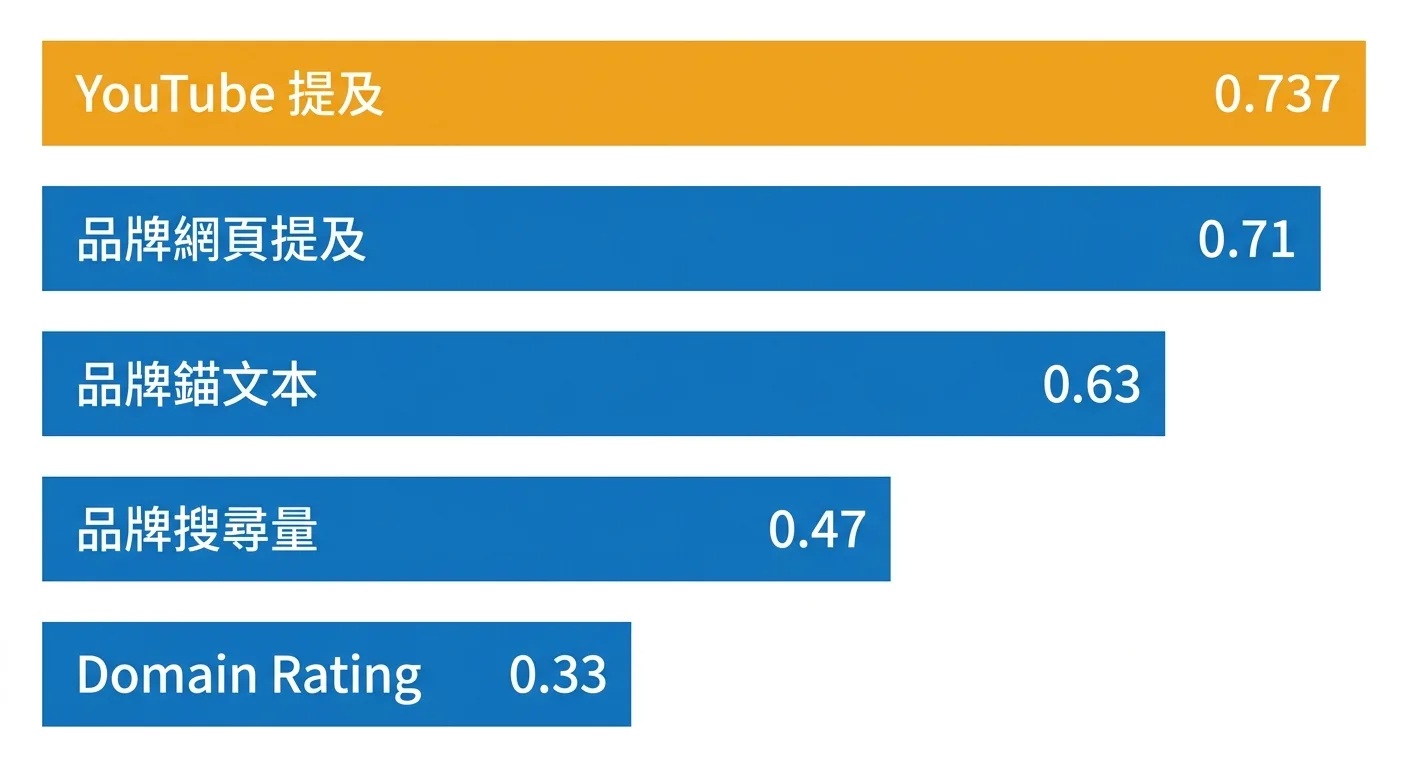
Straight to the numbers. Ahrefs analyzed 75,000 brands (DR>40, keywords with 800+ monthly volume) using Spearman correlations (Ahrefs, 2026):
| Factor | Correlation |
|---|---|
| YouTube mentions | 0.737 |
| YouTube mention impressions | 0.717 |
| Brand web mentions | 0.66–0.71 |
| Branded anchors | 0.511–0.628 |
| Branded search volume | 0.352–0.466 |
| Domain Rating | 0.266–0.326 |
| Page count | ~0.194 |
See how brutal the ordering is? Domain Rating — the metric SEOs know best — sits around 0.3, while YouTube mentions (your brand appearing in video titles, transcripts, descriptions) lead at 0.737.
Why YouTube? Two plausible layers: AI training and retrieval consume vast amounts of YouTube's public text, and YouTube buzz is itself a proxy for "real people actually talk about you" — much harder to fake than link building.
Platform preferences differ too: AI Mode responds most to branded anchors (0.628), AI Overviews still respects Domain Rating (0.326), and ChatGPT is the least moved by traditional authority signals (Ahrefs, 2026). Betting everything on one signal wins on no platform — which is why the action list later deliberately picks moves that work on all three.
One statistical reminder: correlation is not causation. The data says brands with high AI visibility also have high YouTube presence — not that opening a channel triggers citations. Our read: YouTube presence is a measurable cross-section of overall brand strength. Worth investing in; not a magic switch.
Is Schema Dead? Look at What the Experiment Tested First
The most sensational headline: "schema markup is useless." The data exists, but the conclusion got stretched.
The design: track 1,885 pages that added JSON-LD between August 2025 and March 2026, against 4,000 control pages, measuring citation changes on three platforms. Results — AI Overviews −4.6% (small but statistically notable decline), AI Mode +2.4%, ChatGPT +2.2% (the latter two statistically indistinguishable from zero). Ahrefs' own conclusion: adding schema "produced no major uplift in citations on any platform" (Ahrefs, 2026).
Three caveats, without which you misread it:
- The sample covered only pages already heavily cited by AI (100+ prior citations). For sites AI hasn't discovered at all, this experiment says nothing (Ahrefs, 2026)
- It measured one metric — AI citations — not SEO overall. Rich results, Knowledge Panels, and entity understanding still consume schema
- Confounding: sites with schema tend to be better maintained with stronger content — how much of schema's past "effect" came from those companions was always hard to separate
So our position matches our structured data guide, with one updated sentence: schema is infrastructure for search engines, not a bonus point for AI citations. Our own site generates BlogPosting and FAQPage schema automatically at the page layer — zero-maintenance infrastructure — and spends the human effort where this research actually points: content structure and brand signals.
Ranking #1 No Longer Guarantees Citations: What 76% → 38% Means
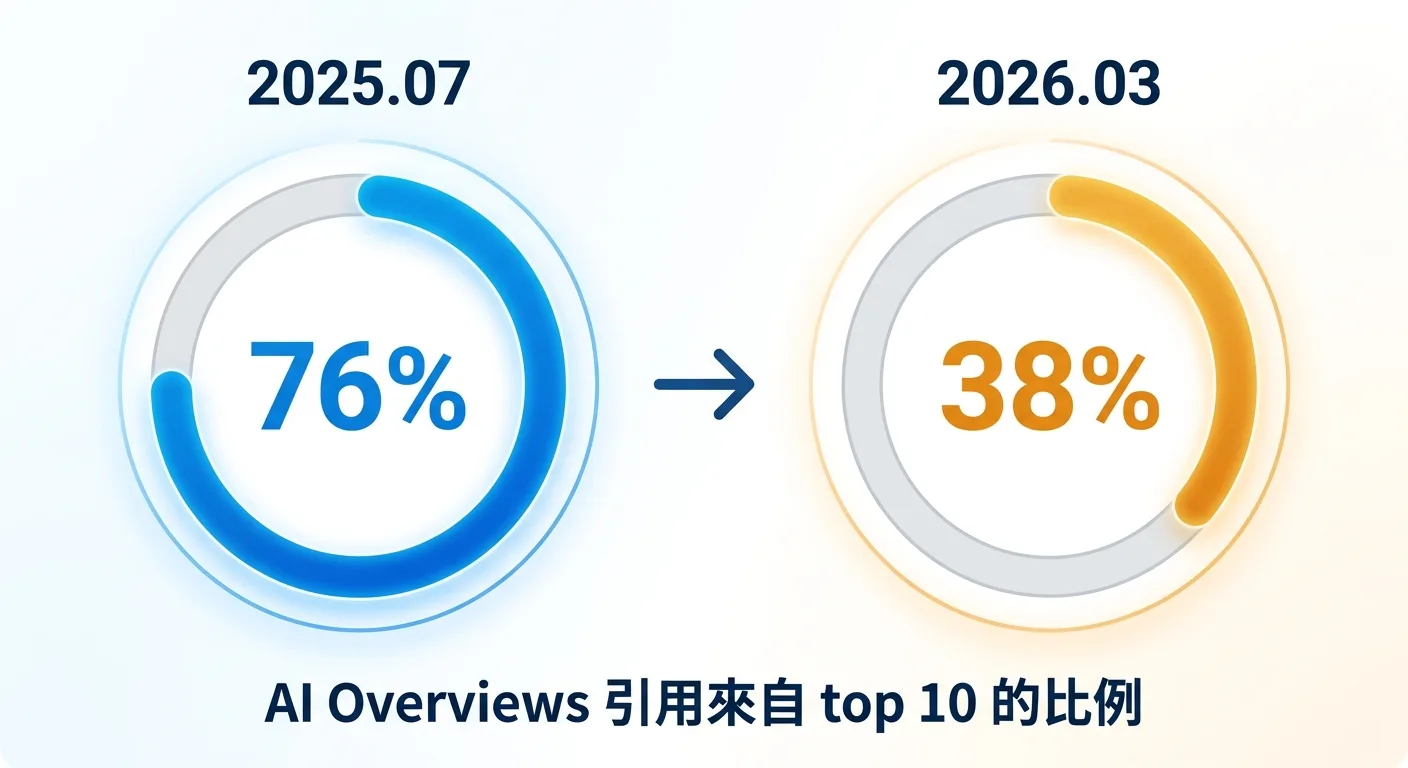
The third study has the most dramatic shift. In July 2025, about 76% of AI Overviews citations came from that query's top-10 results; by March 2026, just 37.9% (sample: 863K keyword SERPs, 4M cited URLs) (Ahrefs, 2026).
Plainly: eight months ago, a top-10 spot was practically a citation ticket; now over 60% of citations come from outside the top 10.
Why? Ahrefs points to query fan-out — Google expanding one query into multiple sub-queries, retrieving separately, then composing the answer. Your page might rank #30 for the main query yet be the best answer for one sub-query, and get cited anyway. Conversely, a #1 page with shallow generalities loses its citations.
One number echoing the YouTube study: 18.2% of unranked AI Overviews citations come from YouTube (Ahrefs, 2026).
The operational meaning: long-tail sub-topic coverage now beats single-keyword position. That's exactly the topic-cluster logic — write each sub-intent of a topic thoroughly so every piece can win some fan-out sub-query.
Three Pre-Publish Questions for the Fan-Out Era
- Which specific sub-question does this piece answer? Fan-out retrieves sub-queries, not big topics. One piece per sub-intent, answered fully, wins more often than a kitchen-sink mega-page
- Does each paragraph stand alone? Sub-queries hit at paragraph level. Lead each H2 with the answer and concrete numbers so AI has a quotable block
- Are sibling sub-topics covered on your own site? Your own cluster should catch the other sub-queries — otherwise fan-out's net catches your competitors
In our client planning, these three questions have replaced "what's the target keyword ranking" as the first-order check. Position is still watched — but demoted from goal to byproduct.
Read the Data, Unsure Where to Start?
Every site starts from a different place. AI SEO Hacker turns these research findings into concrete operations for your website.
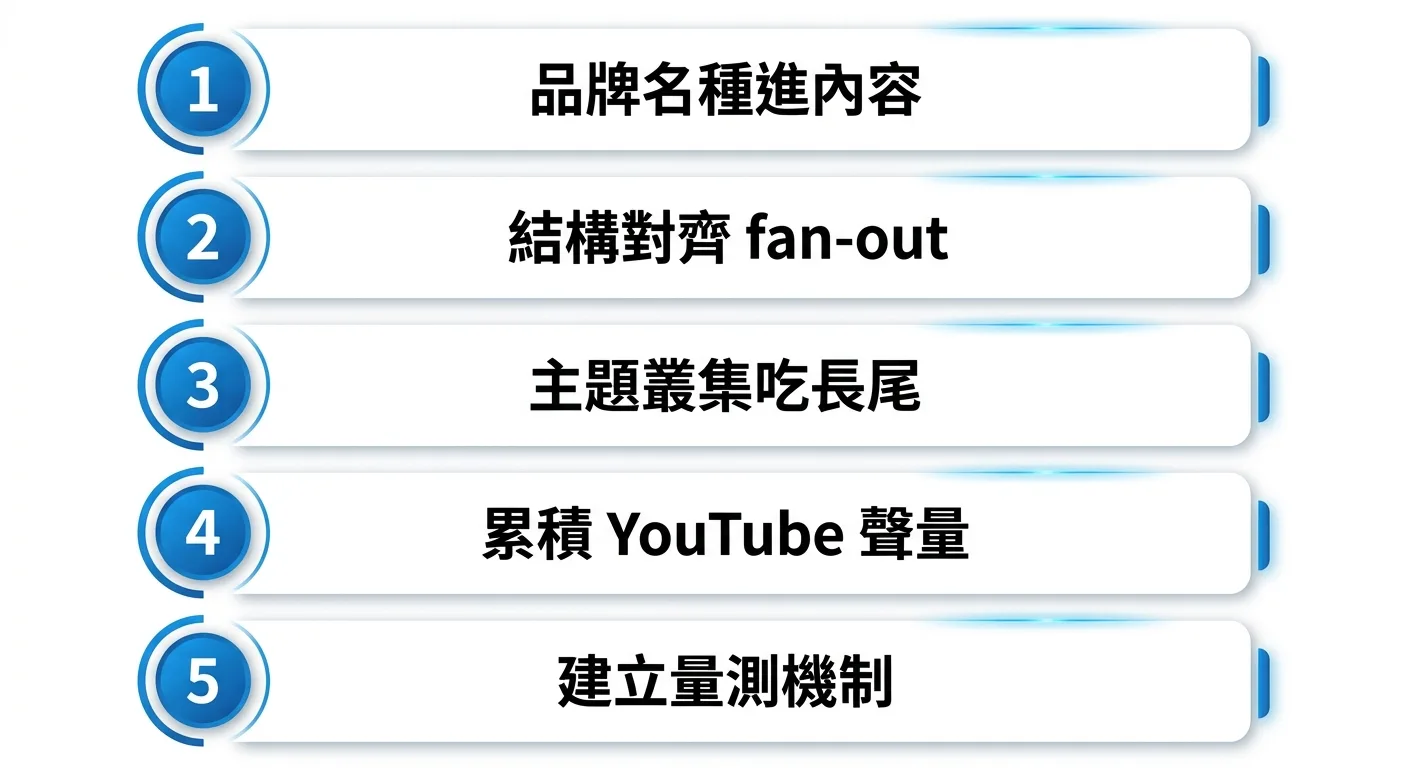
Five Actions for Small Businesses
The studies are large-sample US-market data; here is how a smaller market player plugs in — five actions ordered by investment.
Action 1: Plant Your Brand Name in Content (Free)
Brand web mentions correlate at 0.66–0.71, second only to YouTube. Use your full brand name naturally in articles (not just "we"), earn mentions in industry articles and partner content, and include the brand name in FAQ answers. Same entity-consistency principle as our GEO complete guide.
Action 2: Align Content Structure With Fan-Out Logic (Free)
Each H2 answers one sub-question directly, paragraphs stand alone, concrete numbers lead. AI grabs paragraphs, not articles — techniques in content chunking for AI.
Action 3: Cover Long-Tail Sub-Topics With Clusters (Content Investment)
In the 76%→38% world, one-article-rules-all is over. Split core topics into sub-intents, write each, interlink — layout method in our topic cluster strategy guide.
Action 4: Start Building YouTube Presence (Mid-Term Investment)
No need to become a YouTuber. The low bar: turn existing articles into 5-minute explainers, put brand name and topic keywords in titles and descriptions, enable subtitles (the text layers are what AI reads). Four text layers to check: video title (brand + topic coexisting), description (first two lines state what question the video answers), subtitles (proofread your brand name — speech-to-text errors hand entity-confusion material straight to AI), pinned comment (summary + site link).
Action 5: Build AI Visibility Measurement (Verification)
After the four actions, measure. Google side via the Search Console AI performance report; cross-platform citations via fixed-question manual testing — full framework in how to measure GEO performance. The studies are market averages; your industry's signal mix may differ — only your own monthly data tells you whether the market rules hold for you.
What to Update, What Not to Panic About
A sober reconciliation. The research does not ask you to torch your SEO.
Update: the instinct that "good rankings = AI citations" (false in the 38% era); the hope that "adding schema boosts AI citations" (experimentally unsupported); the website-only content mindset (YouTube and off-site mentions now have data behind them).
Don't panic about: classic rankings still matter — 37.9% of citations still come from the top 10, and traditional search still dwarfs AI referrals in click volume; schema still serves rich results and entity understanding; and no number in any of the three studies dethrones content quality as the root variable.
One sentence: AI search doesn't overturn SEO — it opens a parallel track with different judges. Run both; redistribute the pace. Background trends in how AI affects SEO.
A reconciliation table for the secondhand takes you'll keep seeing:
| What you'll hear | What the research said | The gap |
|---|---|---|
| "Old SEO is dead" | Ranking signals weakened; top 10 still takes 37.9% of citations | Weakened ≠ zero |
| "Remove your schema" | No significant lift for AI citations; sample limited to already-cited pages | Still serves rich results and entities |
| "Make YouTube videos, get cited" | YouTube mentions correlate at 0.737 | Correlation, not causation |
| "Rankings don't matter" | Top-10 share fell from 76% to 38% | Still the largest single source |
FAQ
The study says schema is useless — should I remove my structured data?
No. The finding is "no significant lift in AI citations" (1,885 pages; AIO −4.6%, AI Mode and ChatGPT statistically zero (Ahrefs, 2026)) — but schema still powers rich results and entity understanding. The right posture: automate schema, redirect human effort to content structure and brand signals.
What does the 0.737 YouTube correlation mean? Will a channel get me cited?
It's a Spearman coefficient showing YouTube presence and AI visibility move together across 75,000 brands (Ahrefs, 2026) — correlation, not causation. AI systems consume YouTube's text layers heavily, so being mentioned there genuinely helps; but presence comes from real discussion, not from uploading three videos.
Do top-10 rankings still matter?
Yes — just no longer as a citation guarantee. March 2026 data shows 37.9% of AI Overviews citations from the top 10, down from 76% in July 2025 (Ahrefs, 2026). The top 10 still takes the largest share and nearly all traditional clicks; the other 60% of citation opportunities went to quality long-tail content. Cover both.
With limited resources, which action first?
The two free ones: plant the brand name in content (mentions correlate 0.66–0.71) and align paragraph structure with AI retrieval. Third, build measurement (GSC AI report + manual tests, both free); then decide YouTube and cluster investment from your own data. Principle: make AI read you right and recognize you first, then amplify.
How fast does this research go stale? Should I keep tracking it?
Fast. Ahrefs' own data shows the top-10 citation share dropping from 76% to 37.9% within eight months (Ahrefs, 2026) — AI search rules iterate monthly. Don't chase studies; build your own monthly measurement (GSC AI report + fixed-question tests). Studies give direction; your data gives current position. Both deserve monthly refresh.
Turning Research Into Advantage: Execution Is the Gap
Three studies, spanning 75,000 brands to 4 million cited URLs, and the conclusion is plain: AI search rewards brands with real-world presence, machine-readable structure, and complete sub-topic coverage. No dark magic — all fundamentals. Just a different fundamentals list than five years ago.
Most site owners will scroll past the headline. A few will finish the five actions. The latest data point in these studies is March 2026, yet plenty of sites still operate on the old rules — and that execution gap is where the citation gap comes from — and it compounds: citations build mentions, mentions correlate with visibility, and the flywheel that starts first spins fastest.

🎯 Take Action
Research gives the map; execution reaches the destination. AI SEO Hacker delivers brand signals, content structure, and measurement in one AI-driven content system.
Free consultation | View service plans
Further Reading
- Search Console AI Performance Report: The Complete Guide
- How to Measure GEO Performance: AI Search Visibility Metrics
- What Is Structured Data? The Schema SEO Guide
- Topic Cluster Strategy: The Complete Guide
- YouTube SEO Tools We Recommend