![How to Measure GEO Performance: AI Search Visibility Metrics Explained [2026]](/_next/image?url=%2Fblog%2Fimages%2Fgeo%2Fgeo-performance-measurement-01.webp&w=3840&q=75)
"We've been doing GEO for three months. So… is it working?"
It's GEO's hardest and most common question. Why is it hard? Because AI search exposure happens inside the answer boxes of ChatGPT, Perplexity, and Google AI Mode — not on your website. In classic SEO you just check rankings; GEO doesn't even have a "ranking" to check.
But "hard to measure" is not "unmeasurable". This guide gives you a workable system: a four-tier metric framework, an official-report-plus-manual-testing combo, and the most important rule — stop measuring the new thing with the old ruler.
💡 Not sure how visible your site is in AI search? We'll check for you. Free consultation
Key takeaway: GEO performance splits into four measurable tiers — exposure, citation, mention, referral. Since June 2026, Google Search Console's generative AI report provides official exposure data (Google official, 2026); add manual testing and GA4 cross-checks for complete GEO measurement.
Why Is GEO Performance Hard to Measure?
One sentence: the value is created outside your measurement range.
Classic SEO has a clean causal chain: ranking rises → clicks arrive → GA4 sees them. GEO's chain is broken in the middle: AI reads your content → AI cites you in an answer → the user reads the answer and may never click through.
The data shows how severe the break is: per SparkToro and Similarweb's Jan–Apr 2026 US research, 68% of Google searches end with zero clicks, and only 232 of every 1,000 searches click out to sites beyond Google's ecosystem; AI Overviews appear on more than 20% of searches and cut overall CTR by nearly 60% when they do (Search Engine Journal, 2026). Even AI Mode, a brand-new interface, is more than doubling its query volume each quarter (Search Engine Journal, 2026).
Which means: your brand might get recommended a hundred times inside AI answers while GA4 records nothing. Without a measurement framework, those hundred exposures effectively don't exist — you'll wrongly conclude GEO "isn't working" and kill a strategy that is.
New to GEO? Start with What is GEO? The complete guide.
The Four-Tier GEO Measurement Framework
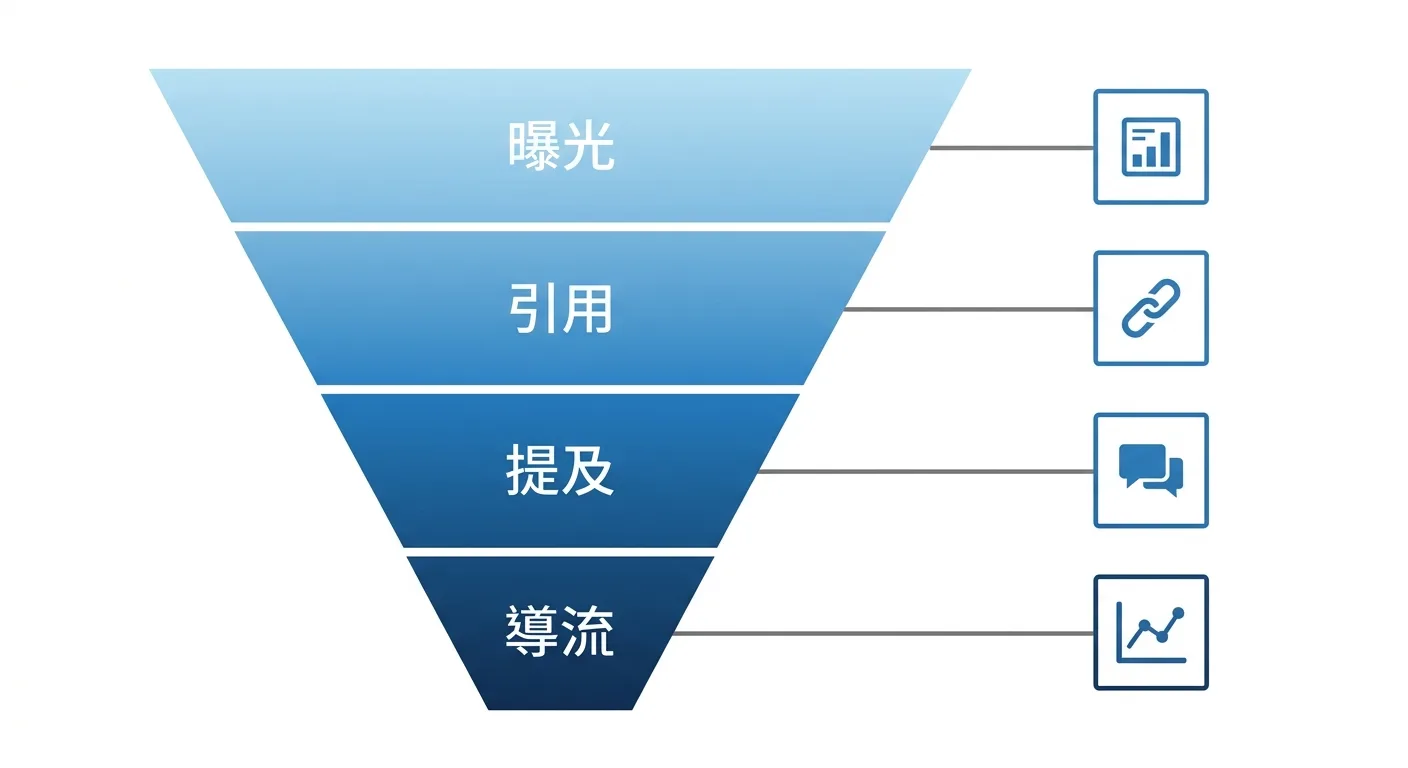
We split GEO performance into four tiers, upstream to downstream. The framework's benefit: every tier has a matching measurement tool, and it localizes where problems occur.
| Tier | Metric | The question | Measurement tool |
|---|---|---|---|
| Tier 1: Exposure | Impressions inside AI features | Is my content in the AI's field of view? | GSC generative AI report |
| Tier 2: Citation | Times listed as an answer source | Does the AI link to me? | Manual testing, third-party monitors |
| Tier 3: Mention | Brand named in answers | Am I on the AI's recommendation list? | Manual testing (brand questions) |
| Tier 4: Referral | AI platform referral visits | Do people click through? | GA4 |
The four tiers work like a funnel: exposure is the foundation, citations and mentions are brand assets, referral is the visible payoff.
One emphasis. Tier 4's absolute numbers are still small — SE Ranking's data shows AI platform referrals are dominated by ChatGPT (74.78% share in Jan–Apr 2026) and remain far smaller than traditional search overall, but the growth curve is steep: Claude referrals in Jan–Apr 2026 were up 320% on 2025 (SE Ranking, 2026). Using Tier 4 as your only KPI badly underestimates GEO — which is exactly why we measure in four tiers.
How to Check AI Search Visibility: Three Methods
Method 1: The GSC Generative AI Report (Official Data, Tier 1)
Since June 2026, Search Console's Search and Discover reports include a "Generative AI" category with five dimensions: impressions, pages, countries, devices, dates (awoo, 2026). It is GEO's first official report — full walkthrough in the Search Console AI performance report guide.
Two caveats: it started with a subset of websites (first seen in the UK, then users in India, the US, Switzerland and other regions reported seeing it — Search Engine Roundtable, 2026), and as of August 31, 2026 is available to all websites worldwide (Google official, 2026); and it covers only Google's own AI features — ChatGPT's and Perplexity's worlds are invisible to it. Hence Method 2.
Method 2: Fixed-Question Manual Testing (Tiers 2 and 3)
This is our standard monthly AI citation test for clients — fully free to run yourself:
- Build a question list: pick 10–20 questions your customers would ask (brand and non-brand, e.g., "best SEO agency in Taiwan", "how to choose a GEO service")
- Fix platforms and cadence: same week each month, one round each on ChatGPT, Perplexity, Google AI Mode
- Log three fields: cited (link shown)? mentioned (brand named)? described accurately?
- Read trends, not points: AI answers are stochastic — one uncited month means little; three consecutive zero months is a signal
The third field gets overlooked but matters: an AI describing your brand wrongly hurts more than not mentioning you. That's a topic of its own; for now, remember to check.
Method 3: GA4 AI Platform Referral Filtering (Tier 4)
Filter referral sources like chatgpt.com and perplexity.ai in GA4, then cross-check against GSC data to answer "exposure without referral" versus "no exposure at all". Full steps and attribution pitfalls in AI search traffic analysis.

Why Two Tools Score the Same Brand Differently
If you have ever run two AI visibility tools at once, you have probably hit this: same brand, same period, two scores that do not match.
Neither is wrong. They are measuring different things.
"AI visibility" has no agreed industry definition, and tools differ on at least four dimensions:
| Difference | Why it moves the score |
|---|---|
| Who chose the query set | Most tools use their own hypothetical queries, not your real user data. Change the set, change the score |
| Which engines are covered | Testing only ChatGPT gives a very different picture from testing ChatGPT, Perplexity and Google AI Mode together |
| Whether mention and citation are one metric | Some tools merge "your brand was named" with "your link was included"; others separate them |
| How it is scored | Frequency, position, whether you were the first recommendation — weightings differ by vendor |
So scores are not comparable across tools. For the same reason you would not subtract readings from two different brands of bathroom scale.
How should you use them, then?
Three rules:
- Pick one and watch only its trend. The absolute value means little; the movement means something. Switching tools mid-stream resets your baseline.
- Put the definition in the contract. If this is outsourced, require the query set, engine coverage and scoring method in writing. A score without a stated definition cannot be an acceptance criterion.
- Keep your own record too. Ten to fifteen fixed questions, fixed engines, fixed cadence, manually recording whether you were mentioned and whether you were cited. That hand-kept record is usually more trustworthy than a score whose computation you cannot inspect.
For how far "mentioned" and "cited" diverge in practice, see AI Recommends Your Brand, Then Cites Someone Else — a study of purchase-decision queries found only 2.8% of cited sources were brand-owned pages.
Tracking AI Citations: Tools and Methods
Tier 2 — citations — deserves its own section, because it's GEO's closest analogue to "rankings".
First, two terms. Citation: the AI answer includes your link, clickable. Mention: the AI names your brand without a link. Citations carry traffic potential; mentions build brand mindshare — track both, log them separately.
Three tracking options, by budget:
- Free: manual testing (the workflow above) — monthly, under 20 questions, half a day for one person
- Semi-automated: a spreadsheet template with question, platform, and result columns, filled monthly into a running trend — our own monthly reports run at this level, and it's enough
- Paid: third-party AI visibility monitors — tools like Otterly or Profound run question sets automatically; suited to teams tracking large question volumes or multiple brands
The tool isn't the point. Fixed cadence building a trend is. Three months of manual data beats any one-off tool report.
To make AI more willing to cite you, two content fundamentals: paragraphs that stand alone (see content chunking for AI) and crawlers that can get in (see the AI crawler setup guide).
How to Increase AI Search Exposure: From Measurement Back to Action
Measurement exists to direct the next move. Three common data scenarios, three action sets:
Scenario 1: Tier 1 exposure at or near zero → audit infrastructure. Is robots.txt blocking AI crawlers, is content indexed, is the structure AI-friendly? AI crawler activity has risen markedly in recent years — the crawlers will come; the question is whether you let them in.
Scenario 2: Exposure but no citations → content structure problem. The AI sees you but finds you "hard to quote". Strengthen key-takeaway blocks, give paragraphs concrete numbers, make each H2 answer one question directly.
Scenario 3: Citations but no business impact → topic alignment problem. The cited content isn't related to your revenue services. Pull the cited-topic list, map it against your service pages — the gap is your next content batch. For overall positioning, see GEO strategy for Taiwanese businesses.
Four Tiers Too Much to Track Yourself?
AI SEO Hacker's GEO service includes a monthly AI citation test report — question design, cross-platform testing, trend tracking, done for you.
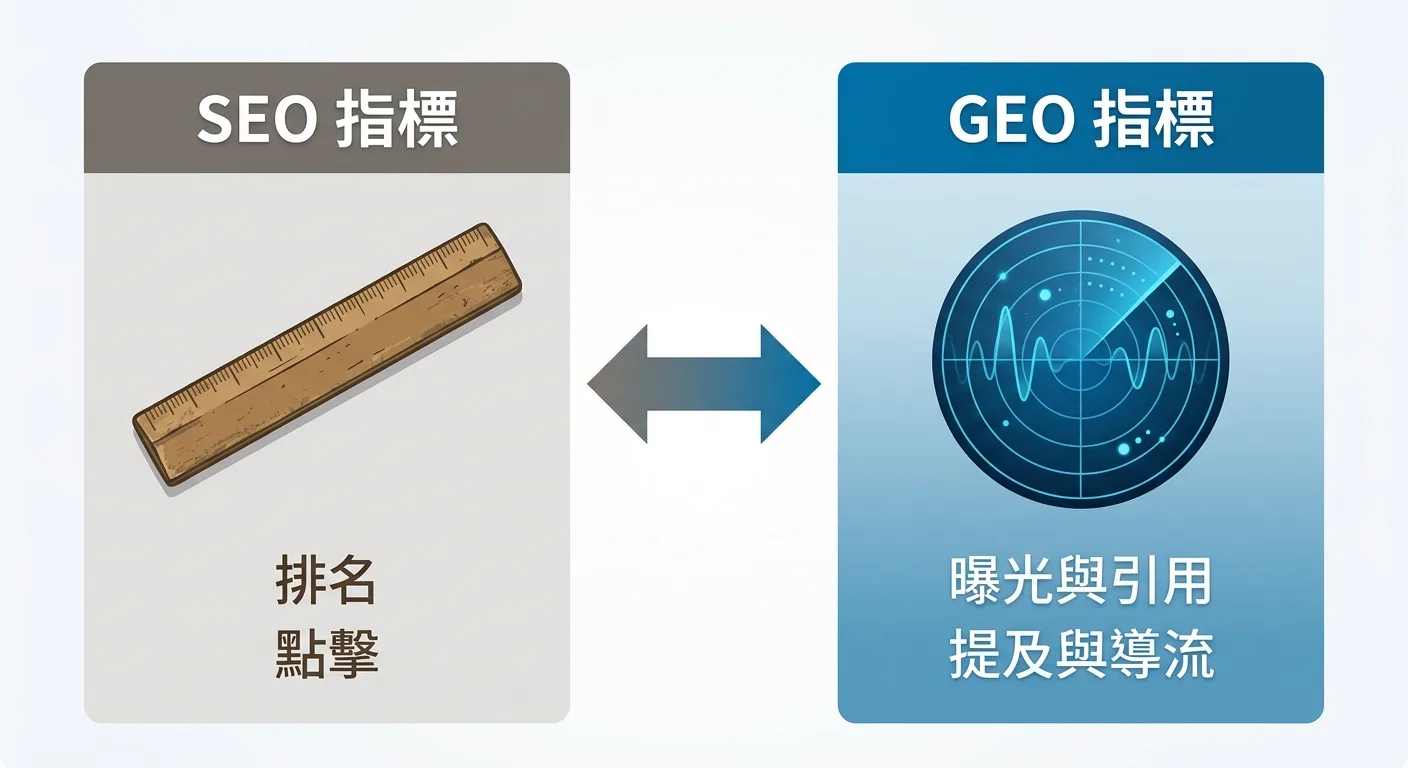
GEO Metrics vs SEO Metrics: Don't Measure the New with the Old Ruler
Finally, a common trap: applying SEO KPIs directly to GEO.
| Item | SEO metrics | GEO metrics |
|---|---|---|
| Core metrics | Keyword rankings, organic clicks | AI exposure, citations, mentions |
| Data source | GSC performance report, rank trackers | GSC generative AI report, manual testing |
| Feedback speed | Rankings trackable weekly | Trends need monthly views; single points are noisy |
| Traffic attribution | Clicks directly measurable | Much value sits in zero-click exposure |
| Tooling maturity | Mature stack | Official tooling only started in 2026 |
The two sets complement, not replace, each other. SEO metric setups are covered in the SEO data analysis guide and the marketing KPI guide.
Practical advice: in year one, set GEO KPIs on Tier 1–3 trends (exposure growth, citation hit rate) — not Tier 4 referral absolutes. Otherwise a working strategy will look like a failing one.
Moz Says the Same Thing: Track These Five Signals
A useful outside confirmation here. In June 2026, Moz published a run of posts arguing you should stop measuring AI search with old SEO metrics and track five signals instead: visibility, being recommended, bot accessibility, citations, and off-site signals (Moz, 2026). That's Moz's view, not an industry standard — but it maps neatly onto our four-tier framework. Visibility, citation, recommendation are our exposure, citation, mention.
The two extras are worth noting. One is bot accessibility — the crawler-clearance point from Scenario 1. The other is off-site signals: how people talk about you on Reddit, forums, and in the press. The four tiers don't list that separately, yet it often decides whether an AI is willing to cite you.
So how does content keep up? Moz also offers a memorable paragraph structure called PEE — Point, Evidence, Explain (state the claim, back it with evidence, then explain it). Write in that order each time you update, and AI finds you easier to quote. Remember one line: what you measure changed, so how you write has to change too.
FAQ
How long until GEO shows results?
Budget more patience than SEO — evaluate by quarter. AI answers are stochastic and monthly data is noisy; our practice is fixed monthly question tests read as three-month trends. The exposure tier (GSC AI report) usually reacts first; referral reacts last — SE Ranking's data shows AI platform referrals are small but fast-growing (SE Ranking, 2026) — treat it as a lagging indicator.
Can free tools measure GEO performance?
Yes — and start with the free stack: the GSC generative AI report (official exposure data) + fixed-question manual testing (citations and mentions) + GA4 referral filtering (referrals). All three cost nothing and are enough to build monthly trends. Paid monitors suit high question volumes or multi-brand teams — not a beginner requirement.
I got cited by AI but received no traffic — does that count as success?
It counts as tier-level success. Jan–Apr 2026 US data shows 68% of searches end with zero clicks (Search Engine Journal, 2026) — AI-era exposure largely happens in no-click contexts. A citation means the AI trusts your content; that trust compounds into brand mentions and, later, branded searches. In the four-tier framework, that's Tier 2 achieved — not failure.
Which AI platforms should I track for GEO?
Three first: Google (AI Overviews + AI Mode, via the official GSC report), ChatGPT (the largest referral source — 74.78% of AI platform referrals in Jan–Apr 2026 per SE Ranking), and Perplexity (the clearest citation links). Add Claude and Copilot when you have spare capacity. For the Taiwan market, those three give representative coverage.
Measurement Is Where GEO Starts, Not Where It Ends
Back to the opening question: "Three months of GEO — is it working?"
You now have a standard way to answer: open the GSC generative AI report for exposure, run fixed-question tests for citations and mentions, check GA4 for referrals — four tiers, logged separately, trended monthly. Working or not, the data speaks.
Next step? If the numbers disappoint, start with the monthly iteration loop in the Search Console AI report guide. If you haven't started measuring at all — build your question list today.

🎯 Take Action
GEO shouldn't be mysticism. AI SEO Hacker's GEO service includes monthly AI citation test reports — data your boss and your clients can both see.
Free consultation | View service plans
Further Reading
- Search Console AI Performance Report: The Complete Guide
- AI Search Traffic Analysis: Tracking ChatGPT and AI Referrals
- Google Search Console Tutorial: From Setup to Reading Reports
- What Is GEO? The Complete Guide to Generative Engine Optimization
- GEO Strategy for Taiwanese Businesses
References
- Introducing Search Generative AI performance reports - Google Search Central Blog
- Search Console Generative AI report - awoo
- Google Search Traffic To Open Web Drops To 23% - Search Engine Journal
- Analysis of Top AI Search Engines: Who Is Catching Up to ChatGPT? - SE Ranking
- Google Search Console Generative AI Performance Report Rolling Out To More - Search Engine Roundtable
![Search Console AI Performance Report: The Complete Guide — GEO Is Finally Measurable [2026]](/_next/image?url=%2Fblog%2Fimages%2Fgeo%2Fgsc-ai-performance-report-01.webp&w=3840&q=75)