![Should You Opt Out of Google AI Search? The UK Mandate Explained — and What to Do Instead [2026]](/_next/image?url=%2Fblog%2Fimages%2Fgeo%2Fgoogle-ai-search-opt-out-01.webp&w=3840&q=75)
For the first time, website owners are getting a "refuse AI search" button. The question: should you press it?
In June 2026, the UK's Competition and Markets Authority (CMA) imposed a world-first requirement on Google: publishers will be able to opt out of having their content power AI features in Google search, and opt out of their content being used to fine-tune AI models (CMA official announcement, 2026). UK media celebrated; coverage spread worldwide; and site owners everywhere started asking the same thing: when this button reaches me, press or not?
This article explains the event first, then answers the bigger question. Conclusion up front: for the vast majority of small businesses, the answer is don't opt out — but the reasoning is worth reading.

💡 Not sure whether AI search is a threat or an opportunity for your site? Free consultation
Key takeaway: The UK CMA requires Google to let publishers opt out of both "content powering search AI features" and "model fine-tuning," with clear source attribution in AI results, fully implemented within nine months (CMA official, 2026). A world first — but opting out costs most SMBs more than it protects.
What Did the UK Demand From Google?
The official terms, not the retellings. After designating Google with strategic market status (SMS) in general search, the CMA required (CMA official, 2026):
- Opt-out from AI features: publishers can prevent their content powering AI features like AI Overviews
- Opt-out from fine-tuning: publishers can refuse content being used to fine-tune AI models
- Attribution: Google must properly attribute publisher content with clear links in AI-generated results
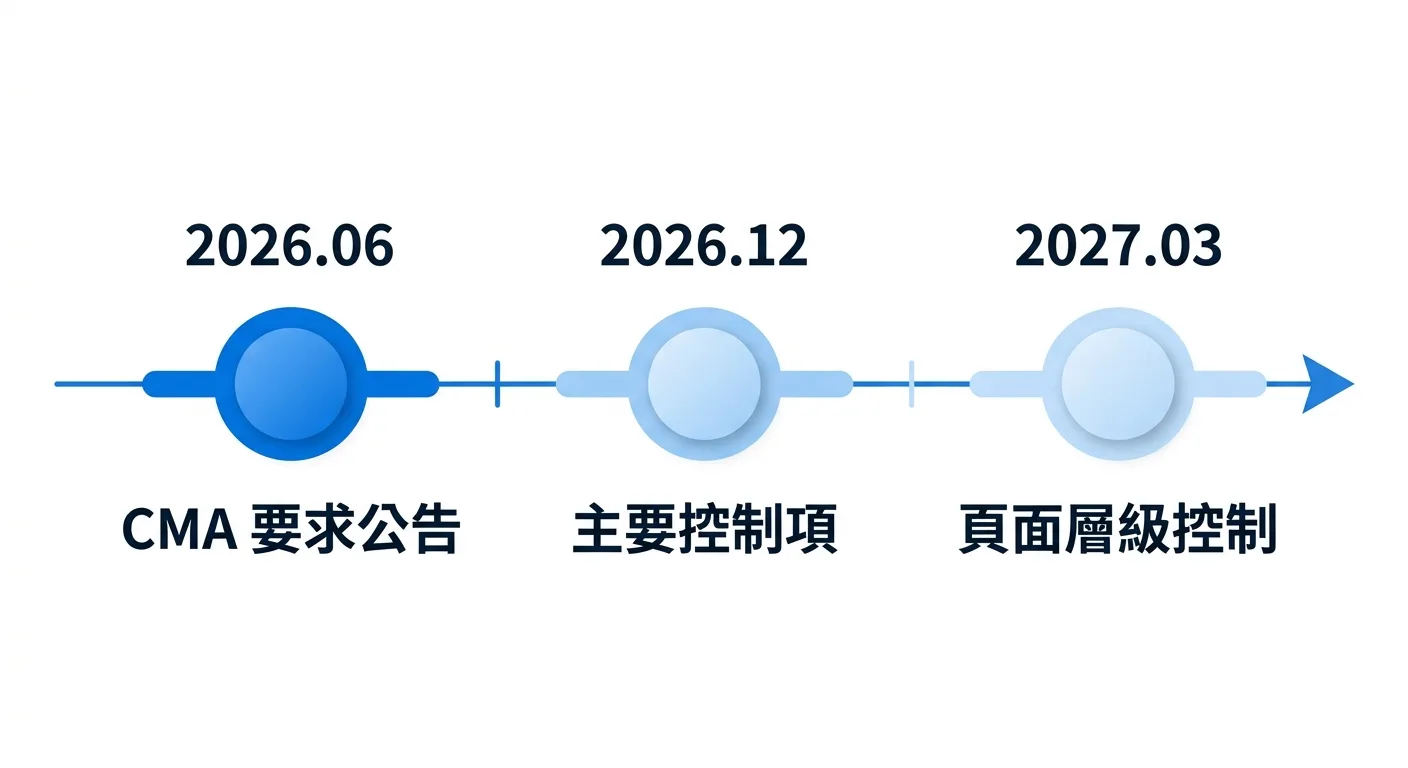
- Timeline: all changes within nine months, important controls expected sooner
- Accountability: published compliance reports with key data every six months in the first year, after which the CMA will review the frequency
What the announcement didn't spell out but Google has since shipped: the control lives in Search Console under Settings → Search generative AI, set per property as Include / Exclude / Inherit from parent, and it covers AI Overviews, AI Mode, and generative AI features in Discover (Search Console Help, 2026); Google also states the setting is not used as a ranking signal (9to5Google, 2026). The "page-level control" mentioned in press coverage is not an option in Google's official documentation.
Two easily-overstated points. First, the CMA explicitly says SMS designation "does not imply that it has acted anti-competitively" — this is ex-ante regulation, not a guilty verdict. Second, the first wave of scope is the UK: Google built the control into Search Console in June 2026, opened it to some UK sites first, and has publicly said it is rolling it out to website owners globally (9to5Google, 2026). As of August 31, 2026, Google has rolled the control out to all websites worldwide (Search Console Help, 2026), so it is already in your property. The second half of this article is the framework for deciding whether to press it.
What Exactly Are You Opting Out Of? Two Tiers
Retellings flatten "opt out" into one action; the CMA actually mandates two independent choices of very different natures.
| Tier | What you opt out of | Effect |
|---|---|---|
| Tier 1: AI feature use | Content not used in real-time answers like AI Overviews | You vanish from AI answer citations |
| Tier 2: Model fine-tuning | Content not used to fine-tune AI models | Your content stays out of training updates |
Look familiar? It's the same logic as the robots.txt world's "search crawlers vs training crawlers" — as covered in our AI crawler setup guide: allowing search and managing training are two separable decisions.
The difference is force. robots.txt is a gentleman's agreement (and not every AI crawler honors it); the CMA requirement is a legal compliance obligation — Google must build controls that actually work. That's what "world first" means here: a regulator turned choice into hard spec.

Why Do Publishers Want Out? Read the News Media's Ledger
To judge your own case, understand what the people who want out are calculating.
UK news media's model: content attracts clicks → clicks monetize (ads, subscriptions). AI Overviews serve the answer directly, intercepting the click on Google's page — content used, traffic gone. The zero-click data backs the anxiety: 68% of US Google searches ended without a click in Jan–Apr 2026, and the top organic result's CTR is nearly 60% lower when AI Overviews appear (Search Engine Journal, 2026).
Media also have a second monetization path: licensing content to AI companies. The opt-out is negotiating leverage — "pay, or we pull out." Leverage works because the exit threat is now credible: before, Google could ignore them because media had nowhere to go; with regulation paving the exit, the table tilts.
So publishers fighting for opt-out are fighting for copyright monetization leverage, not expressing hatred of AI. It's a different front of the same war as the news-site crawler blockade (79% of top news publishers block at least one AI training bot).
Should Your Site Follow? Three Site Types, Three Answers
Back to your website. Split the question into three scenarios and the answer surfaces itself.
Scenario 1: You Monetize Content Directly (News Media, Paid Content)
Seriously evaluate opting out (Search Console now offers the option). Your ledger matches the UK media's: content is the product; AI taking it free erodes the core business. Opting out while keeping licensing-negotiation room is a coherent strategy.
Scenario 2: You're a Content-Marketing-Driven SMB Site (Most Readers Are Here)
Don't opt out — double down the other way. A completely different ledger: your content isn't the product, it's the customer-acquisition channel — articles exist so potential clients find you. AI citing your content is free exposure plus a trust signal; opting out is delisting yourself from the fastest-growing new channel and gifting the space to competitors who stayed.
Every client we serve falls in this category, and the play is always "make AI cite you correctly" rather than "hide from AI": allow search crawlers, strengthen structure, build measurement. The few clicks an SMB loses buy a position inside AI answers — currently a good trade.
"Currently" isn't "forever," so here are the re-evaluation triggers. Re-run the math when any of these appears:
- Measured net loss: two consecutive quarters of rising AI exposure with clearly falling total site entries (including branded search), and no other explanation
- Your content starts monetizing directly: subscriptions, paid courses, licensing — the ledger flips from "acquisition" to "product," and you move to Scenario 1
- You're about to use the Search Console opt-out control (available to all websites worldwide since August 31, 2026): as long as you have GSC AI report history and manual test data — the button decision takes five minutes with your own numbers
No trigger, no monthly anxiety. Swap worry for a quarterly review and follow the data — emotions can track the headlines; decisions should track your own numbers.
Scenario 3: You Host Sensitive or Highly Proprietary Content
Partial opt-out (specific directories or pages) is worth considering, but check the granularity first: Google's Search generative AI control is set per property, and the official documentation lists no page-level option (Search Console Help, 2026). To fence off individual pages today you still need robots.txt plus page-level markup like nosnippet / data-nosnippet (Google AI features documentation). Either way, that's fencing off restricted zones, not full retreat.
| Site type | Recommendation | Why |
|---|---|---|
| Media / paid content | Evaluate opt-out + license | Content is the product |
| Content-marketing site | Stay in, optimize harder | Content is the acquisition channel |
| Sensitive content | Fence off zones with robots.txt / nosnippet |
Fence zones, don't retreat |

Which Type Is Your Site?
If the call isn't obvious, let us take a look. AI SEO Hacker offers a free site health check including your current AI search exposure.
Staying In? Convert Exposure Into Assets
If you stay in AI search, maximize what staying buys you. Three moves:
- Make sure AI gets in and reads you right: robots.txt allowing search crawlers (setup guide), self-contained paragraphs, key numbers up front
- Measure the AI-side return: the Search Console AI performance report (launched June 2026) gives official exposure data; cross-platform citations via fixed-question tests (measurement guide)
- Watch the attribution dividend: the CMA requires "clear links" crediting sources — the more visible attribution becomes, the more a citation converts into clicks and brand recognition
The attribution dividend changes the value structure of being cited, and it suggests three writing adjustments: put your brand name inside quotable paragraphs ("according to {brand}'s testing…") so attribution is built into the content; pair key numbers with sources and dates (freshness is citation competitiveness); and give every article a one-or-two-sentence quotable conclusion — that's the unit AI summaries lift. These work in unregulated markets too, because their essence is making citations carry your brand.
The bigger GEO-vs-SEO picture: see GEO vs SEO differences.
robots.txt: The "Half Opt-Out" You Already Have
The button born in the UK has been available to all websites worldwide since August 31, 2026, and you also already hold a rough version of these controls: robots.txt AI crawler management.
| Item | CMA mechanism (UK) | robots.txt (available now) |
|---|---|---|
| Granularity | Property level, covering only whether AI features use your content; model training (fine-tuning) is outside this control and needs Google-Extended; no page-level option in the official docs | Per-crawler, per-directory |
| Force | Legal obligation with compliance reports | Honor system (not every AI crawler complies) |
| Ranking after opt-out | Google states the control "isn't used as a ranking or inclusion signal affecting other parts of Search" (Search Console Help, 2026) | Blocking the wrong crawler can hurt indexing |
| Scope | Legal obligation UK-only; Google's control open to all websites worldwide since 2026-08-31 | Any website, worldwide |
Our standard client configuration: search-purpose crawlers (OAI-SearchBot, Claude-SearchBot, PerplexityBot) all allowed; training crawlers (GPTBot, ClaudeBot) decided case by case — the civilian version of the CMA's two tiers. In other words, the Search Console control covers Google's AI features, while robots.txt covers individual crawlers (including Google-Extended for Google's training use); the two work together, and either can be reversed at any time if you get it wrong. Per-crawler steps in the AI crawler setup guide.
Mind the granularity difference: robots.txt controls whether crawlers get in; the CMA mechanism controls what content gets used for. The former is the front door — close it and nothing else matters. That's why we usually advise keeping the door open and steering usage with content strategy.
Where Does This Regulation Go Next?
Announced facts only, no fortune-telling.
- Nine-month implementation: all changes within nine months of June 2026, key controls expected earlier (CMA official, 2026)
- Six-month compliance reports (first year) with key data and metrics, after which the CMA will review the frequency
- Reality has outrun the reported milestones: the Search Console control reached some UK sites in June 2026, well ahead of the "main publisher controls by December 2026" figure in press coverage (9to5Google, 2026), and reached all websites worldwide on August 31, 2026 (Search Console Help, 2026); the press-reported "page-level controls by March 2027" is not mentioned in Google's official documentation, which remains the reference
For readers outside the UK, the point isn't the British timeline — it's the template effect: the world's first hard spec for AI-search choice now exists, ready for other jurisdictions to copy. What you should do now, before using the choice that is already open to you, is figure out, with data, whether AI search is a net gain or net loss for you — so when you do press the button, your decision runs on evidence instead of headlines.
FAQ
Can sites outside the UK opt out of Google AI search now?
Yes. Google shipped the control in June 2026 under Search Console → Settings → Search generative AI, set per property as Include / Exclude / Inherit, opened to some UK sites first (9to5Google, 2026), and rolled out to all websites worldwide on August 31, 2026 (Search Console Help, 2026). The CMA mandate itself still applies only to the UK, where Google has nine months to implement controls (CMA official, 2026). Practical step: go straight to the Search Console settings page. The other tool available is robots.txt-level crawler management — separately controlling search and training crawlers, as in our AI crawler setup guide.
Does opting out of AI search hurt Google rankings?
No. Google has explicitly said the control is not used as a ranking signal: after opting out your content still appears in regular Search and Discover (9to5Google, 2026), and your other choices for services such as Merchant Center and Google Ads don't change (Search Console Help, 2026). What's certain: opting out removes you from AI Overviews citations, and AI features now appear on more than 20% of searches (Search Engine Journal, 2026) — a growing surface.
Why shouldn't small businesses opt out?
Different ledger. Media content is the product — AI summarizing it is taking the product free. SMB content is an acquisition channel — AI citing it is free exposure and trust. Opting out means delisting from the fastest-growing channel while competitors stay. The better play: optimize structure so AI cites you correctly, then measure the return via the GSC AI report and manual testing.
What's the difference between opting out of "fine-tuning" vs "AI features"?
Opting out of AI features keeps your content out of real-time answers like AI Overviews (affects current exposure); opting out of fine-tuning keeps it out of model training updates (affects long-term knowledge absorption). The CMA requires both choices separately (CMA official, 2026) — mirroring the search-crawler/training-crawler split in robots.txt. Note that Google's current Search Console control covers only the first tier: the official docs say it doesn't affect AI training, and limiting training use requires Google-Extended (Search Console Help, 2026).
I already block AI crawlers in robots.txt — same effect as the UK opt-out?
No. robots.txt is door-blocking — crawlers stay out, but not every AI crawler honors it, and blocking the wrong search crawler can hurt regular indexing too. The UK mechanism is usage authorization — content gets crawled normally but you dictate what it may power, with legal accountability. Coarse vs fine; configure the coarse tool carefully.
Choice Is Good — Just Don't Rush to Use It on Yourself
Three sentences: the UK got the world's first hard-spec AI search choice, landing within nine months; those who want out are playing a copyright-monetization hand — that's the media ledger; the SMB ledger is acquisition — stay in, optimize, measure, and decide with your own data when you consider pressing the button.
Regulation will keep moving and AI search will keep growing. Neither waits — but your data can be ready. The most practical next step is two actions: check your robots.txt crawler settings this week, and stand up AI exposure measurement this month. When you decide whether to press the button that is already open to you, you'll be among the few who can decide in five minutes.

🎯 Take Action
Don't guess whether AI search is friend or foe — measure it. AI SEO Hacker health-checks your site free, AI exposure included.
Free consultation | View service plans
Further Reading
- OAI-SearchBot & Claude-SearchBot Setup Guide
- Search Console AI Performance Report: The Complete Guide
- How to Measure GEO Performance
- GEO vs SEO: What's the Difference?
- GEO Strategy for Taiwanese Businesses
References
- CMA secures fairer deal for publishers and improves Google search services in UK - GOV.UK
- Google Search Traffic To Open Web Drops To 23% - Search Engine Journal
- Google lets publishers opt out of AI Mode and AI Overviews in Search Console - 9to5Google
- Search generative AI control - Search Console Help