"Why do my competitors' articles always outrank mine?"
The answer to that question usually lies in the competitive analysis you haven't done yet.
SEO isn't a solo effort -- it's a ranking competition. Understanding what your competitors are doing, how well they're doing it, and where their weaknesses lie is essential for crafting a more effective strategy.
This guide will teach you how to conduct a complete SEO competitor analysis, from identifying competitors and analyzing data to developing strategies that put you ahead.
Want to uncover your competitors' SEO strategies? Get a free competitor analysis report via LINE consultation and let our expert team help you see the full competitive landscape.
Who Are Your SEO Competitors?
SEO Competitors vs Business Competitors
First, a critical distinction: Your SEO competitors aren't necessarily your business competitors.
Business competitors: Companies selling the same or similar products/services SEO competitors: Websites competing for the same keyword rankings in search engines
For example:
- You sell coffee machines online
- Business competitors are other coffee machine retailers
- SEO competitors might include: coffee machine review sites, home appliance bloggers, and electronics retailer websites
These sites may not sell coffee machines, but they're competing for your keyword rankings.
How to Identify Your SEO Competitors
Method 1: Direct search
- List your target keywords (10-20)
- Search each one and record the top 10 results
- Tally which websites appear most frequently
- The most frequent ones are your SEO competitors
Method 2: Use SEO tools
- Ahrefs: Organic competitors report in Site Explorer
- Semrush: Competitors report in Organic Rankings (formerly Organic Research)
- Moz: True Competitors feature
These tools automatically identify websites competing for the same keywords.
Method 3: From Google Search Console
- Look at keywords where you rank low
- Search those keywords
- Record the sites ranking above you
Competitor Classification and Prioritization
Not all competitors deserve equal attention. Categorize them strategically:
| Type | Definition | Priority | Strategy |
|---|---|---|---|
| Direct competitors | Similar products, same target audience | Highest | Track closely, compete directly |
| Indirect competitors | Competing for same keywords but not rivals | Medium | Learn from their content strategy |
| Industry giants | Large websites with high domain authority | Low | Avoid head-on competition |
| Emerging threats | New entrants, rapid growth | Medium | Monitor continuously |
Focus on "direct competitors" and "emerging threats" -- these are within your sphere of influence.
What Should an SEO Competitor Analysis Include?
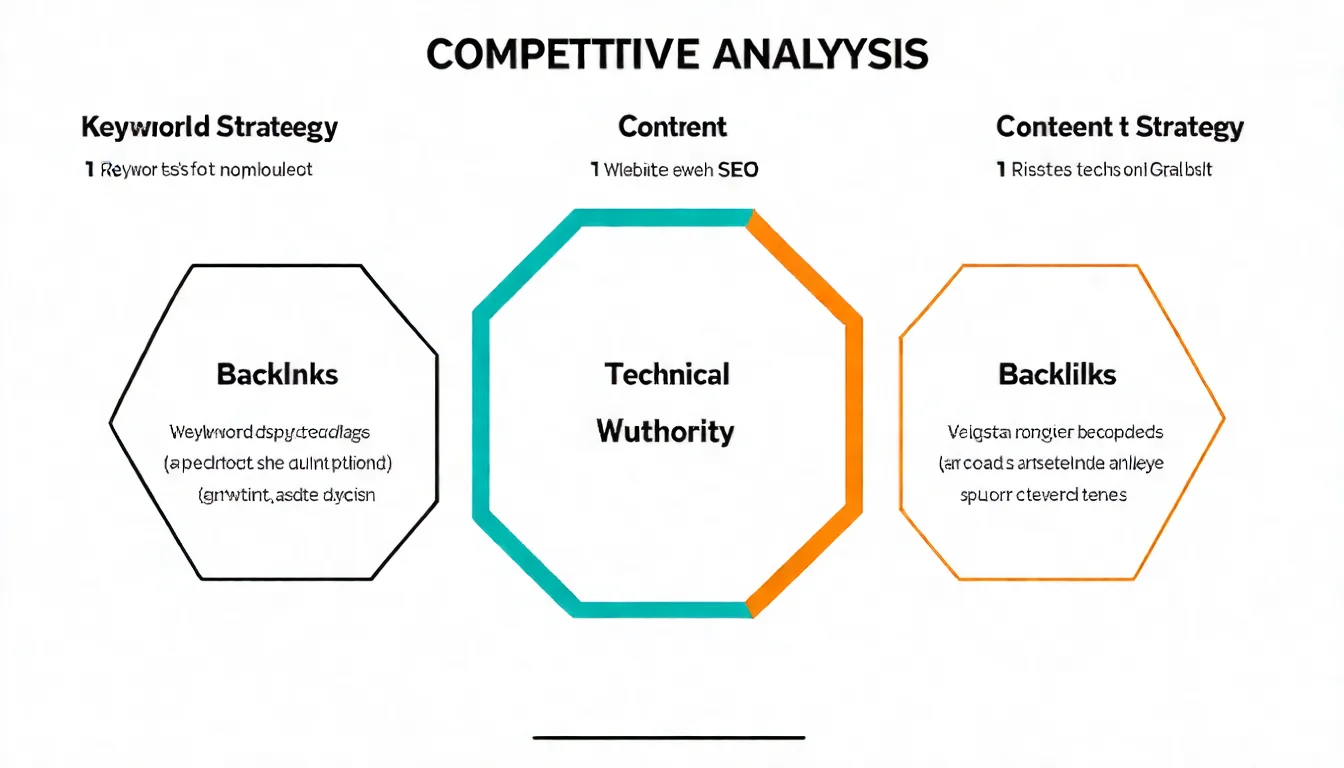
A comprehensive SEO competitor analysis should cover the following dimensions:
Keyword Strategy Analysis
Understanding which keywords your competitors are targeting is the core of competitive analysis.
Analysis items:
-
What keywords does the competitor rank for?
- Total number of ranking keywords
- High-traffic keywords
- High commercial-intent keywords
-
Keyword overlap analysis
- Keywords you both rank for (direct competition)
- Keywords they rank for but you don't (potential opportunities)
- Keywords you rank for but they don't (your advantages)
-
Keyword gap
- Identify valuable keywords where competitors rank but you don't
- This is your most direct opportunity source
Recommended tools:
- Ahrefs: Content Gap feature
- Semrush: Keyword Gap report
- Manual: Compare GSC data
Content Strategy Analysis
Content is the foundation of SEO. Analyzing competitors' content strategies offers valuable insights.
Analysis items:
-
Content topic distribution
- What topics does the competitor cover?
- Article count per topic
- Do they use a topic cluster strategy?
-
Content formats
- Primarily text articles, videos, or infographics?
- Article length distribution
- Any interactive content?
-
Content quality assessment
- Depth and expertise
- Original research or proprietary data
- Visual presentation quality
-
Publishing frequency
- How many pieces of content per month?
- Regular publishing cadence?
- Do they update older content?
Backlink Analysis
Backlinks are a major ranking factor. Analyzing competitors' link profiles reveals building opportunities.
Analysis items:
-
Link quantity
- Total backlinks
- Referring domains
- Link growth velocity
-
Link quality
- Links from high-authority sites
- Link relevance
- Link types (editorial, guest posts, etc.)
-
Link source analysis
- Where are competitors earning links?
- Are there replicable opportunities?
- Industry media or blogger sources
For more tracking tools, see SEO Performance Tracking Tools.
Technical SEO Comparison
Technical fundamentals are the foundation of SEO. What competitors do well is worth learning from.
Analysis items:
| Item | How to Check | Importance |
|---|---|---|
| Site speed | PageSpeed Insights | High |
| Mobile experience | Lighthouse / PageSpeed Insights (mobile) | High |
| Structured data | Schema Markup Validator | Medium |
| URL structure | Direct observation | Medium |
| Internal linking | Screaming Frog | Medium |
| Site architecture | Direct observation | High |
Website Authority Assessment
Website authority reflects how trustworthy a site appears to Google.
Common metrics:
- Domain Authority (Moz): 0-100 scale
- Domain Rating (Ahrefs): 0-100 scale
- Authority Score (Semrush): 0-100 scale
Interpretation guide:
| Score Range | Meaning | Competition Difficulty |
|---|---|---|
| 60+ | High-authority site | Extremely high |
| 40-60 | Medium authority | High |
| 20-40 | Average site | Medium |
| 0-20 | New or small site | Low |
If competitors' authority scores are significantly higher than yours, overtaking their rankings in the short term will be very difficult -- it requires sustained effort.
Competitor Content Analysis
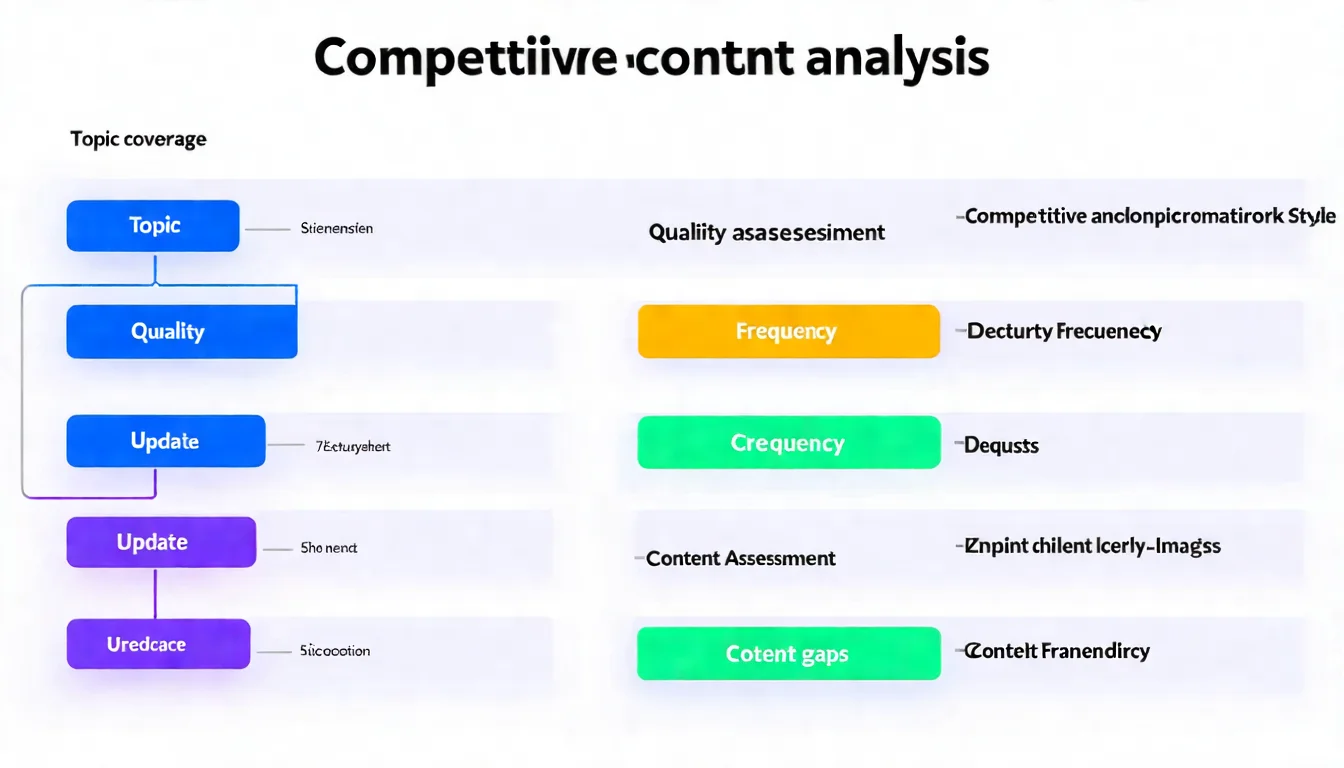
Content analysis is the most important part of competitive analysis because it's the most actionable.
Content Topics and Coverage
Analysis steps:
-
List all competitor articles
- Use Ahrefs/Semrush Top Pages feature
- Or crawl the competitor's website directly
-
Categorize and organize
- Classify by topic (product guides, tutorials, reviews, etc.)
- Record article counts per category
-
Compare with your own content
- Topics they cover that you don't
- Topics where they have more articles
- Topics you cover that they don't
Example findings:
| Topic Category | Competitor Articles | Our Articles | Gap |
|---|---|---|---|
| Product tutorials | 25 | 10 | -15 |
| Comparison reviews | 15 | 3 | -12 |
| FAQ content | 30 | 20 | -10 |
| Industry trends | 8 | 12 | +4 |
This table tells you: prioritize "product tutorials" and "comparison reviews."
Content Quality Assessment
Beyond quantity, quality matters more.
Assessment dimensions:
-
Content depth
- Word count
- Topic comprehensiveness
- Actionable details
-
Expertise
- Original data or research
- Author's professional background
- Content accuracy
-
Readability
- Article structure clarity
- Use of paragraphs and headings
- Visual aids (images, tables, charts)
-
Practicality
- Can readers directly apply the information?
- Step-by-step instructions?
- Templates or tools provided?
Scoring example:
| Assessment | Competitor A | Competitor B | Us |
|---|---|---|---|
| Content depth | 8/10 | 6/10 | 7/10 |
| Expertise | 9/10 | 5/10 | 6/10 |
| Readability | 7/10 | 8/10 | 8/10 |
| Practicality | 8/10 | 7/10 | 6/10 |
This comparison tells you: to outperform Competitor A, strengthen your expertise; to outperform Competitor B, maintain your current level.
Content Publishing Frequency
Consistent publishing is key to SEO success.
Tracking methods:
- Subscribe to competitors' newsletters
- Set up Google Alerts
- Regularly check competitor websites
- Use the new-pages filter in Ahrefs' Top pages report
Analysis focus:
- How many new articles per month?
- Is there a consistent publishing cadence?
- How often is older content updated?
Identifying Content Gap Opportunities
Content gaps are the most direct SEO opportunities.
Types of content gaps:
-
Topic gaps
- Topics with search demand that no one covers
- Topics all competitors cover but you haven't yet
-
Depth gaps
- Existing content is shallow -- you can go deeper
- "Ultimate guide" content opportunities
-
Format gaps
- Everyone writes text -- you can create video
- No one offers tools -- you can build free tools
-
Freshness gaps
- Existing content is outdated
- "2026 edition" update opportunities
Found content gaps? Let AI help you fill them quickly and seize the opportunity to build a content advantage.
Competitor Analysis Tools
Ahrefs Competitive Analysis Features
Ahrefs is the most commonly used tool for competitive analysis.
Core features:
Site Explorer
- Enter a competitor's URL to view complete SEO data
- Traffic estimates, keyword rankings, backlinks
Content Gap
- Find keywords competitors rank for but you don't
- Compare multiple competitors simultaneously
Top Pages
- View competitors' highest-traffic pages
- Understand which content performs best
Domain Comparison
- Compare link data across multiple websites
- Identify link building opportunities
Semrush Competitive Intelligence
Semrush offers comprehensive competitive intelligence features.
Core features:
Domain Overview
- Complete overview of a competitor's website
- Traffic trends, keywords, links
Keyword Gap
- Keyword overlap analysis
- Identify gap opportunities
Backlink Gap
- Link source comparison
- Find link sources competitors have that you don't
Traffic Analytics
- Estimate competitor traffic data
- Traffic source analysis
SimilarWeb Traffic Comparison
SimilarWeb specializes in traffic data estimation.
Core features:
- Traffic estimation (potentially more accurate than Ahrefs/Semrush)
- Traffic source distribution (direct, search, social, referral)
- Visitor behavior data (bounce rate, time on site)
- Industry rankings
Best use cases:
- Market analysis requiring traffic data
- Understanding competitors' traffic source mix
- Industry competitive landscape analysis
Free Alternatives
When budget is limited, free tools can handle basic analysis:
| Need | Free Tool | Limitations |
|---|---|---|
| Keyword rankings | Ubersuggest | Daily limits |
| Backlinks | Moz Link Explorer | 10 queries/month |
| Traffic estimates | SimilarWeb Free | Limited data |
| Technical analysis | Screaming Frog | 500-page limit |
| Site speed | PageSpeed Insights | Free |
From Analysis to Strategy
How to Interpret Competitive Data
Collecting data is just the first step -- interpretation is what matters.
Interpretation principles:
-
Focus on trends, not absolute values
- A competitor has 1 million visits while you have 100,000 -- that's not the point
- What matters: is the gap widening or narrowing?
-
Identify cause and effect
- Do they rank well because of better content or more backlinks?
- Finding the real cause enables an effective response
-
Distinguish replicable vs non-replicable advantages
- Some competitor advantages can be learned and replicated
- Others (brand recognition, history) cannot
-
Quantify the gap
- Not just "the competitor is stronger"
- Be specific: "the competitor has 3x our backlink count"
Finding Differentiation Opportunities
Don't try to outperform competitors on every front. Find the battlefields where you can win.
Differentiation approaches:
-
Content angle differentiation
- They write beginner tutorials; you write advanced strategies
- They cover theory; you share real-world case studies
-
Format differentiation
- They produce text; you create video
- They write long articles; you build tools
-
Target audience differentiation
- They target the mass market; you focus on a niche
- They write for beginners; you write for professionals
-
Speed differentiation
- They update slowly; you stay current
- Their content is outdated; you offer the 2026 edition
Developing Strategies to Overtake Competitors
Based on your analysis, create a concrete action plan.
Strategic framework:
Short-term strategy (1-3 months)
- Fill content gaps: Publish on topics competitors cover but you don't
- Optimize existing content: Make your articles surpass competitor quality
- Fix technical issues: Match competitors' technical SEO standards
Mid-term strategy (3-6 months)
- Build links: Target competitors' link sources for outreach
- Establish expertise: Publish original research or data
- Build topical authority: Complete topic clusters
Long-term strategy (6-12 months)
- Build brand: Increase branded search volume
- Build a moat: Create advantages competitors can't easily replicate
- Continuous monitoring: Track competitor activities and adjust as needed
Competitor Analysis Case Studies
B2B Industry Case Study
Scenario: A B2B SaaS company wants to improve SEO rankings
Analysis process:
-
Identify competitors
- Searched core keywords directly
- Identified 5 main SEO competitors
-
Data collection
| Metric | Us | Competitor A | Competitor B | Competitor C |
|---|---|---|---|---|
| DR | 32 | 58 | 45 | 52 |
| Estimated traffic | 5K | 45K | 25K | 30K |
| Keyword count | 500 | 3,200 | 1,800 | 2,500 |
| Backlinks | 800 | 5,500 | 2,200 | 3,800 |
| Article count | 30 | 150 | 80 | 120 |
-
Key insights
- Our domain authority is significantly lower than competitors
- Article count is the most obvious gap
- Competitor B doesn't have the highest authority but has a strong content strategy
-
Strategy development
- Short-term: Publish 8 articles/month to fill content gaps
- Mid-term: Build backlinks to increase domain authority
- Long-term: Publish original research to establish industry expertise
E-commerce Case Study
Scenario: An e-commerce store wants to overtake competitors for product keyword rankings
Analysis process:
-
Keyword gap analysis
- Discovered 200 keywords competitors rank for but we don't
- 50 of those are high commercial-value keywords
-
Content comparison
- Competitors' product pages include detailed usage guides
- Competitors have "product comparison" articles
- Our product pages only show basic specs
-
Technical SEO comparison
- Competitors have complete Product Schema markup
- Competitors' page load speed is faster
- Our mobile experience needs improvement
-
Strategy development
- Enrich product page content with usage guides
- Create 30 product comparison articles
- Fix technical SEO issues
- Build product-related backlinks
FAQ
How Often Should You Conduct Competitor Analysis?
Recommended frequency:
| Analysis Type | Frequency | Focus |
|---|---|---|
| Full analysis | Quarterly | Comprehensive competitive landscape review |
| Ranking tracking | Monthly | Monitor core keyword changes |
| Content monitoring | Weekly | Track newly published competitor content |
| Quick checks | Ongoing | Immediate response to major changes |
If your industry is highly competitive, increase the frequency.
How to Track Competitor Changes?
Tracking methods:
-
Set up Google Alerts
- Track competitor brand names
- Track industry keyword news
-
Subscribe to competitor newsletters
- Be first to know about new content
- Understand their marketing strategy
-
Use monitoring tools
- Ahrefs rank tracking
- Semrush competitive monitoring
-
Regular manual checks
- Browse competitor websites
- Note any changes
Should You Copy Everything Competitors Do?
No. Analysis is for outperforming, not imitating.
Follow when:
- Competitors are following industry best practices
- You've genuinely missed important content topics
- Their approach has proven effective
Don't follow when:
- It doesn't fit your brand positioning
- You lack the resources to execute well
- It's just an experimental attempt by the competitor
- You have better differentiation opportunities
Principle: Learn from competitors' strategic thinking, but execute with your own style.
Why Competitor Analysis Is About Outperforming, Not Imitating
The ultimate goal of SEO competitor analysis is to help you develop a better strategy.
Remember this process:
- Identify competitors: Recognize SEO competitors, not just business rivals
- Collect data: Keywords, content, backlinks, technical, authority
- Analyze and interpret: Find gaps, causes, and opportunities
- Develop strategy: Concrete short-, mid-, and long-term actions
- Monitor continuously: Track competitor changes and adjust accordingly
The most important takeaway: Find the battlefields where you can win, rather than trying to outperform competitors on every front.
Outperforming competitors starts with quality content. Consult us about AI content solutions now and let our expert team help you build a content competitive advantage.