![Taiwan Enterprise GEO Strategy: A Practical Guide to AI Search Optimization for SMEs [2026]](/_next/image?url=%2Fblog%2Fimages%2Fgeo%2Ftaiwan-enterprise-geo-strategy-01.webp&w=3840&q=75)
Taiwan is home to 1.716 million small and medium-sized enterprises (2024 figure published in the Ministry of Economic Affairs' 2025 SME White Paper) — the backbone of the island's export, manufacturing, and B2B trade. And the way those businesses get found is changing.
Buyers who once opened Google and scanned a list of links now increasingly ask ChatGPT or Perplexity directly, or read the AI-generated summary at the top of the results page (AI Overviews, AI Mode). AI doesn't lay out ten blue links — it recommends a handful of sources. The ones it names are the ones that make a buyer's shortlist.
For Taiwan's export- and manufacturing-driven SMEs, this rewrites the rules: whether an international buyer or B2B purchaser can see you inside an AI answer is starting to decide whether the inquiry ever lands. Only a small share of businesses have started to respond — which is exactly the window for early movers.
This article is written specifically for Taiwanese businesses, breaking down a complete, actionable strategy from assessment to execution — so you can get your brand into AI's answers as efficiently as possible.
Want Your Business to Be Found by AI Search Engines?
Don't let your competitors get there first. Find out which GEO strategy is right for your business today.
Taiwan's AI Search Market Overview
Before diving into strategy, let's look at the reality of the Taiwanese market.
AI Search Habits Among Taiwanese Users
The growth of AI search in Taiwan has been faster than expected.
The following reflects what we've observed while working with Taiwanese businesses — practical observations rather than quantitative survey data:
| Metric | What We Observe |
|---|---|
| ChatGPT usage | More users are turning to AI tools to look things up |
| Primary User Demographics | Mostly working professionals and students |
| Common Use Cases | Professional queries, product comparisons, learning and research |
| Language Preferences | Primarily Traditional Chinese; English for certain specialized fields |
What's particularly noteworthy are the use cases. The most common scenarios where Taiwanese users turn to AI search include:
- "Recommend me...": The best coffee machine, a beginner-friendly camera, brunch spots in Taipei
- "Compare...": iPhone vs Android, WordPress vs Shopify
- "How do I...": Tax filing process, business registration, SEO optimization
- "What is...": Technical terminology, concept clarification
If your business can answer these types of questions, you have a chance of being cited by AI.
GEO Adoption Among Taiwanese Enterprises
Frankly speaking, most Taiwanese businesses haven't yet recognized the importance of GEO.
| Business Type | GEO Adoption Status |
|---|---|
| Large enterprises | Some have started investing, but most are still watching |
| SMEs | Very few have taken action; most don't know what GEO is |
| Startups | More receptive; some have already begun experimenting |
What does this mean?
Now is the best time to act. When the market has few competitors, it's much easier to become the "authoritative source" in AI's eyes.
For a deeper understanding of GEO fundamentals and how it works, check out our core guide.
Why SMEs Have the Advantage in GEO
Many people assume GEO is only for large corporations. The opposite is actually true.
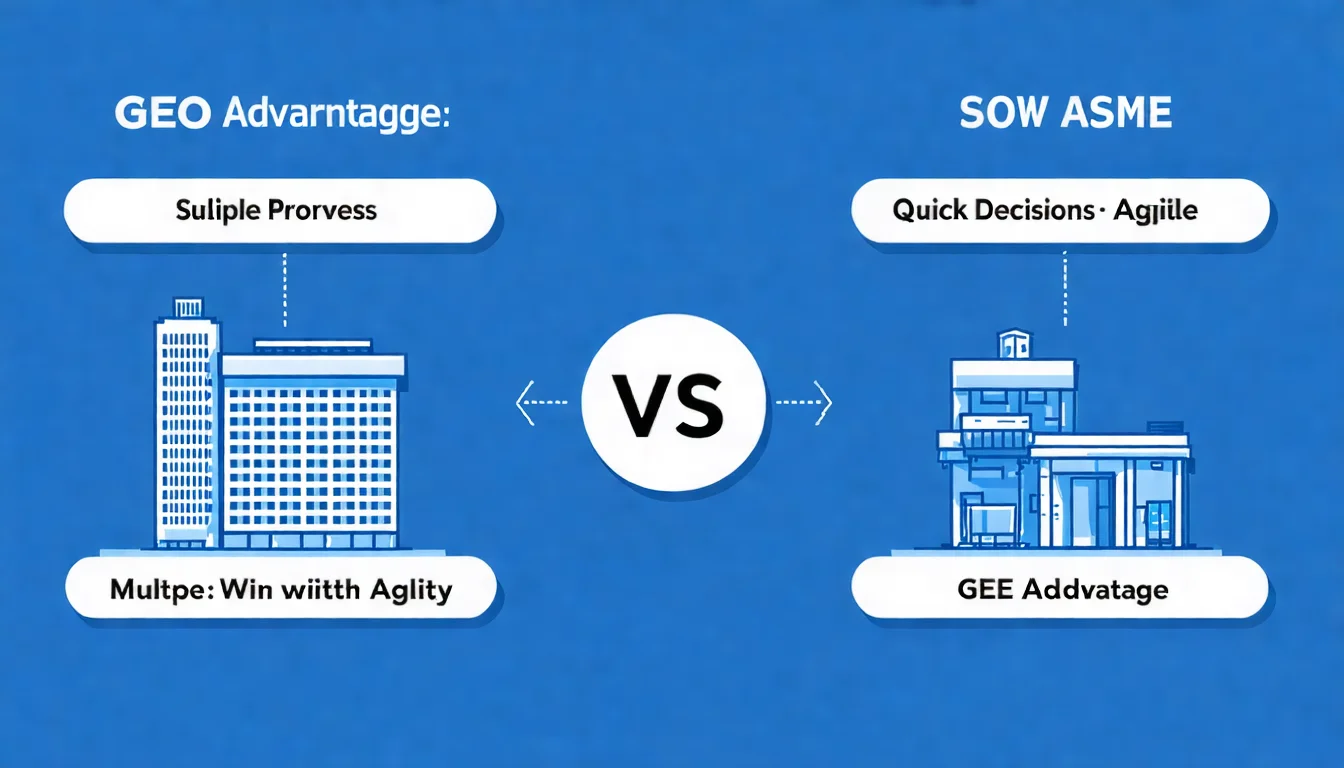
Advantage 1: High Agility and Fast Execution
Large enterprises need layers of approval for everything — just deciding whether to pursue GEO might require three separate meetings.
SMEs are different:
| Large Enterprises | SMEs |
|---|---|
| Lengthy decision-making processes | The owner decides |
| Multi-department coordination required | Small teams execute quickly |
| Complex budget approvals | Flexible resource allocation |
| High cost of trial and error | Quick iteration and adjustment |
GEO is still in its early stages, with rules and best practices constantly evolving. Businesses that can adapt quickly actually have the upper hand.
Advantage 2: Easier to Build Authority in Specialized Fields
This is the most important advantage.
When AI decides whose content to cite, it looks at expertise, not company size.
A consulting firm specializing in "digital transformation for traditional Taiwanese manufacturers" may have deeper expertise in this area than a large consulting conglomerate. When AI needs to answer questions about "digital transformation in Taiwan's manufacturing sector," specialized content has a better chance of being cited.
Niche market + in-depth content = GEO advantage
| Business Type | GEO Strategy Direction |
|---|---|
| Accounting firm | Comprehensive guide on a specific tax topic |
| B2B manufacturer | Technical FAQ for a product category |
| Local e-commerce | Buying guide for a specific product category |
| Professional services | Detailed answers to common questions |
5 Steps to GEO Optimization for Taiwanese Enterprises
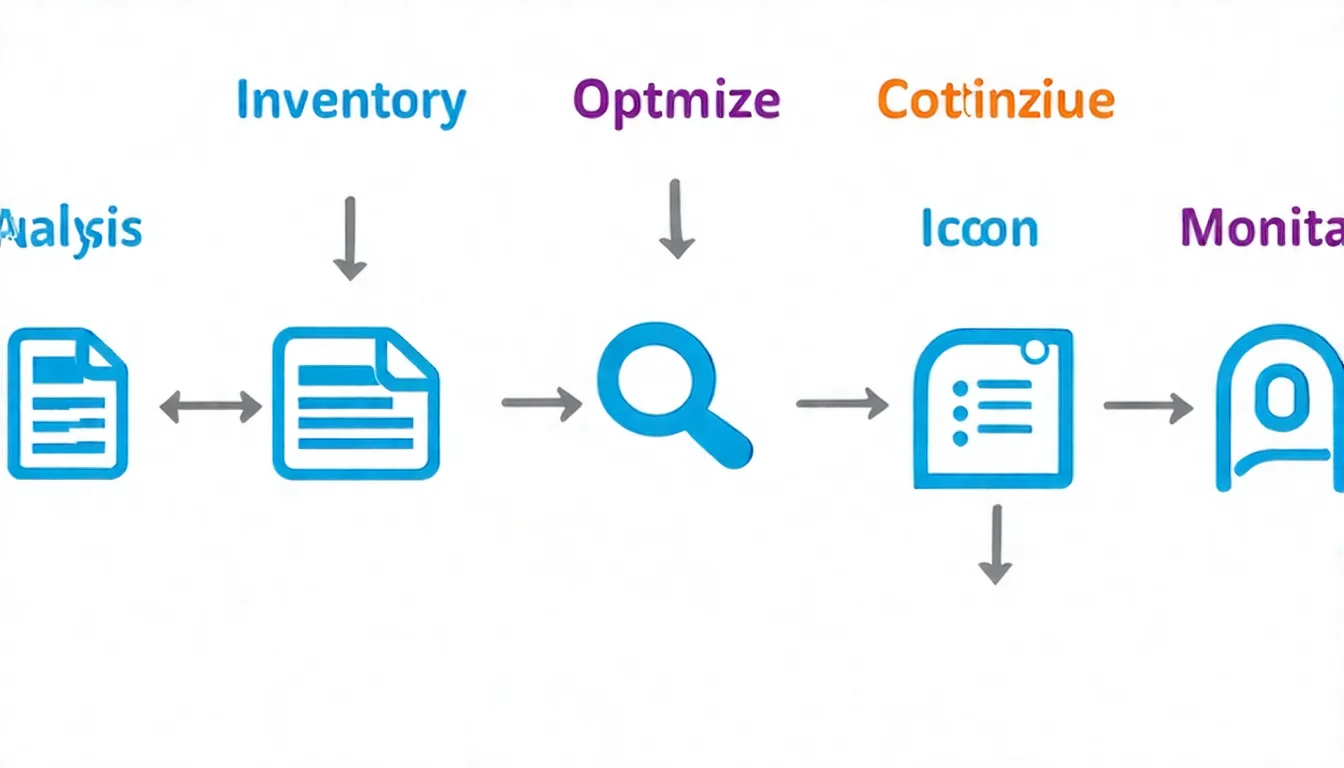
Theory covered — let's get into the practical steps.
Step 1: Audit Your Existing Content Assets
Before optimizing anything, start by understanding what you already have.
Audit Checklist:
- What pages does your website have? (Service pages, About Us, blog, etc.)
- Which pages contain unique professional knowledge?
- Which existing content is suitable for AI citation?
- Do you have a FAQ or frequently asked questions page?
- How many articles are in your blog or knowledge base?
Evaluation Priorities:
| Content Type | Citation Potential | Optimization Priority |
|---|---|---|
| FAQ | High | Top priority |
| Expert knowledge articles | High | Priority |
| Service description pages | Medium | Secondary |
| Company introduction page | Low | Lower priority |
Step 2: Analyze AI Search Keywords
Understand how AI search responds to questions related to your business.
How to Do It:
-
Test your brand visibility
- Ask ChatGPT: "What companies in Taiwan offer [your industry]?"
- Check if your brand gets mentioned
-
Analyze industry-related queries
- Search Perplexity for "[your product/service] recommendations"
- See which sources AI cites
-
Research competitors
- Identify competitor content that AI frequently cites
- Analyze what makes their content stand out
Build a Target List:
- What questions do you want AI to mention you in when answering?
- Do you currently have content that addresses those questions?
- If not, what content needs to be created?
Step 3: Optimize Content Structure
This is the most critical step.
Optimization Focus Areas:
-
Refine heading hierarchy
- Use clear H1, H2, H3 structure
- Make headings descriptive and aligned with user language
-
Add FAQ sections
- Answer your customers' most frequently asked questions
- Answers should be direct, complete, and self-contained
-
Optimize paragraph length
- One key point per paragraph
- Suitable for AI chunking (150–300 words per block)
-
Include data and examples
- AI prefers content with concrete information
- Data-backed content is more persuasive
For detailed content structuring techniques, see Content Chunking for AI: A Beginner's Guide.
Step 4: Configure Technical Settings
Technical configuration is the foundation for making AI "see" you.
Settings to Consider:
| Setting | Priority | Description | Reference |
|---|---|---|---|
| robots.txt | Essential | Allows AI crawlers and agents to access your site instead of blocking them | AI Crawler Settings Guide |
| Schema markup | Essential | Increases content structure | FAQ Schema, Organization Schema |
| llms.txt | Optional | You can publish one to describe your site, but don't treat it as a requirement: Google states you don't need such files to appear in its generative AI features, no major AI platform has committed to reading it, and there's no evidence it improves AI search visibility | llms.txt Setup Guide |
Verification Steps:
- Confirm robots.txt allows AI crawlers
- If you publish an llms.txt, confirm it is accessible
- Use Schema validation tools to check your markup
Step 5: Continuously Monitor and Adjust
GEO isn't a one-and-done effort — it requires ongoing tracking.
Monitoring Methods:
| Method | Frequency | What to Watch |
|---|---|---|
| AI search testing | Weekly | Whether your brand is mentioned |
| Traffic analysis | Weekly | Changes in AI-driven traffic |
| Content review | Monthly | Whether content needs updating |
| Competitive analysis | Monthly | Competitors' AI performance |
Adjustment Strategy:
- Content being cited: Keep it updated and expand depth
- Content not being cited: Analyze why and optimize structure
- Newly discovered opportunities: Create new content to fill gaps
Industry Case Studies: GEO in Action for Taiwanese Enterprises
The three scenarios below illustrate how different industries can approach GEO. They are strategy illustrations, not measured results from specific clients.
Case Study 1: B2B Manufacturing
Background: A traditional Taiwanese manufacturer producing industrial components, looking to expand into overseas markets.
Challenges:
- Highly specialized products that general consumers don't understand
- Difficulty reaching international buyers
- Website only had a basic product catalog
GEO Strategy:
- Built comprehensive product technical FAQs
- Material properties, specifications, application scenarios
- Created industry knowledge content
- Manufacturing processes, quality standards, buying guides
- Confirmed AI crawlers can actually access the technical content (robots.txt settings)
- (Optional) Published an llms.txt describing areas of expertise — not a requirement today; it neither helps nor hurts
What This Aims to Achieve:
- Give international buyers searching for industrial components a chance to see you in AI answers
- Open up inquiries coming through AI search channels
Key Success Factor: Structured presentation of specialized technical content
Case Study 2: Professional Services (Accounting Firm)
Background: A mid-sized accounting firm seeking to increase online visibility and attract more clients.
Challenges:
- Highly homogeneous services, difficult to differentiate
- Clients frequently had tax questions but didn't know who to ask
- Limited online content
GEO Strategy:
- Created a tax FAQ series
- Business tax filing, payroll withholding, startup taxation
- Regularly updated regulatory change explanations
- New regulation interpretations, filing deadline reminders
- Built industry-specific guides
- E-commerce tax filing, freelancer tax obligations
What This Aims to Achieve:
- Give AI a chance to cite the firm's content when answering tax-related questions
- Use expert content to bring in website traffic and consultation requests
Key Success Factor: Professional knowledge + timely updates
Case Study 3: Local E-Commerce
Background: A local e-commerce brand selling home and lifestyle products, wanting to gain visibility in AI shopping assistants.
Challenges:
- Competing against major e-commerce platforms
- Product descriptions lacked differentiation
- No content marketing foundation
GEO Strategy:
- Optimized product description structure
- Specification tables, feature lists, usage scenarios
- Created buying guide content
- Category comparisons, beginner recommendations, how-to tutorials
- Integrated customer reviews
- Authentic user experiences, frequently asked questions
What This Aims to Achieve:
- Give products a chance to appear in AI shopping assistant recommendations
- Support conversion with more complete buying information
Key Success Factor: Structured product information + review integration
For a deeper dive into e-commerce GEO optimization strategies, see the E-Commerce GEO Optimization Guide.
Want to Know Which GEO Strategy Suits Your Industry?
Every industry is different. Let our experts analyze the best entry point for your business.
Common Myths and Recommendations
Through our experience helping Taiwanese businesses implement GEO, we've identified several common misconceptions.
Myth 1: GEO Is Only for Large Enterprises
Wrong! AI evaluates content quality, not company size.
The reality:
- SME expert content is actually more likely to be cited
- Limited resources can force a focused content strategy
- A small but precise approach is more effective than a broad but shallow one
Myth 2: If You Do SEO, You Don't Need GEO
Incorrect! SEO and GEO are complementary.
| Aspect | SEO | GEO |
|---|---|---|
| Target platform | Google and other search engines | AI search tools |
| Technical setup | Sitemap, meta tags | AI crawler settings, structured data (llms.txt optional) |
| Content focus | Keyword optimization | Structured, citable content |
SEO-optimized content isn't necessarily suited for AI, and the technical configurations differ. We recommend running both in parallel for maximum impact.
For more on the differences, see GEO vs SEO: A Complete Comparison.
Myth 3: GEO Results Are Immediate
Patience is required.
The reality:
- Technical settings can take effect immediately
- But it takes time for AI to index your content
- In our hands-on experience, clear progress usually starts to show within 3–6 months; Google's own guidance is that some changes take effect in a few hours while others can take several months, and you'll likely want to wait a few weeks before assessing (Google SEO Starter Guide)
- Consistent content production is needed to maintain visibility
GEO is a long-term investment, not a short-term sprint. The good news: the earlier you start, the greater your cumulative advantage.
Frequently Asked Questions
Q1: How much does GEO cost for a Taiwanese business?
It varies widely depending on your approach.
| Approach | Cost | Best For |
|---|---|---|
| DIY | Low (time investment) | Businesses with in-house marketing staff |
| Partial outsourcing | Medium | Businesses needing professional guidance |
| Full outsourcing | Higher | Businesses wanting faster results |
We recommend starting with optimizing existing content. Technical setup can be handled internally or with outside help. The primary investment is in ongoing content production — that's the part requiring sustained effort.
Q2: Which industries are best suited for GEO?
Nearly every industry can benefit, but the following have a particular advantage:
| Industry | Why It's a Good Fit |
|---|---|
| Professional services | Consulting, legal, accounting — professional knowledge is your asset |
| B2B manufacturing | Technical FAQs and product knowledge are ideal for citation |
| E-commerce retail | AI shopping assistants are a new traffic source |
| Education & training | Knowledge content is naturally suited for AI |
| Healthcare | Regulations must be considered, but expert content is highly valuable |
Q3: How do you measure GEO effectiveness?
Key metrics to monitor:
| Metric | How to Track |
|---|---|
| Brand mentions | Regularly test in AI tools |
| AI-referred traffic | Monitor referral sources |
| Keyword performance | Review AI responses to relevant queries |
| Inquiry volume changes | Compare before and after optimization |
We recommend maintaining a tracking log to monitor changes over time.
Q4: Do I need external help?
It depends on your resources and goals.
DIY is suitable when:
- You have basic digital marketing knowledge
- You have time to invest in learning and execution
- Budget is limited and you're willing to trade time for cost
External help is suitable when:
- You want to get started quickly
- You don't have dedicated marketing staff
- You need expert judgment and strategic planning
How Should Taiwanese Enterprises Start with GEO? Key Takeaways
Congratulations on finishing this practical guide! Here's a quick recap:
| Key Point | Summary |
|---|---|
| Market opportunity | AI search usage is growing in Taiwan; most businesses haven't started |
| SME advantages | High agility; easier to build authority in specialized fields |
| 5-step process | Audit, Analyze, Optimize, Configure, Monitor |
| Keys to success | Deep expert content + structured presentation |
| Timeline | In our hands-on experience, clear progress usually starts to show within 3–6 months; long-term cumulative advantage |
Now is the best time for Taiwanese enterprises to invest in GEO. While your competitors are still on the sidelines, one step ahead means staying ahead.
Let Experts Plan Your GEO Strategy for the Taiwan Market
From content planning to technical configuration — a one-stop AI search optimization service.
Not sure where to start? Let us assess your current situation and plan your strategy:
Free LINE Consultation | View Our Services
Further Reading
- How to Measure GEO Performance: AI Search Visibility Metrics: how to verify results after executing your strategy
References
- GEO: The Complete Guide to Generative Engine Optimization
- GEO vs SEO: A Complete Comparison
- llms.txt Setup Guide
- AI Crawler Settings Guide
- Content Chunking for AI: A Beginner's Guide
- E-Commerce GEO Optimization Guide
![AI Exposure Isn't Revenue: How SMEs Monetize AI Traffic in 2026 [5 Paths]](/_next/image?url=%2Fblog%2Fimages%2Fgeo%2Fsme-zero-click-monetization-01.webp&w=3840&q=75)