![What If AI Gets Your Brand Wrong? Reputation Management After the German Ruling [2026]](/_next/image?url=%2Fblog%2Fimages%2Fgeo%2Fai-overview-brand-reputation-01.webp&w=3840&q=75)
Imagine someone googles your company, and the AI summary answers: this business is involved in scams and subscription traps. Except you aren't.
Not hypothetical. In May 2026, two Munich publishing companies lived it: Google's AI summaries mixed another shady company's record into theirs, generating accusations that "didn't appear in any of the linked sources." They sued — and won. The Regional Court of Munich ruled Google must answer for false AI summary content, because the AI Overview is "Google's own content" (THE DECODER, 2026).
This article does two things: explains the landmark ruling clearly, then hands you a working playbook — how to check whether AI is getting your brand wrong, what to do when it is, and how to make it less likely in the first place.
💡 Want to know how AI describes your brand right now? We'll test it. Free consultation
Key takeaway: On May 28, 2026 the Regional Court of Munich issued a temporary injunction against Google (case 26 O 869/26): AI Overviews constitute Google's own content, traditional search-engine immunity doesn't apply, and Google bears 80% of costs (THE DECODER, 2026). Brand AI reputation management now has a legal anchor.
What Did the German Court Rule?
The case facts, laid out (THE DECODER, 2026):
- Court and case: Regional Court of Munich, case 26 O 869/26, ruled May 28, 2026
- Nature: temporary injunction — Google barred from continuing to spread the false claims via AI summaries
- Plaintiffs: two Munich publishing companies
- What the AI got wrong: for certain queries, Google's AI summaries tied the plaintiffs to scams, subscription traps, and shady practices. The court found the AI had mixed in information about genuinely questionable companies and drawn connections "that didn't appear in any of the linked sources"
- Costs: Google pays 80%, each plaintiff 10%
Note the "temporary injunction" nature: not a final judgment, and Google notes the decision isn't final. But it is currently the clearest judicial statement on who answers for false AI summary content — from a court in one of Google's major markets.
Update (as of July 2026): Commentators have framed the ruling as German courts declining to extend ordinary search-engine liability immunity to AI search (Techdirt, 2026-07-01). The US Library of Congress Global Legal Monitor also covered the case on July 17, 2026 (Library of Congress, 2026).
Google's position: AI summaries are designed to "reflect" information that already exists on the web, and may occasionally miss context or misread content. That defense is precisely what the court rejected — next section explains why.
Why This Ruling Matters: AI Summaries Go From "Relaying" to "Speaking"
The core isn't damages — it's a characterization question: who is talking when an AI summary talks?
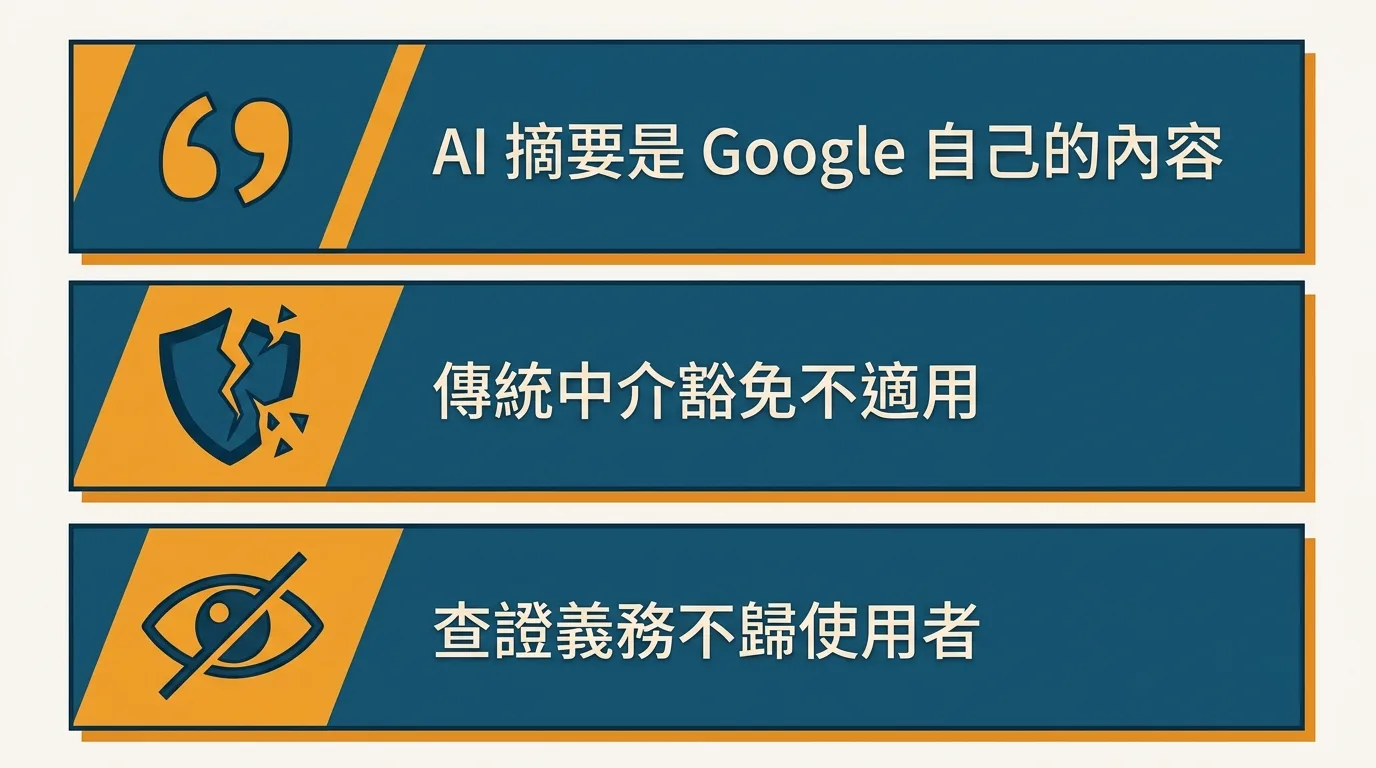
Google's classic immunity logic: a search engine is an intermediary presenting other sites' content; take errors up with the source. For two decades that mostly held. The Munich court answered differently, on three grounds (THE DECODER, 2026):
- The AI summary is Google's own content — not a results list, but an independent statement generated in Google's own words and structure
- Traditional search-engine immunity doesn't apply — immunity protects intermediaries, not speakers
- The "users can verify it themselves" defense was rejected — the duty to verify cannot be tossed back to readers
One sentence for the shift: under this ruling's logic, an AI summary is no longer the library's index card — it's the publisher's editorial. Say it wrong, and the publisher answers. For brands, the implication flips too: when web content smeared you before, you chased every source site; if AI platforms answer directly for their generated content, brands finally have one large, well-defined counterparty.
This is one court's temporary injunction in one jurisdiction — not a global rule. But the direction signal is clear, and smart brands won't wait for global rules to start managing their AI reputation.
Why Does AI Get Brands Wrong?
To prevent errors, understand how they happen. The Munich case exposes a mechanism best called confused synthesis:
When AI answers, it retrieves fragments from multiple sources and composes a fluent statement. The failure sits in "compose" — if one retrieved fragment describes another company's misconduct and the AI doesn't separate the entities, it can pin company A's record on company B, delivered in a perfectly confident tone. That's exactly what happened in Munich: information about questionable companies blended into the plaintiffs' description, producing accusations that existed in no source.
Three structural risk factors for brands:
- Same or similar names: your brand resembles another company, product, or the protagonist of a negative event → confusion odds jump
- Thin information about you online: when AI can't find enough authoritative description, it leans harder on inference and stitching — information vacuum is hallucination's breeding ground
- Stale information residue: old disputes, discontinued products, pre-rebrand pricing still floating around — AI can't tell which is current
The counterintuitive read on point two: the less content a brand has, the higher its risk of being misdescribed — and the later it finds out. Staying quiet doesn't make AI forget you; it makes AI improvise about you.
Stack the three factors into a quick self-grading:
| Risk level | Profile | Check cadence |
|---|---|---|
| High | Name close to other brands/common words + thin site + past controversy | Monthly, with negative probes |
| Medium | Distinct name but low buzz, or recent price/plan/name changes | Fold into monthly routine |
| Low | Distinct name, thick site, consistent info everywhere | Quarterly spot checks |
Grading isn't for scaring yourself — it allocates resources. High-risk brands make reputation checks routine; low-risk brands need "test after every change": price, plan, or name changes all mint stale-info residue, so test the following month.
Is AI Already Getting You Wrong? A Three-Step Self-Check
This flow comes from the monthly AI citation tests we run for clients — the same method that tracks visibility doubles as a reputation check with one extra column:
Step 1: Build a Brand Question List (10 Minutes)
Cover at least four types: "what does {brand} do," "{brand} reviews," "is {brand} a scam / reliable," "{brand} vs {competitor}." Always include negative probes — users genuinely ask these, and you need to know the answer being given.
A copy-ready template (swap in your brand and industry):
| Type | Example question | What it tests |
|---|---|---|
| Basic identity | What does {brand} do? | Is the basic description right |
| Review probe | What are {brand}'s reviews like? | Which review sources get cited |
| Negative probe | Is {brand} a scam? Reliable? | Any borrowed misconduct |
| Comparison | {brand} vs {competitor} — which is better? | How you're positioned |
| Service detail | How does {brand} charge for {core service}? | Stale info residue |
Type five gets skipped most — and it's the high-incidence zone for stale residue. Brands that changed pricing or plans must test it.
Step 2: Test Across Platforms and Log (Half a Day)
Run the list through Google (AI Overviews/AI Mode), ChatGPT, and Perplexity, one round each. Log three columns per question: mentioned or not, described correctly or not, and which sources were cited. The third column is the key — when AI gets it wrong, the citations tell you whether the error has an external source or was synthesized from thin air. Full methodology in how to measure GEO performance.
Step 3: Re-Test Monthly
AI answers are stochastic and models update. One correct round proves nothing permanent. Fold the reputation check into your monthly AI visibility routine — near-zero added cost.

Rather Not Run This Yourself?
AI SEO Hacker's GEO service includes monthly AI citation testing — brand description accuracy is a standard column. If AI gets you wrong, you hear it from us first.
Found an Error? Four Remedy Channels
Pick by severity; run in parallel.
Channel 1: Fix the Source (When the Error Is Traceable)
The citations you logged in step two earn their keep. If the error traces to outdated or wrong web content — ask that site to correct it, or publish a fresher authoritative version that wins future retrieval. The practical order: open each cited link, find the piece behind the false statement, and classify it as "wrong" or "stale." Wrong → a polite correction request with evidence (success rates are better than you'd guess). Stale → don't chase others' edits; publish your own newer, fuller version — AI prefers fresh content and the new version wins subsequent retrieval. When neither moves, at least answer the claim in your own FAQ ("we're often asked whether… here's the reality"), giving AI a retrievable rebuttal source.
Channel 2: Platform Feedback (Always)
Google's AI answers carry feedback controls; ChatGPT and Perplexity have report paths. Single reports aren't guaranteed to work, but the cost is trivial and the record matters. Just do it.
Channel 3: Publish Authoritative Self-Description (For Vacuum-Type Errors)
AI improvises about you when the web lacks an authoritative "your version." Fix the vacuum: about pages, service pages, and FAQ stating the basic facts completely, written in AI-readable structure (self-contained paragraph techniques in content chunking).
Channel 4: Legal Action (Severe, Persistent False Claims)
Munich proves the path exists — note its conditions: a specific error, provably false, causing commercial harm, in a jurisdiction whose courts accept similar reasoning. For most businesses this is the last resort for severe cases, not a daily tool. If it comes to that, your step-two logs (screenshots, dates, cited sources) are the evidence base.
| Channel | When | Cost | Speed |
|---|---|---|---|
| Source fix | Error traceable | Low–mid | Medium (next retrieval) |
| Platform feedback | Always | Minimal | Uncertain |
| Authoritative self-description | Information vacuum | Mid | Mid–slow |
| Legal | Severe falsehoods | High | Slow |
Prevention Beats Appeal: Help AI Know Your Brand Correctly
Handling errors is the emergency room; prevention is the daily health plan. Three long-term works — which happen to be GEO fundamentals:
- Thick authoritative content: your site's self-description should be more complete and current than any third party's. With ample first-hand information, AI doesn't need to stitch
- Entity consistency: brand name, service description, contact info identical across site, social, and directories — the antidote to name confusion. Minimal self-audit: is the brand name written identically everywhere (spacing and casing included), do your about page and Google Business Profile match, do old domains or names redirect with explanation
- Let AI in, make it readable: allow search crawlers (setup guide), self-contained paragraphs, key facts with numbers and dates. Full intro in the GEO complete guide
Notice it? Reputation management and visibility optimization are the same set of actions. Making your content easier for AI to cite is simultaneously making you harder to misdescribe. One investment, two returns.
Classic-era reputation work (Google reviews, negative-review handling) still applies — see the review management guide; the AI era adds a layer on top, it doesn't replace it.

FAQ
Is Google really liable for AI summary errors?
In Germany, the Munich court's May 28, 2026 temporary injunction (case 26 O 869/26) held that AI Overviews are Google's own content and Google answers for false statements, bearing 80% of costs (THE DECODER, 2026). It's a non-final ruling in one jurisdiction — a direction signal, not yet a global rule.
How do I know whether AI is misdescribing my brand?
Test with a fixed question list: at least four types — identity, reviews, reliability, comparisons — run monthly through Google's AI features, ChatGPT, and Perplexity, logging mention, accuracy, and cited sources. One round takes half a day, and the citations column tells you where any error came from.
Can I sue if AI gets my brand wrong?
The German ruling doesn't transfer directly to other jurisdictions, and as of July 2026 no equivalent precedent has surfaced in public records for most of them. The practical order: fix sources, report to platforms, publish authoritative self-description; reserve legal action for specific, provably false, damaging claims — and talk to a lawyer first. Whichever path, your routine test logs (screenshots, dates, sources) are the foundation.
What's the single most effective prevention?
Eliminate the information vacuum. AI fabricates most when it can't find authoritative first-hand information — keep your site's brand facts complete and current, maintain entity consistency across the web, and let AI crawlers in. With ample information, AI is too busy citing you to improvise.
Does this ruling change GEO strategy?
Directionally, it helps. The more pressure platforms feel over false content, the more AI systems will favor verifiable, well-sourced, entity-clear content when composing answers — exactly what GEO optimizes for. Brands with clean structure and consistency get more citation share in a "platforms playing safe" world; messy ones get cautiously skipped.
My brand is small and rarely searched — do I still need this?
Yes, for the opposite reason: information-thin brands are AI hallucination's high-risk group. The upside: your checks are cheap (few questions, quick rounds), and publishing authoritative self-description works fast — in a near-empty information space, your site easily becomes AI's main reference about you. Start with one round per quarter.
Make AI Reputation a Routine: Why Start Now
The Munich ruling draws a line: AI platforms are starting to answer as speakers for what they generate. On the other side of the line is the brand's homework — you can't demand AI describe you correctly until you know how it currently describes you.
The three-step check can run this month. Half a day buys early detection, preserved evidence, and a direction for prevention. The Munich publishers gathered evidence after the damage; you can make monitoring a habit before it — same tools, but one is firefighting and the other is insurance. AI answers "who are you" on your behalf every day. Don't leave it to improvisation.

🎯 Take Action
How AI describes your brand shouldn't be a mystery. AI SEO Hacker's GEO service includes monthly AI citation tests with brand description checks.
Free consultation | View service plans
Further Reading
- How to Measure GEO Performance: AI Search Visibility Metrics
- What Is GEO? The Complete Guide
- What Is Content Chunking for AI?
- Google Review Management Guide
- Search Console AI Performance Report: The Complete Guide


![Should You Opt Out of Google AI Search? The UK Mandate Explained — and What to Do Instead [2026]](/_next/image?url=%2Fblog%2Fimages%2Fgeo%2Fgoogle-ai-search-opt-out-01.webp&w=3840&q=75)