Used AI to write an article and worried about it being detected?
With more AI detection tools popping up online, you might wonder — how accurate are they? And what happens if your content gets flagged?
This guide helps you understand how AI writing detection works and, more importantly, teaches you how to make AI articles feel more "human" and produce genuinely valuable content.
What Is AI Writing Detection?
How AI Detection Tools Work
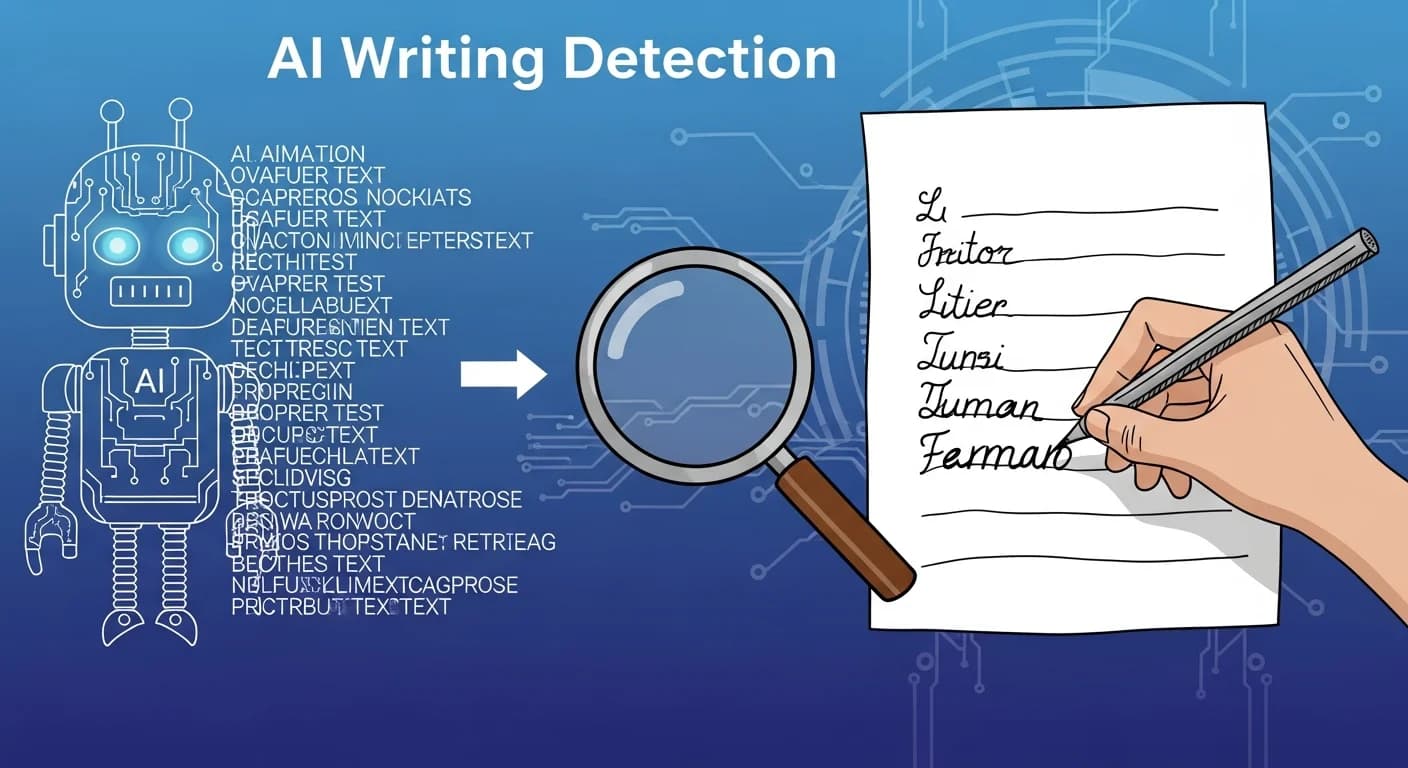
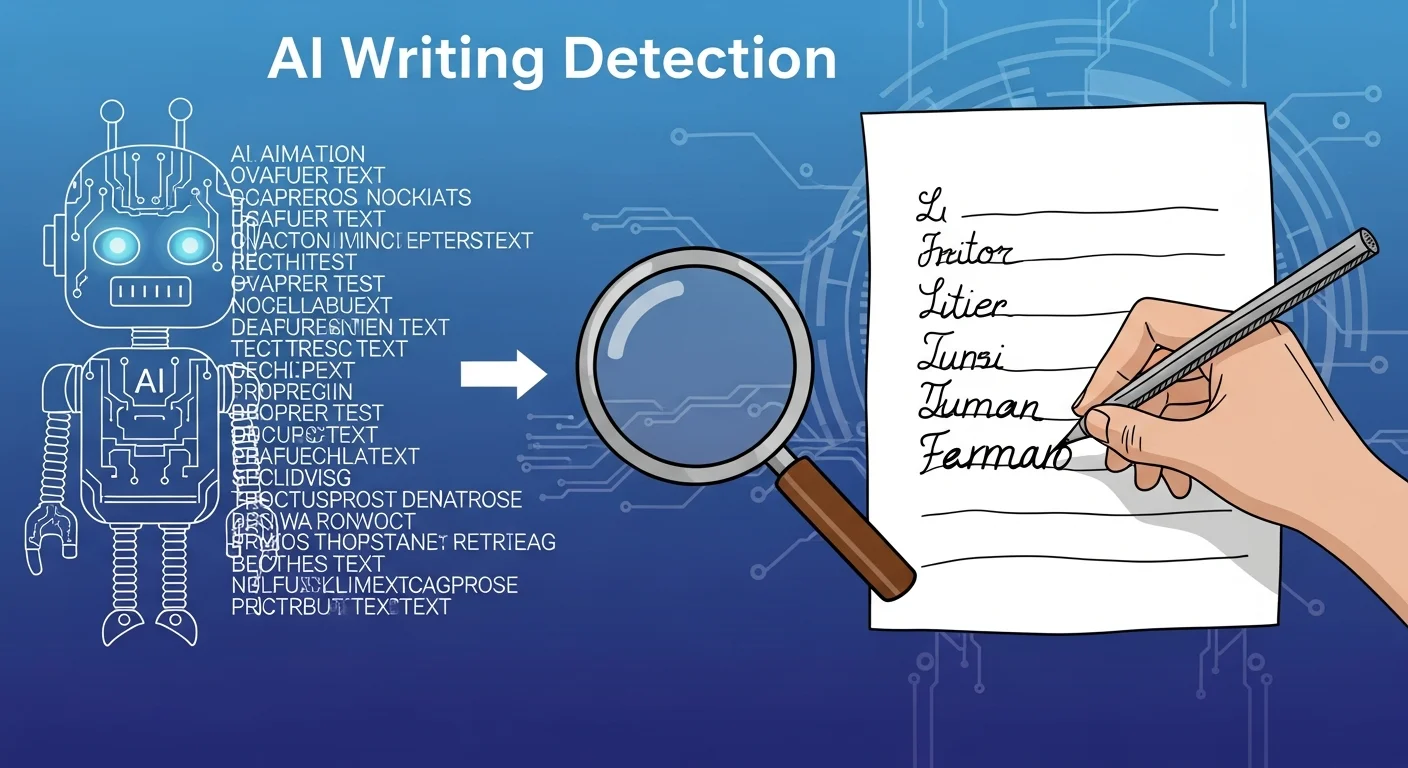
AI writing detection tools analyze text characteristics to determine whether content was generated by AI.
What they look for:
- Text patterns: AI tends to use specific sentence structures
- Word choice: AI frequently uses certain vocabulary
- Writing rhythm: AI sentence lengths and variations tend to be more uniform
- Perplexity: AI text is more predictable
- Burstiness: Human writing has more variation and unpredictability
In simple terms:
AI writing is "too perfect" and "too uniform," while human writing has more variation and unpredictability.
Why Should You Understand AI Detection?
Key reasons:
- Academic requirements: Schools may prohibit AI-generated assignments
- Client expectations: Some clients require original content
- Quality concerns: Content with obvious AI traits may feel lower quality
- SEO worries: Concerns about search engine penalties
But more importantly:
Rather than worrying about detection, focus on producing content that's genuinely valuable.
For more foundational AI writing knowledge, check out our core guide.
AI Writing Detection Tool Reviews
GPTZero
The most well-known AI detection tool.
Key details:
- Creator: Princeton University student Edward Tian; acquired in June 2026 by Superhuman, Grammarly's parent company
- Pricing (official plans as of September 2026): free to get started / Premium $23.99/mo billed monthly (about $12.99/mo billed annually) / Professional $45.99/mo billed monthly (about $24.99/mo billed annually)
- Focus: Designed for education
Features:
- Single article detection
- Batch document analysis
- Source attribution
- Writing reports
Pros and cons:
- ✅ Most commonly used in academia
- ✅ Clean interface
- ❌ Free version is limited
- ❌ False positives still occur
Detection accuracy: ★★★★☆
Originality.AI
A professional-grade detection tool for content creators.
Key details:
- Pricing: From $12.95/mo billed annually (credit-based)
- Focus: Combined plagiarism and AI detection
Features:
- AI content detection
- Plagiarism detection
- Website scanning
- API integration
Pros and cons:
- ✅ High detection accuracy
- ✅ Complete feature set
- ❌ Higher price point
- ❌ Free Basic plan is limited: AI detection only, 3 scans per day, 2,000 words per scan
Detection accuracy: ★★★★★
Copyleaks
An enterprise-grade solution.
Key details:
- Pricing: From $13.99/mo
- Focus: Multilingual support
Features:
- AI content detection
- Plagiarism detection
- Code detection
- LMS integration
Pros and cons:
- ✅ Multilingual support
- ✅ Robust enterprise integrations
- ❌ More complex interface
- ❌ Not cost-effective for light use
Detection accuracy: ★★★★☆
ZeroGPT
The free option.
Key details:
- Pricing: Free tier available, plus paid plans — Pro $13.99/mo ($8.99/mo billed annually), Plus $22.99/mo ($15.49/mo annually) and Max $29.99/mo ($19.99/mo annually), with separate API pricing
- Focus: No registration required on the free tier
Features:
- Basic AI detection
- Real-time analysis
- Free tier caps each scan at roughly 10,000–15,000 characters and shows ads
Pros and cons:
- ✅ Free tier available
- ✅ No registration needed on the free tier
- ❌ Lower accuracy
- ❌ Basic features only
Detection accuracy: ★★★☆☆
Tool Accuracy Comparison
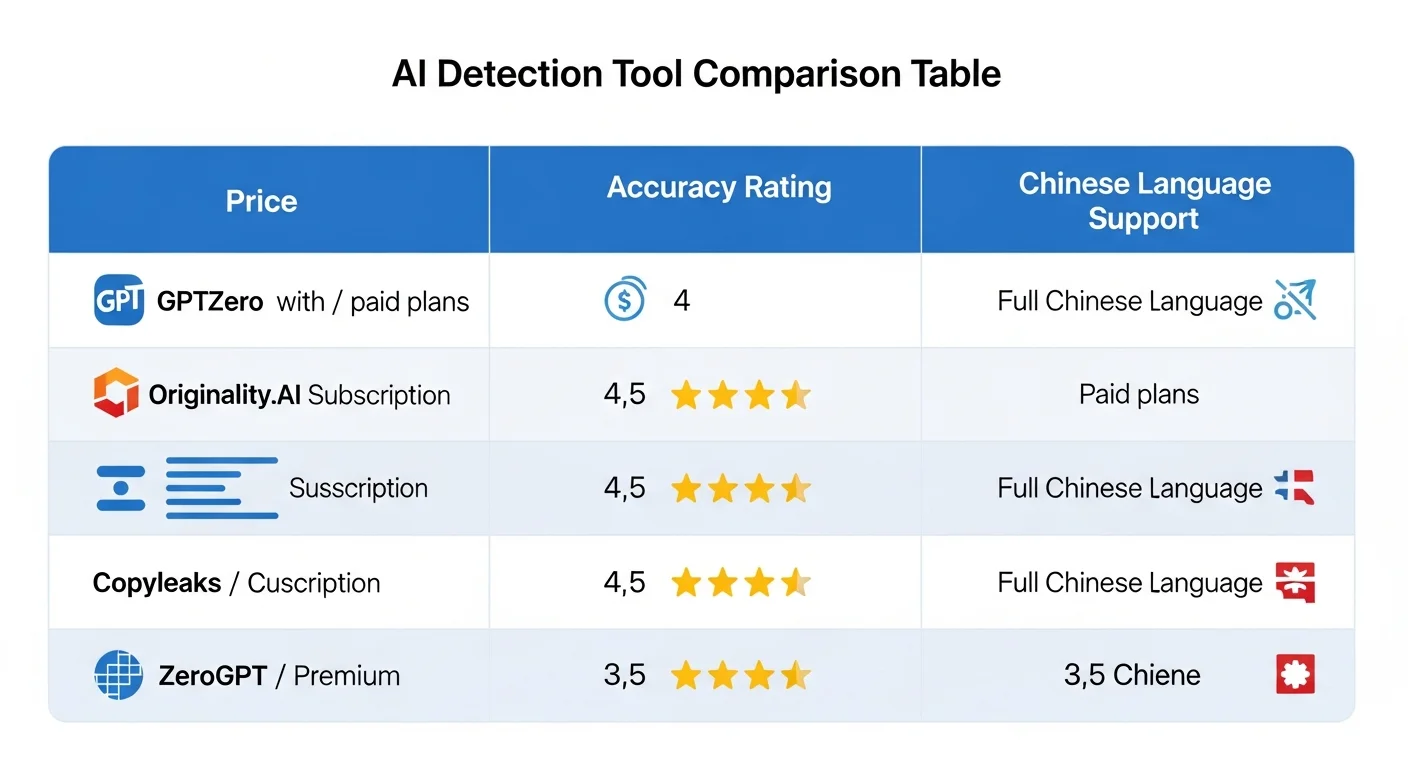
| Tool | Accuracy | Price | Multilingual Support |
|---|---|---|---|
| GPTZero | ★★★★☆ | Free+ | Average |
| Originality.AI | ★★★★★ | From $12.95/mo | Average |
| Copyleaks | ★★★★☆ | From $13.99/mo | Good |
| ZeroGPT | ★★★☆☆ | Free+ | Weak |
| Turnitin | ★★★★☆ | Institutional | Good |
Analyzing Detection Tool Accuracy
Limitations of Detection Tools
No tool is 100% accurate.
Common limitations:
-
False positives on human writing
Formal, academic-style human writing is often misidentified as AI.
-
Missed AI content
AI content that's been manually edited may pass detection.
-
Language bias
Most tools are developed primarily for English; detection of other languages is less reliable.
-
Outdated models
Content from newer AI models may evade older detection tools.
False Positive Rates and Reliability
Research data:
- GPTZero and other detectors all produce false positives, and formal or academic human writing is more likely to be misflagged as AI
- Non-native writers are the bigger risk: a 2023 Stanford HAI study found that English essays (TOEFL) by non-native speakers were flagged as AI 61% of the time on average
- For Originality.AI, the vendor's self-reported accuracy and third-party independent benchmarks differ substantially, and the benchmarks don't agree with each other — treat it as a range under debate, not a fixed number
- Manually edited AI content does see detection rates drop noticeably, but how far depends on the extent of editing, the model used, and the tool version; there is no single publicly citable figure
What this means:
- Detection results should be used as reference, not as absolute truth
- "Flagged as AI" doesn't necessarily mean it is
- "Passed detection" doesn't mean there's no AI involvement
Detection Discrepancies Across Tools
The same article can get different results from different tools.
Every tool is trained on different data and sets its own thresholds, so the same passage may be flagged as AI by one tool and pass cleanly on another. If you're going to rely on a detection score at all, record which tool, which version, and what date it came from.
Conclusion: Detection tools are aids, not definitive judges.
Worried about AI article quality? Let our professional team handle it.
👉 Free consultation on LINE: @006ljkda
How to Make AI Articles More "Human"
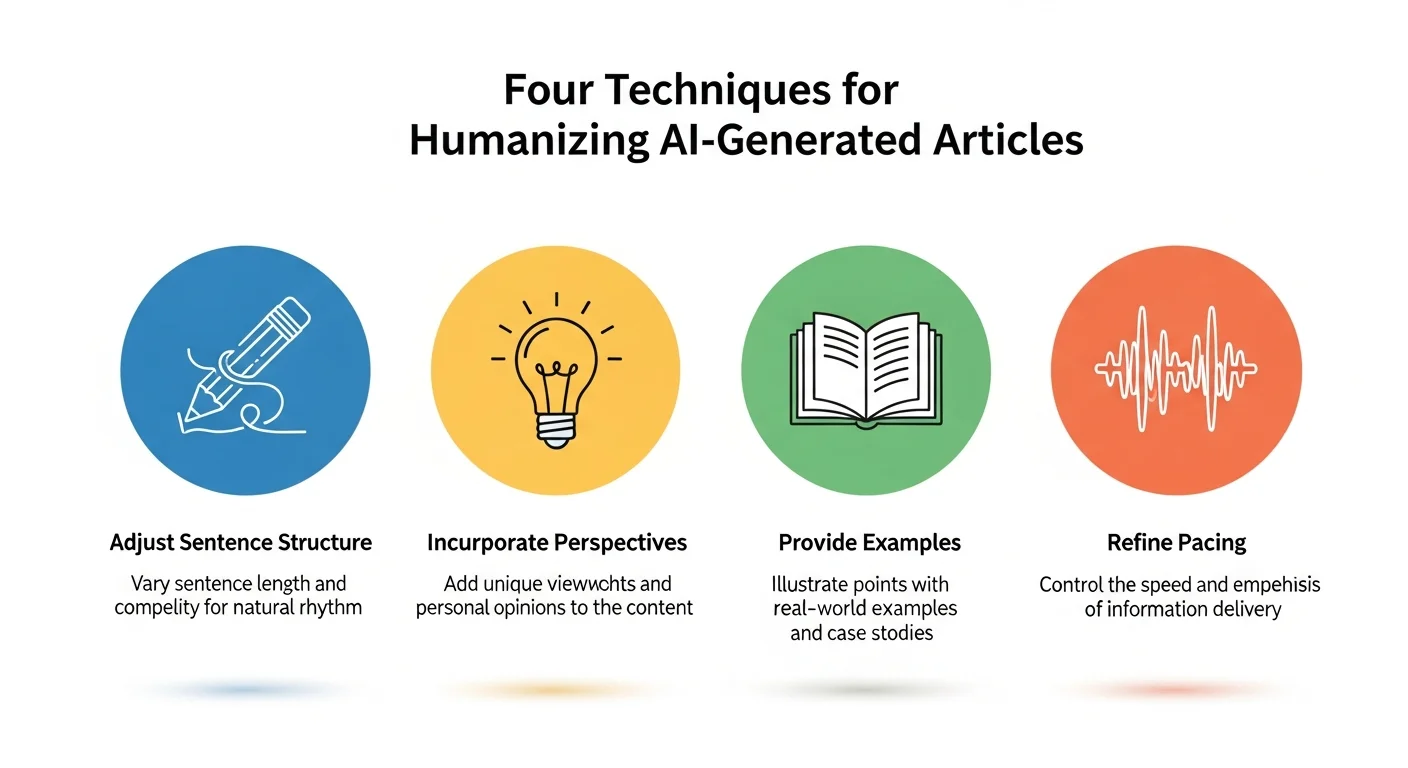
Adjust Sentence Structure and Grammar
Technique 1: Break the pattern
AI articles have very uniform sentence lengths. Deliberately introduce variation with short and long sentences.
Original: "AI can help with writing. AI can improve efficiency. AI can save time."
Rewritten: "AI helps with writing in so many ways — from boosting efficiency to saving time, it's changing how we work."
Technique 2: Use conversational language
AI tends toward formal language. Add colloquial expressions to make text more natural.
Original: "Users should consider this option" Rewritten: "You might want to give this a try"
Technique 3: Add imperfections
Human writing sometimes uses dashes, ellipses, and parenthetical asides.
Example: "Honestly — I've tried this method, and it really works."
Add Personal Opinions and Experiences
This is the most effective humanization technique.
1. Include first-person perspective
"Over the past three years, I've tested at least 20 AI tools..." "In my experience, this approach works best..."
2. Share real stories
"One of our clients once..." "I remember a case from last year..."
3. Take a stance
"Frankly, I think this tool is overrated..." "If you ask me, I'd recommend..."
4. Show emotion
"To be honest, this surprised me..." "These results were genuinely exciting..."
Include Data and Specific Examples
Common AI writing problem: Too vague, lacking specifics.
Solutions:
-
Add concrete data
Original: "Many businesses use AI" Rewritten: "According to [survey name] ([year]), XX% of businesses have adopted AI tools" — always name the publisher and year and link the original source; if you can't find the source, leave the number out
-
Add real case studies
"One of our clients, a traditional manufacturer, saw significant results after adopting AI content..."
-
Add time and place
"At a conference in New York last year..."
-
Add expert quotes
When you quote an expert, say who said it and where, and link the original source (for example, Google Search Central documentation or an official video). "So-and-so has publicly stated..." with no source attached isn't a citation at all.
Adjust Article Rhythm and Tone
1. Vary paragraph length
Don't make every paragraph 3-4 lines. Some can be just one sentence.
Like this.
2. Use questions
"Have you ever wondered why..." "Does this actually work?"
3. Add twists and surprises
"But the truth might not be what you think." "The results were unexpected."
4. Use a conversational voice
"Let me be direct..." "Here's the key point..."
AI Article Humanization: Step-by-Step Process
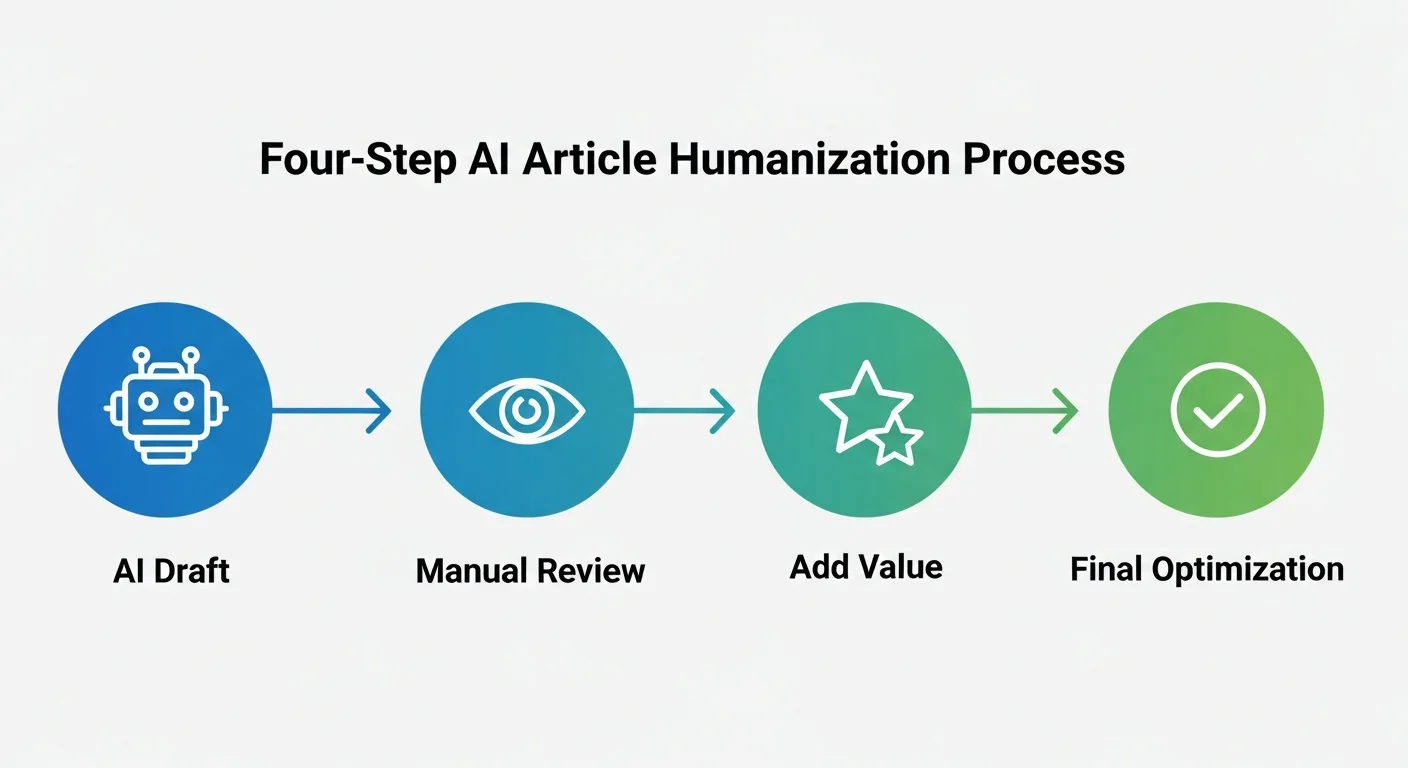
Step 1: Generate an AI Draft
Prompt suggestions:
Write an article about [topic].

Requirements:
- Approximately 2,000 words
- Professional but not stiff tone
- Include practical advice
- Divide into multiple sections

Give me the outline first — I'll confirm before you start writing.
Key points:
- Don't generate the full article at once
- Confirm the outline first
- Generate section by section for better control
Step 2: Manual Review and Editing
Review checklist:
✅ Are the facts correct? ✅ Is there any outdated information? ✅ Does the tone match the brand? ✅ Are there overly vague descriptions? ✅ Is the structure logical?
Editing priorities:
- Correct factual errors
- Adjust tone and wording
- Break up overly uniform sentence patterns
- Remove redundant content
Step 3: Add Unique Value
This is the critical step.
What to add:
-
Your professional insights
"Based on my experience, there's a common misconception here..."
-
Real case studies
"We once helped a client who..."
-
Proprietary data
"Our internal analytics show..."
-
Contrarian viewpoints
"While many people say this, I believe..."
-
Practical advice
"If you're a beginner, I'd recommend starting with..."
Step 4: Final Check and Optimization
Check for:
- Readability: Paragraph lengths, subheadings
- Flow: Read aloud — does it sound natural?
- Logic: Is the argument coherent from start to finish?
- SEO: Are keywords used naturally?
- Value: What does the reader walk away with?
Optional: Use detection tools to verify (but don't obsess over scores)
Google's Official Stance on AI Content

E-E-A-T and AI Content
Google doesn't care whether content is "AI or not" — they care about quality.
E-E-A-T principles:
- Experience: Does the creator have relevant experience?
- Expertise: Does the content demonstrate expertise?
- Authoritativeness: Is the source credible?
- Trustworthiness: Is the information accurate and reliable?
The challenge for AI content:
Pure AI content struggles to demonstrate "Experience" and "Authoritativeness" because AI has no real-world experience.
Solutions:
- Include real author information
- Add personal experiences and case studies
- Cite reliable sources
- Ensure factual accuracy
What Kind of AI Content Gets Penalized?
Google will explicitly penalize:
- Content created purely to manipulate rankings rather than help users
- Mass low-quality content flooding search results
- Misleading or inaccurate information
- Thin content with no value
What won't be penalized:
- AI-assisted content that provides genuine value
- AI content reviewed by professionals
- Content enriched with original perspectives and experience
- Content that genuinely helps users
How to Comply with Google's Quality Guidelines
Core principle: Create for users, not for search engines
Specific actions:
-
Provide real value
Ask yourself: "What will readers learn from this?"
-
Ensure accuracy
Fact-check everything. Don't let AI hallucinations remain in your articles.
-
Demonstrate expertise
Add professional analysis and insights — go beyond surface-level information.
-
Clear authorship
Include clear author information and contact details.
-
Keep content updated
Regularly review content to maintain freshness.
For more on AI article generators, check out our reviews.
AI + human review = quality you can trust.
AI Detection FAQ
Q: Will AI articles always be detected?
A: Not necessarily. (1) Pure AI-generated articles are easier to detect; (2) Content with human editing sees detection rates drop significantly; (3) Detection tools themselves have false positive rates. Focus on content quality, not on passing detection.
Q: Will humanization processing beat detection?
A: It usually helps significantly. Well-humanized content: (1) Shows notably lower detection scores; (2) But still can't guarantee 100% pass rates; (3) The real focus should be whether the content has value, not the detection score.
Q: Should you aim for 100% undetectable?
A: No — and it's not practical. (1) Detection tools aren't accurate enough themselves; (2) Spending too much time "evading detection" puts the cart before the horse; (3) Focus on producing valuable content. If the content is genuinely good, some AI involvement is perfectly fine. For more, see our guide on AI article rewriting techniques.
Why Content Quality Matters More Than Detection Scores
Instead of obsessing over "will it be detected," focus on "is it actually good."
Key takeaways from this article:
- Detection tools have limits: No tool is 100% accurate
- Humanization techniques: Adjust sentence patterns, add perspectives, include case studies
- Practical process: AI draft → Human review → Add value → Final optimization
- Google's stance: They care about content quality, not whether AI was involved
Our recommendations:
- Use AI to boost efficiency, not to replace thinking
- Always add your expertise and experience
- Ensure factual accuracy and reader value
- Don't obsess over detection scores
For more AI writing tips and AIGC trends, check out our other articles.
High-quality AI article service with professional oversight.