"Can AI help me write articles?"
In 2026, the answer is: Yes, and it works remarkably well.
Since ChatGPT took the world by storm, AI writing has evolved from an experimental novelty into a practical productivity tool. Whether it's SEO articles, marketing copy, or social media posts, AI can help you produce content quickly.
But AI writing isn't as simple as "type a topic and press a button." To produce high-quality AI articles, you need to understand the tools, master the techniques, and establish a review process.
This is the definitive guide to AI writing — from foundational concepts to real-world applications, covering everything you need to know about this technology that's reshaping the content industry.
What Is AI Writing?
Definition and Evolution
AI writing is the use of artificial intelligence technology to assist in or generate written content.
Evolution timeline:
- 2015-2019: Basic text generation with limited quality
- 2020-2022: GPT-3 brought breakthroughs, but the "AI feel" was still obvious
- 2023: ChatGPT exploded into the mainstream
- 2024-2026: GPT-5.x and GPT-6, Claude Opus 5.x, Gemini 3.x, and other models approach human-level quality
Today's AI can:
- Produce grammatically correct, logically coherent articles
- Adjust tone and style based on instructions
- Handle virtually any type of writing task
How Generative AI Has Changed Writing
Traditional writing workflow:
Idea → Research → Outline → Draft → Edit → Publish
AI-assisted writing workflow:
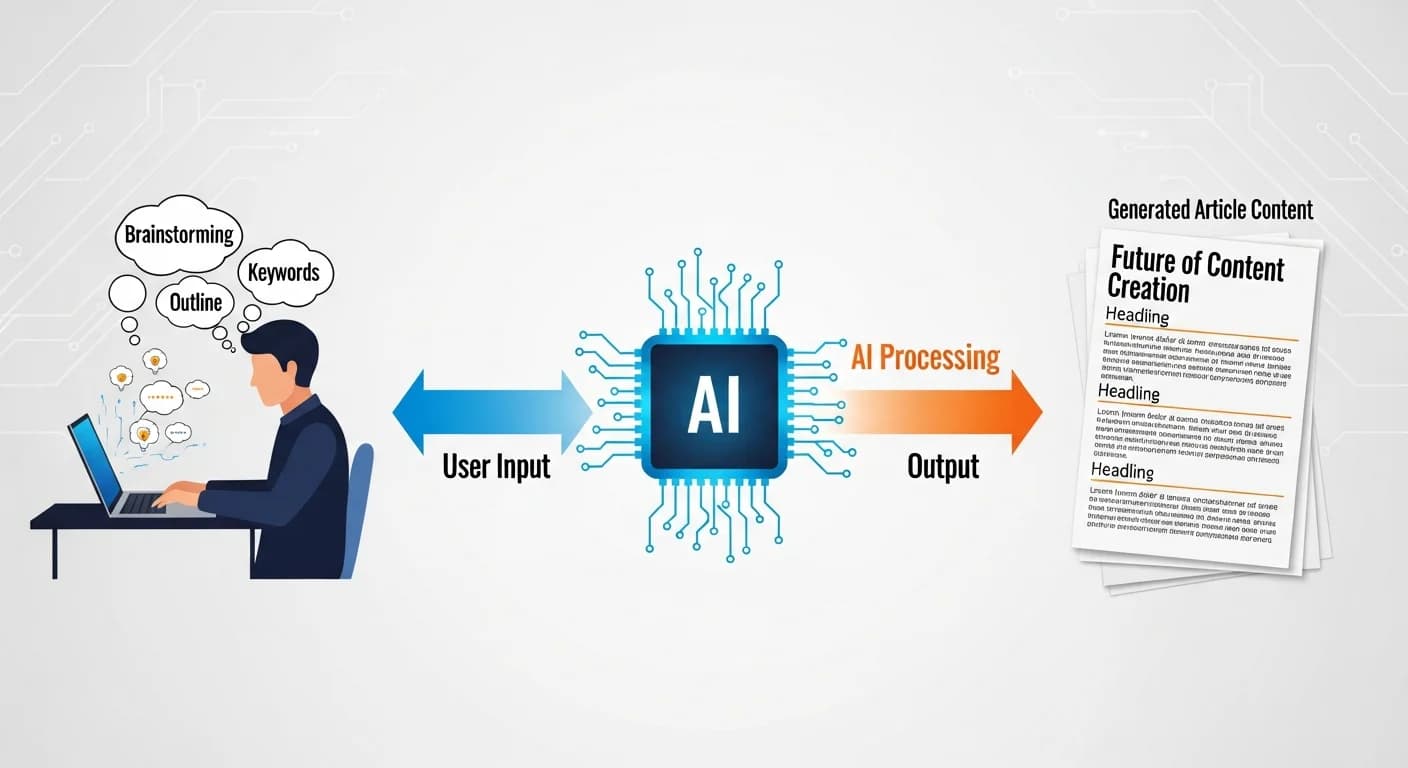
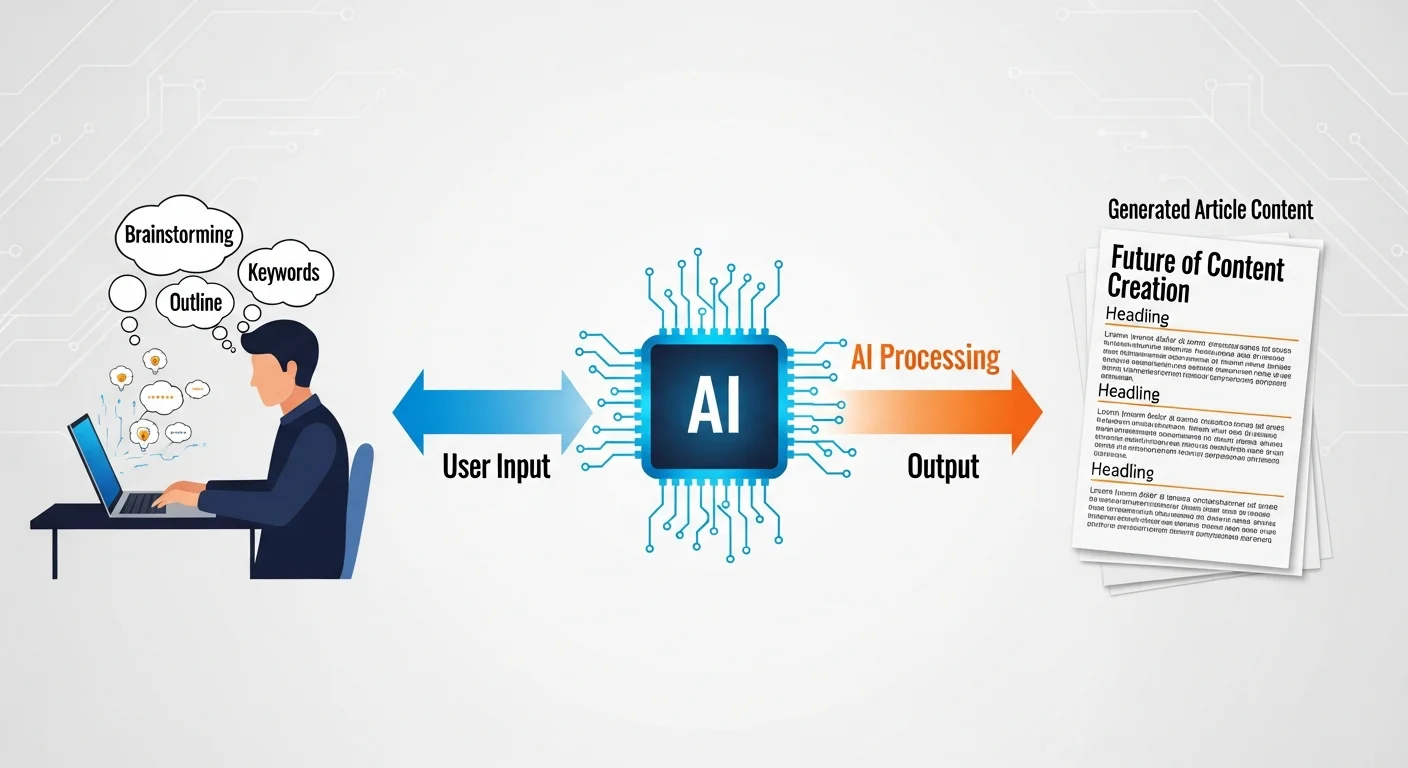
Idea → Give AI instructions → AI generates draft → Human review and editing → Publish
Key changes:
- Efficiency gains: Drafting a 3,000-word article takes noticeably less time
- Lower barriers: People who aren't natural writers can still produce content
- Scalable output: Multiple writing tasks can be handled simultaneously
To learn more about generative AI, check out our beginner's guide.
AI Writing vs. Traditional Writing
| Aspect | Traditional Writing | AI Writing |
|---|---|---|
| Time | Longer | Shorter |
| Originality | Fully original | Based on training data |
| Personal style | Distinctive | Requires adjustment |
| Accuracy | Author-verified | Needs verification |
| Cost | High labor costs | Low tool costs |
| Scalability | Limited by labor | Easily scalable |
Key insight:
AI writing isn't about "replacing humans" — it's about "human-AI collaboration."
The best results come from:
- AI handling rapid draft production
- Humans handling creativity, judgment, and quality assurance
The Technology Behind Generative AI

To use AI writing tools effectively, it helps to understand how they work.
Introduction to Large Language Models (LLMs)
What is an LLM?
Large Language Models are the core technology powering AI writing.
How they work (simplified):
- Training: The model trains on billions of articles from the internet
- Learning: It learns to "predict the next word based on preceding text"
- Generation: Given a starting point, it continues writing
An analogy:
An LLM is like a super-reader who has read every book ever written. When you ask it a question, it generates the most reasonable answer based on "everything it has read."
Limitations:
- It doesn't truly "understand" — it "predicts"
- Training data has a cutoff date, so it doesn't know the latest information
- It can produce content that "sounds right but is actually wrong"
Differences Between ChatGPT, Claude, and Gemini
The major AI writing models available today:
ChatGPT (OpenAI)
- Most widely used AI conversational tool
- The current lineup is GPT-5.x plus the GPT-6 family launched in September 2026 (the GPT-4 generation was phased out of ChatGPT during 2026)
- Richest ecosystem
- Free version is quite capable
Claude (Anthropic)
- Excels at long-form content
- 1M token ultra-long context window (Claude Opus 5.5 and other current flagship models)
- Strong analytical and reasoning abilities
- Greater emphasis on safety and accuracy
Gemini (Google)
- Best Google integration
- Can access up-to-date information
- Strong multimodal capabilities
- Free version has more limitations
Choosing the right one:
- General use: ChatGPT free version
- Long-form needs: Claude
- Need latest information: Gemini
What Is AIGC (AI-Generated Content)?
AIGC = AI-Generated Content
This term encompasses all content produced by AI, including:
- Text (articles, copy, conversations)
- Images (Midjourney, GPT Image)
- Video (AI video generation tools)
- Audio (voiceovers, music)
In the writing domain, AIGC primarily refers to AI-generated text content.
For more on AIGC trends and business applications, check out our feature article.
Want to use AI to write articles that rank? We can help.
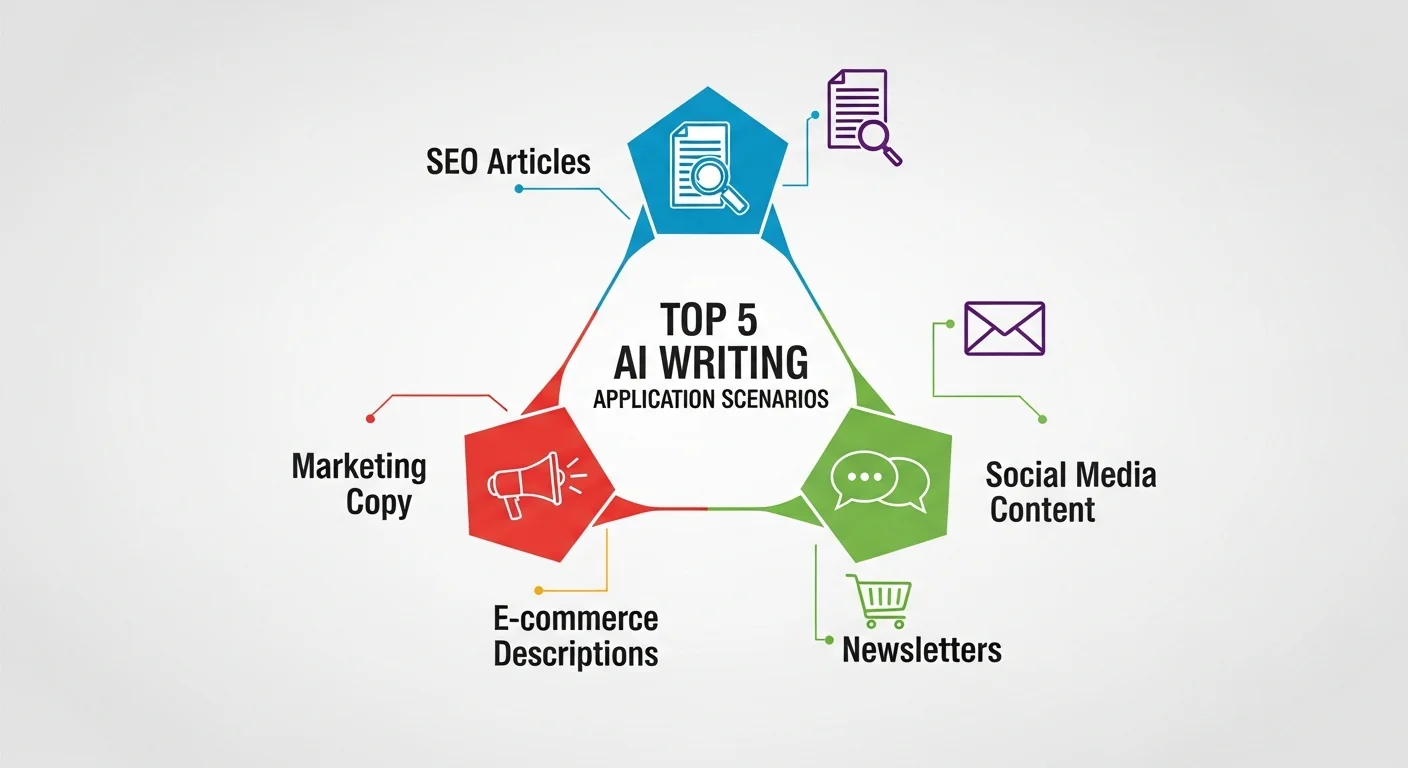
5 Key AI Writing Applications
Where can AI writing be applied? Here are the most common use cases.
SEO Article Writing
Applications:
- Generate article outlines based on keywords
- Write SEO-optimized content
- Create Meta Descriptions
- Rapidly produce long-tail keyword articles at scale
Results:
- Noticeably higher production efficiency
- Coverage of more long-tail keywords
- Lower content production costs
Important notes:
- Human review is essential for quality
- Add professional insights and original perspectives
- Fact-checking is a must
For more SEO article writing techniques, check out our tutorial.
Marketing Copy Generation
Applications:
- Ad copy (Facebook, Google)
- Product feature descriptions
- Landing page content
- Email marketing copy
Results:
- Quickly produce multiple versions for A/B testing
- Break through writer's block
- Save time on creative ideation
For AI copywriting tool applications, check out our tutorial.
Social Media Content
Applications:
- Facebook, Instagram posts
- LinkedIn business content
- X (formerly Twitter) posts
- Social media engagement replies
Results:
- Maintain consistent posting frequency
- Rapidly produce creative content
- Adapt content across multiple platforms
Product Descriptions and E-Commerce Content
Applications:
- Product description text
- Specification details
- Feature introductions
- Comparison page content
Results:
- Complete large volumes of product descriptions quickly
- Consistent brand voice
- Reduced labor costs
Newsletters and Blog Posts
Applications:
- Newsletter content
- Blog articles
- Industry analysis
- Educational content
Results:
- Maintain steady content output
- Quickly respond to trending topics
- Expand content coverage
AI Writing Tools Overview
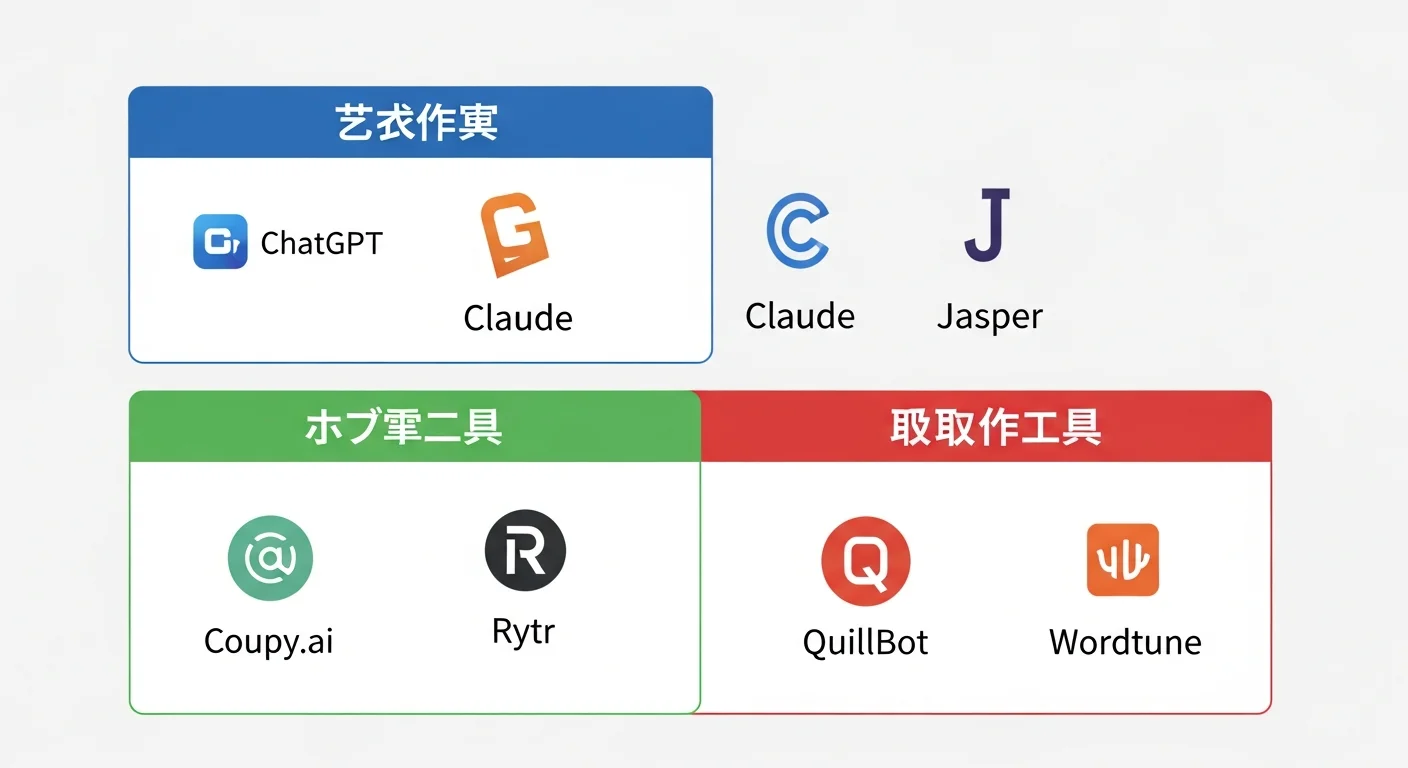
An overview of the major AI writing tools on the market.
AI Article Generators
ChatGPT
- Most widely used
- Free / Plus from $20/mo (higher tiers also available — check the official site)
- Excellent multilingual quality
Claude
- Excels at long-form content
- Free / Pro $20/mo
- Strong analytical capabilities
Jasper
- Designed for marketing
- Pro from $59/mo billed annually ($69/mo monthly)
- Rich template library
For more AI article generator reviews, check out our complete comparison.
AI Copy Generators
Copy.ai
- Now positioned as a GTM (go-to-market) AI platform; copywriting is just one of its use cases
- No permanent free tier (Chat plan from $29/mo)
Rytr
- Affordable pricing
- Multilingual support
- Simple to use
Writesonic
- SEO features included
- Can access latest data
- Mid-range pricing
AI Article Rewriting Tools
QuillBot
- Professional rewriting tool
- Multiple rewriting modes
- Grammar check included
Wordtune
- Sentence rewriting
- Tone adjustment
- Browser extension
For more AI article rewriting tips, check out our tutorial.
Free vs. Paid Tools Comparison
| Aspect | Free Tools | Paid Tools |
|---|---|---|
| Usage limits | Restricted | Higher or unlimited |
| Features | Basic | Complete |
| Model | Older | Latest |
| Quality | Adequate | Better |
| Support | Community | Dedicated |
Recommendations:
- Start with free versions to learn the tools
- Only consider paying after you've identified your needs
- Monthly subscriptions are only worth it with high output volume
How to Write High-Quality AI Articles
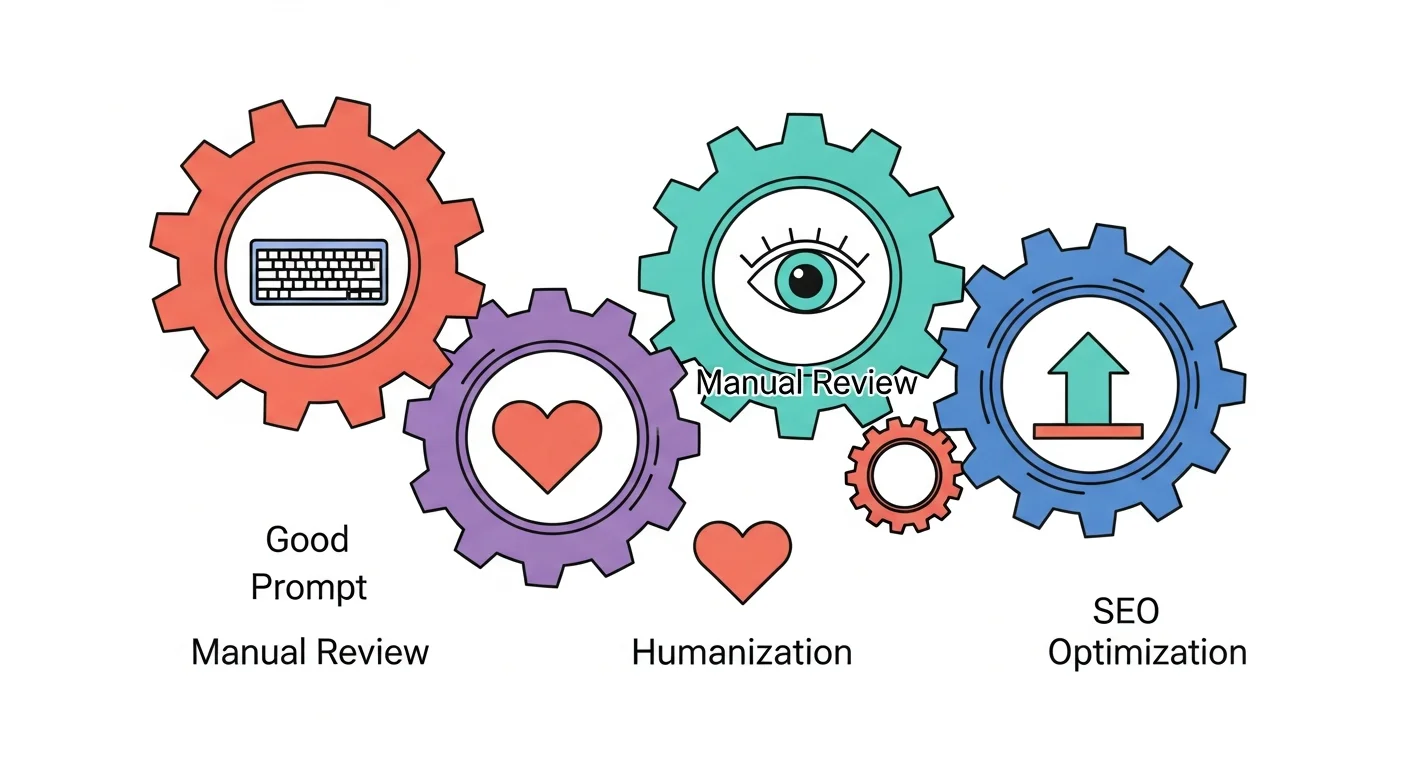
AI tools are just the starting point — producing great articles still requires skill.
Prompt Writing Tips
A prompt is the instruction you give AI, and it determines output quality.
Elements of a good prompt:
- Role assignment: "You are a professional SEO article writer"
- Task description: "Write an article about XX"
- Format requirements: "Use H2/H3 structure, each paragraph under 150 words"
- Audience description: "Target readers are SEO beginners"
- Tone specification: "Professional but accessible tone"
Example prompt:
You are a professional SEO content expert.

Write a tutorial article about "keyword research."

Requirements:
- Approximately 2,500 words
- Target readers are SEO beginners
- Write in natural, professional English
- Include practical step-by-step instructions
- Approachable and easy-to-understand tone
- Use H2 and H3 heading structure

Please begin writing.
Human Review Process for AI Articles
After AI generates content, here's what humans must do:
Step 1: Fact-checking
- Confirm data and information accuracy
- Verify cited sources
- Update outdated information
Step 2: Add professional content
- Include personal experiences and case studies
- Add unique perspectives
- Incorporate practical advice
Step 3: Optimize readability
- Adjust paragraph lengths
- Improve transitions
- Refine headings
Step 4: SEO optimization
- Confirm keyword placement
- Optimize Meta Description
- Add internal links
Making AI Articles More "Human"
The problem: AI articles can be too "polished" and "perfect," lacking personality.
Solutions:
1. Add personal experience
- Share situations you've actually encountered
- Include your personal perspective
2. Use conversational language
- Don't be overly formal
- Add a conversational feel
3. Show emotion and attitude
- Express your opinions
- Don't be too neutral
4. Create "imperfection"
- Vary sentence lengths
- Include unexpected topic shifts
For more on AI writing humanization techniques, check out our feature article.
AI articles + human optimization = guaranteed quality.
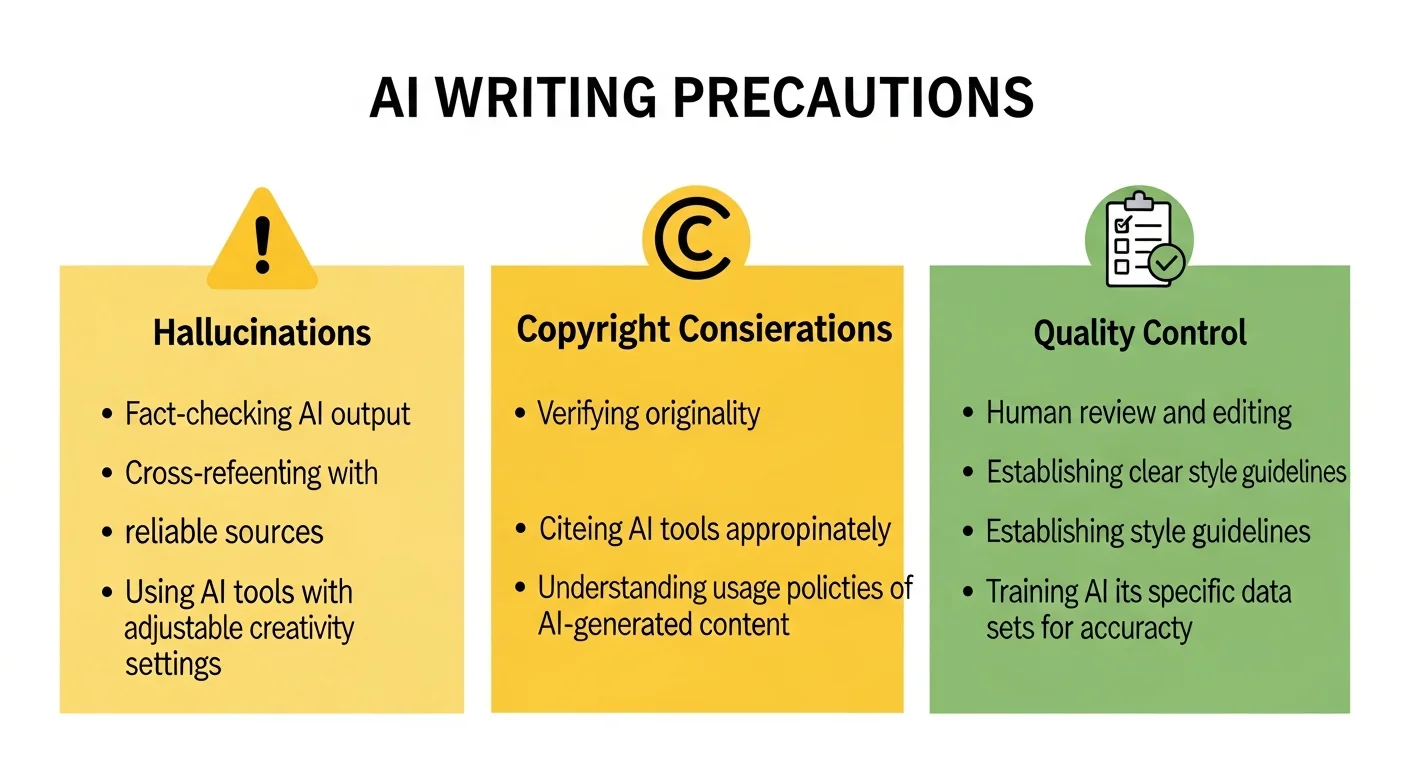
Important Considerations for AI Writing
Risks and considerations to keep in mind when using AI writing.
AI Content Accuracy Issues
AI "hallucinations"
This is one of AI's biggest problems: it can produce content that "sounds correct but is actually wrong."
Common issues:
- Fabricating non-existent data
- Citing incorrect sources
- Stating outdated information
- Confusing similar concepts
Solutions:
- Fact-checking is mandatory
- Pay special attention to data and citations
- Always verify sensitive content
Google's Policy on AI Content
Google's official position:
In 2023, Google explicitly stated:
"We reward high-quality content, however it is produced."
What this means:
- AI content itself won't be penalized
- The focus is on content quality, not its source
- Mass low-quality AI content will be problematic
E-E-A-T remains important:
- Experience
- Expertise
- Authoritativeness
- Trustworthiness
AI can help you write, but you need to ensure the content meets these standards.
Copyright and Originality Considerations
Copyright issues:
- AI-generated content typically belongs to the user
- But terms vary by tool — always check
- Verify licensing terms before commercial use
Originality issues:
- AI generates based on training data, so output may resemble other content
- Consider using plagiarism detection tools
- Add original perspectives to increase uniqueness
AI Writing FAQ
Q: Can Google detect AI-written articles?
A: Google hasn't publicly stated that it detects AI content. They focus on content quality, not content source. High-quality AI articles (with human review and optimization) won't have ranking issues.
Q: Will AI writing replace human writers?
A: Not in the short term. AI excels at efficiency and scale, while humans excel at creativity, judgment, and professional insight. The future trend is "human-AI collaboration," not "AI replacing humans."
Q: Is using AI for writing legal?
A: Yes. There are currently no laws prohibiting AI writing. However, be aware of specific context requirements — for example, academic papers may have integrity requirements. Commercial use is generally fine.
Q: Do AI articles need human editing?
A: Strongly recommended. AI-generated first drafts need: (1) Fact-checking; (2) Professional insights; (3) Readability optimization; (4) SEO adjustments. Publishing unedited content carries higher risk.
Q: Which AI tool is best for writing?
A: ChatGPT and Claude both produce excellent output. ChatGPT has the largest user base and richest ecosystem; Claude excels at long-form content and analysis. Try both and choose what feels right.
How to Leverage AI Writing to Boost Content Production
AI writing represents a new era of content creation — using it wisely can dramatically improve efficiency.
Key takeaways from this article:
- AI writing fundamentals: Based on large language models that predict the most appropriate text output
- Top tools: ChatGPT, Claude, Jasper — each with unique strengths
- 5 key applications: SEO articles, marketing copy, social media content, e-commerce descriptions, newsletters
- Quality formula: Good prompts + human review = high-quality content
- Key considerations: Fact-checking, E-E-A-T, copyright awareness
Our recommendations:
- Start experimenting with free tools
- Learn to write effective prompts
- Establish a human review process
- Continuously optimize and adjust
AI is a tool, not magic. Used correctly, it multiplies your productivity. Used poorly, it can backfire.
More AI writing resources:
Professional AI article service — free consultation on LINE.