You assume that when someone searches "dehumidifier recommendations," AI takes those two words and goes looking.
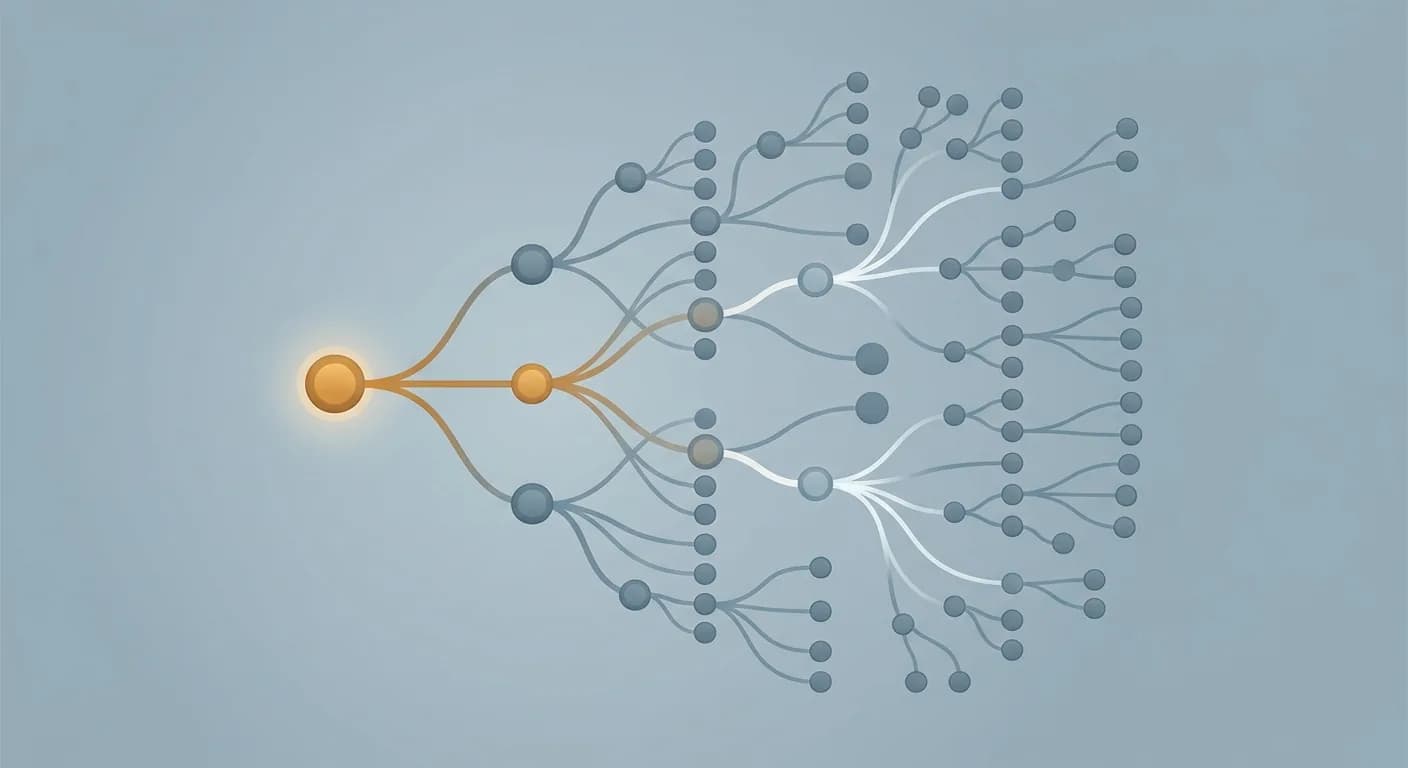
It does not. AI first expands the question into a set of sub-questions the user never typed — how do I size capacity, which brands are efficient, how many litres for a small apartment, how does this differ from an air purifier — retrieves for each separately, then assembles the results into one answer.
The mechanism is called query fan-out, and it is not industry jargon. It is the term Google uses in its own documentation.
Understand it and you will see why "ranking on page one" and "being cited by AI" are different achievements.
💡 Want to know which sub-questions your content misses? We will audit the gaps. 👉 Free consultation on LINE
Key takeaway: Query fan-out is Google's own term for how AI features work — they "display a wider and more diverse set of helpful links" than classic search because a query fan-out technique explores multiple subtopic sources. Moz tested 50,000 fan-outs and found two expansion types accounted for 97% of brand mentions. Coverage needs both breadth and alignment.
How the Mechanism Works
Google is fairly direct about this in its documentation on AI features and your website:
AI features "display a wider and more diverse set of helpful links" than classic web search, using a query fan-out technique that explores multiple subtopic sources.
Three steps:
- Expand: generate multiple related sub-queries from the user's single question
- Retrieve separately: each sub-query runs through the normal ranking systems to find sources
- Assemble: combine what was found into one answer, with sources listed
Step two is the key. Each sub-query is retrieved independently — so your page does not need to rank first for the original question. If it is judged a good source for any one sub-question, it can enter the answer.
That is good news and bad news:
- Good: you do not have to beat the huge generalist pages to be cited
- Bad: if your content only answers the headline question and never touches the sub-questions, you appear nowhere in the entire expansion
Moz's 50,000-Fan-Out Study
Moz published a large-scale query fan-out study on 6 August 2026, with a clearly stated method:
| Item | Detail |
|---|---|
| Sample | 50,000 fan-out prompts |
| Generation | Produced via the Gemini API |
| Coverage | 20 industry verticals × 1,000 subtopics, 50 prompts per subtopic |
| Measure | Cosine similarity between sub-question and topic (alignment score) |
| Mean alignment | 0.67 |
The headline finding:
Two fan-out types accounted for 97% of all brand mentions.
In other words, AI does not expand questions evenly — expansion concentrates heavily in a small number of patterns. Moz reads the 0.67 mean alignment as "a good balance between relevance and diversity": the sub-questions neither drift off-topic nor cluster on a single angle.
What this means for you: rather than trying to cover every possible sub-question (impossible, and unnecessary), work out which expansion patterns dominate in your topic and concentrate there.
This Explains Three Things You May Have Noticed
1. You do not rank well, yet AI cites you
Because you are a good source for one sub-question. Your ranking on the original query is not directly involved.
2. You rank first, and AI ignores you
Your page was probably written for the headline question — thorough, well-built, and never directly answering those sub-questions. At every retrieval in the expansion, you were not the most suitable passage.
3. A competitor's shorter content keeps getting cited
Length is not the point. Their content is structurally easier to extract usable passages from — question stated, answer in the next sentence, rather than three paragraphs of build-up.
How to Audit Your Own Coverage Gaps
You can do this yourself. No tooling required.
Step 1: pick the headline question you care most about
Use the words a customer would actually use — "should a mid-sized company invest in GEO," say.
Step 2: expand it into sub-questions
Two methods; do both.
A. List them yourself. Take the reader's position: what else were they wondering before asking this? What will they ask next? You will usually get 10-20.
B. Have AI expand it. Ask a model to list the related sub-questions someone might want answered alongside this one. That is literally simulating step one of fan-out.
Step 3: check against your existing content
Go through the list and ask, for each:
- Is there a passage on my site that directly answers this?
- Is it a direct answer, or does the reader have to infer it from a long section?
Step 4: find the high-frequency gaps
Do not try to fill everything. Take the sub-questions that appear in both your own list and the AI expansion — those are usually the dominant patterns. Fill those first.
Filling a gap does not always mean a new article. Often, adding a subsection to an existing piece and putting the answer at the top of the paragraph is enough.
How to Write So Passages Can Be Extracted
Reasoning backwards from the mechanism, three practical rules:
1. One subheading answers one question. Splitting "how to choose a dehumidifier" into "how to calculate capacity," "what determines efficiency," and "how many litres for a small apartment" beats one long section.
2. Put the answer at the start of the paragraph. Heading asks, next sentence answers, then explain. Do not open with three paragraphs of background.
3. Use the reader's phrasing in subheadings, not keyword strings. Fan-out expands into "how a person would ask," not keyword combinations.
FAQ
Is query fan-out Google's official terminology?
Yes. Google uses the term directly in its documentation on AI features and your website, describing how AI features explore multiple subtopic sources via a query fan-out technique.
Do I need a separate article for each sub-question?
No, and usually you should not. In most cases, adding a subsection to an existing article and front-loading the answer is sufficient. Producing many thin articles risks the "scale without value" problem instead.
What does Moz's 97% actually mean?
Across the study's 50,000 fan-outs, brand mentions concentrated in two expansion types, which together accounted for 97%. It shows fan-out is not evenly distributed but follows clear dominant patterns.
Is a 0.67 alignment score high or low?
Moz reads it as a good balance between relevance and diversity — the expanded sub-questions neither drift off-topic nor repeat the same angle. The number has no absolute good or bad; what matters is that it shows fan-out has structure rather than being random.
Is this the same as traditional keyword research?
No. Keyword research finds what people type. Fan-out auditing maps what people want to know next, once they have asked. One is input; the other is the expansion of intent.
Conclusion: From Winning a Ranking to Covering a Field of Questions
The real significance of query fan-out is that it moves the SEO goal from "rank first for a term" to "have a usable passage across a whole field of related questions."
That is genuinely good news for smaller sites — you do not need to beat large publishers on the most competitive head term. You need to be a good answer to enough sub-questions.
The next step is simple: pick the question you care most about, expand it, and check honestly against what you already have. The gaps are usually more obvious than you expect.
💡 Want a fan-out coverage audit for your topic? We will map what is missing. 👉 Contact AI SEO Hacker
Further Reading
- How to Measure GEO Performance: AI Search Visibility Metrics
- AI Recommends Your Brand, Then Cites Someone Else
- How to Get Cited by AI in the Zero-Click Era
- Content Chunking for AI
- The Complete Guide to Keyword Research
![Is Cheap GEO Worth It? Risks of Paid AI Posting [2026]](/_next/image?url=%2Fblog%2Fimages%2Fgeo%2Fcheap-geo-posting-risk-01.webp&w=3840&q=75)