

"How do I even bring up next year's marketing budget with my boss?"
If you run marketing at a company, that question probably comes up every year around this time. It used to be simple -- so much for Facebook ads, so much for Google ads, so much for hiring a writer. One channel, one line item. But now customers increasingly find their answers right inside ChatGPT or Google's AI overviews, and that old ledger stops adding up.
This article does something practical: it takes a fresh budget framework from abroad and translates it into a version that small and mid-sized businesses in Taiwan can actually use.
Still stuck on next year's marketing direction? Get a free consultation on LINE and let us take a look at where you should start.
Why Do 2027 Marketing Budget Categories Need Rebuilding?
On July 21, 2026, Search Engine Journal published an article by Greg Jarboe, co-founder of SEO-PR, arguing that the old "PESO" channel classification (paid, earned, shared, owned media) is no longer enough, and that 2027 budgets should switch to five new line items organized by the work involved. To be clear up front: this is one person's viewpoint, which he named DIRHAM 2.0. It is not an industry consensus, and certainly not an official Google standard.
So why is it worth reading? Because the pain point behind it is real.
We used to budget by channel. One box for Facebook, one for Google ads, one for SEO. That logic assumes customers walk in along a specific channel, so you just have to bet on the right one.
But when we actually help small and mid-sized businesses in Taiwan review their budgets, we see that assumption loosening. Owners keep asking, "Why is our website traffic down, but inquiries haven't dropped?" The answer is often this: customers got their answer inside AI search and never clicked through to your site. A budget built around channels simply can't capture that invisible stretch.
Jarboe's framework cuts it differently: not by channel, but by the work to be done. That's why he rebuilds the categories rather than just adding one "AI budget" row to the old table. In his view, cramming an AI box into the old classification only scatters the money.
This is a viewpoint, not a verdict. You don't have to adopt all of it, but it works well as a way to check whether this year's budget missed any of these five kinds of work.
The Five New Line Items: Breaking Down the SEJ Framework
The five new line items Jarboe proposes in this SEJ article each correspond to a type of work that has become important in the AI search era, yet often has no dedicated budget. Here is each one, with the article's own definition for reference.
 Caption: The five new line items -- (1) AI visibility & citation management, (2) trust verification, (3) distribution engineering, (4) human judgment & editorial oversight, (5) measurement rebuild.
Line Item One: AI Visibility and Citation Management
This one replaces part of traditional SEO work. The focus shifts from "what rank does the page hold" to "does your brand get cited in AI-generated answers."
You used to care about page one of the search results. Now you care more about whether ChatGPT or Google's AI overview mentions you when answering a relevant question. Jarboe suggests tracking this with a metric like Citation Share of Voice.
For a small business, in plain terms: this money is spent so AI "remembers you and mentions you."
Line Item Two: Trust Verification
This budget goes toward structuring your brand's facts, credentials, and reviews so AI models can verify them.
Why does it matter? Because AI easily gets your information wrong, and consumer trust in AI answers is still forming. According to a supporting figure cited in this SEJ article, only about 28% of Americans currently trust AI search results. Your job is to lay out the correct information in a structured way, so models can find it and verify it.
Ask yourself: if AI states your business hours or services incorrectly, will customers blame AI, or blame you?
Line Item Three: Distribution Engineering
The correct name for this line item is "distribution engineering," not "channel engineering." The article defines it as: content built once and pushed through owned, earned, and AI-crawled surfaces at the same time, instead of being funded channel by channel.
This is also the core of Jarboe's DIRHAM 2.0 framework -- one piece of content, produced once, surfaced in many places.
Most people talking about AI marketing fixate on "how to produce content," yet few calculate the cost of "how one piece of content surfaces in many places." Distribution engineering handles exactly that overlooked work. For cash-strapped small companies, this is actually the money-saver: instead of making five pieces of content for five channels, make one piece and place it across five surfaces.
 Caption: Distribution engineering -- one piece of content built once, pushed simultaneously to owned, earned, and AI-crawled surfaces.
Line Item Four: Human Judgment and Editorial Oversight
This one deliberately keeps "people" in the budget. It funds a team of trained editors and strategists to catch the errors and blind spots AI misses.
AI produces fast, but it won't judge for you whether "saying this out loud could cause a problem." That gatekeeping role needs a budget behind it. Citing Gartner data, Jarboe notes that labor's mean share of marketing budgets has already risen from 21.9% to 24.5% this year -- in his framework that number is a reminder not to cut people to the bone, not a target for you to copy.
Line Item Five: Measurement Rebuild
The last item replaces old last-click attribution with new measurement that can capture the AI journey.
Here's the classic problem: a customer asks ChatGPT three rounds of questions, forms an opinion, then searches your brand name directly. The final click gets logged under "brand search," and all the earlier credit vanishes. Measurement rebuild aims to recover that stretch. The directions Jarboe names include AMEC's GEO Principles and the Citation Share of Voice metric mentioned earlier.
Honestly, this is the hardest item to put into practice, because the tools are still maturing. That's what the "limitations" section below gets into.
Translating It for Taiwan's Small Businesses: How to Build the Budget Table
Handing the five line items directly to a Taiwan small business doesn't quite fit, because the framework assumes you have a full marketing team. In practice, the job is to compress it into "one table your boss understands": how much each item costs in rough magnitude, who owns it, and what it produces.
The example below assumes a small company with a monthly marketing budget of around NT$50,000. This is our recommended allocation -- not a market rate, and unrelated to our own service pricing. Adjust it to your own situation.
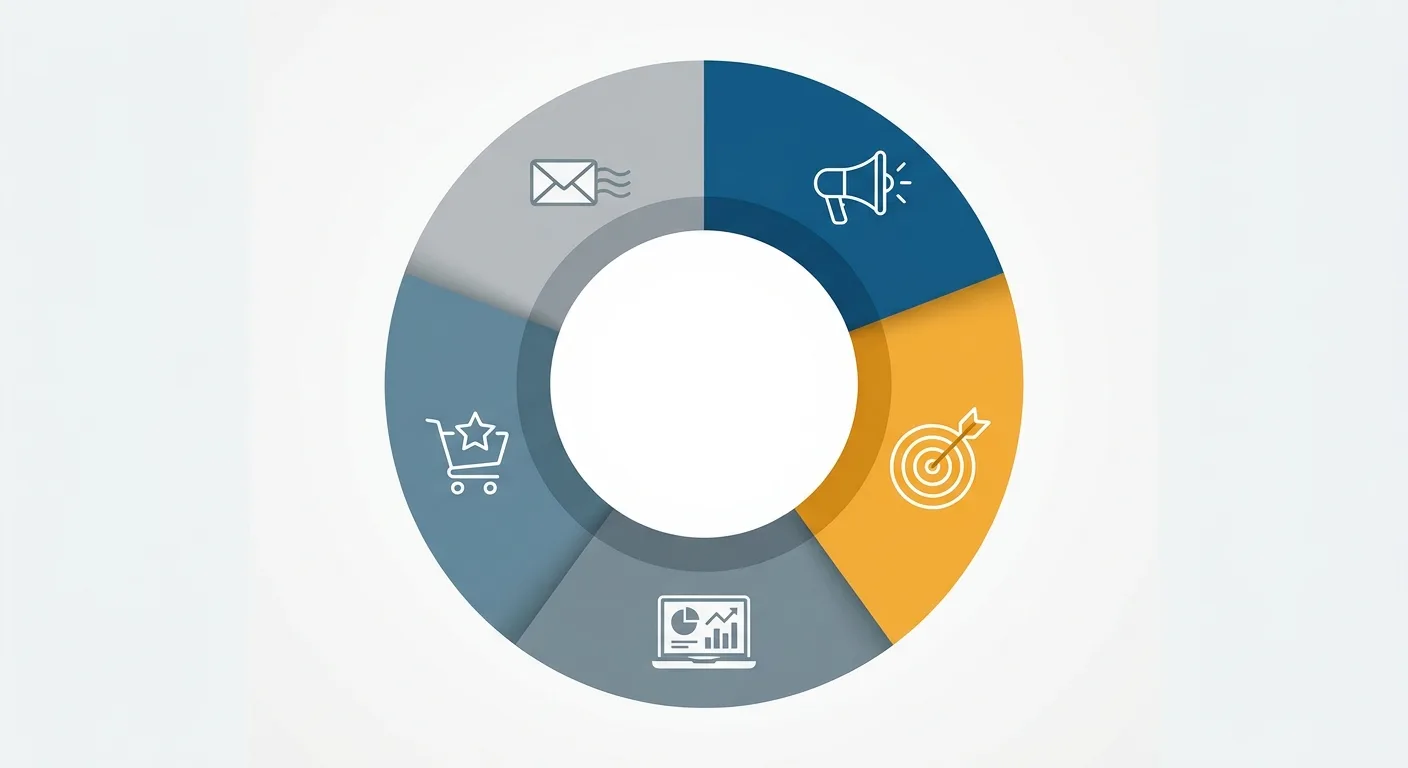 Caption: A reference allocation for small businesses -- AI visibility 30%, trust verification 20%, distribution engineering 25%, human oversight 15%, measurement 10%.
| New Line Item | Suggested Share | What This Money Does | Who Owns It |
|---|---|---|---|
| AI visibility & citation management | ~30% | Get AI answers to mention you; track whether you're cited | Marketing/content lead |
| Trust verification | ~20% | Organize correct info, add structured data, manage reviews | Marketing + owner (fact check) |
| Distribution engineering | ~25% | Push one piece of content to your site, social, and AI-crawled surfaces | Content lead |
| Human judgment & editorial oversight | ~15% | Fact and tone review before publishing | Senior colleague / outside advisor |
| Measurement rebuild | ~10% | Build new performance tracking | Marketing + tools |
The way to use this table is to let you explain, item by item, why each cost exists when you talk to your boss. It isn't about splitting strictly by percentage. It's a reminder that every type of work should map to a person and a line of budget.
When we help clients put this into practice, we usually start with the free Google Search Console to look at "impressions" -- because right now, what AI search reliably measures is mostly impressions; click and per-query data are still scarce. That step costs almost nothing, yet it gives every later budget line a basis.
Want to Know Which Item to Start With?
Not sure which of the five items your company is weakest on right now? AI SEO Hacker offers a free website audit to find the gaps in your current AI visibility, so you can decide how to allocate the budget.
Which Two Items Come First in Year One?
If budget and headcount are both limited, start year one with only AI visibility and trust verification, and observe the other three. The reasoning is simple: these two require the least investment and directly affect whether AI mentions you -- and whether it mentions you correctly.
Why these two first?
- AI visibility: If AI doesn't mention you at all, everything else is moot. This is the entry point.
- Trust verification: AI mentioning you but getting it wrong is worse than not mentioning you. Laying out correct information is low-cost and cuts the most risk.
Distribution engineering, human oversight, and measurement rebuild are better added once the first two are stable and you have early data. Measurement rebuild especially -- the tools are still maturing, and betting heavily too early risks buying something that gets obsolete.
 Caption: Year one -- start with (1) AI visibility and (2) trust verification; add distribution engineering, human oversight, and measurement rebuild once those two are stable.
If you want to tie this allocation back to your overall strategy, read it alongside our complete marketing strategy planning guide -- set the big direction first, then split the budget.
The Framework's Limits: It Is Not an Industry Standard
The biggest limit of this five-item framework is that it's one author's personal viewpoint -- not a recognized industry standard, and with no official backing. Know its boundaries before you use it.
A few things to be honest about:
- A single source. This is DIRHAM 2.0, proposed by Greg Jarboe alone, and reported only by SEJ. It makes sense, but it doesn't mean everyone divides budgets this way.
- Don't hard-code the numbers. Figures like 28% and 24.5% are cited to support his argument -- not KPIs for you to copy as targets.
- Measurement isn't there yet. The fifth item, measurement rebuild, sounds great, but in practice AI search performance mostly only shows impressions today; click and per-query data are still missing. Don't read this article and then promise your boss that "AI performance can be fully measured."
- It's written for an English-language context. The five items assume a full team. Taiwan's small companies need to compress and merge roles rather than staff up literally.
So is it still worth referencing? Yes. Treat it as a checklist of "which new work not to miss," not a system to copy wholesale. That's its most practical use.
FAQ
Do 2027 marketing budgets have to follow these five line items?
No. These five items come from a personal framework proposed by Greg Jarboe and published by SEJ in 2026 -- not an industry standard or official rule. Their value is as a checklist, helping you confirm whether this year's budget missed new work like AI visibility or trust verification. When you actually budget, adjust for your company's size and resources.
Are "distribution engineering" and "channel engineering" the same thing?
No -- the correct term is distribution engineering. It means content built once and pushed simultaneously to owned, earned, and AI-crawled surfaces, with the emphasis on "one piece surfacing in many places." "Channel engineering" is a common mistranslation that gets read as "open more channels," which is the opposite direction.
Which item should a small business invest in first?
Start with AI visibility and trust verification. The former ensures AI mentions you; the latter ensures AI mentions you correctly. Both cost relatively little and have the most direct impact. Distribution engineering, human oversight, and measurement rebuild are better added once the first two show early data, so you don't spread too thin at once.
Can AI marketing performance be measured accurately right now?
Not yet. With Google's own tools, AI-search data mostly gives you impressions only; click and per-query data are still absent. So while measurement rebuild matters, don't tell your boss that AI performance can be fully tracked. Take care of the impressions you can measure first, then add more as the tools mature.
Conclusion: Rebuild the Categories First, Then Talk Amounts
The hard part of a marketing budget is rarely "not enough money." More often it's "the money is split by old categories that can't capture the new work."
The biggest contribution of this five-item framework from Greg Jarboe via SEJ isn't a set of numbers -- it's forcing you to ask one question again: on next year's budget table, is there a line for "getting AI to mention you, and mention you correctly"?
Hold to three principles:
- Rebuild the categories first: AI visibility, trust verification, distribution engineering, human oversight, measurement -- each type of work should map to a person and a budget.
- Focus on two items in year one: Do AI visibility and trust verification first; observe the rest.
- Use it as a checklist, not a bible: This is one author's viewpoint -- use it to fill gaps, not to copy.
To sort out your overall direction and budget together, read on with our marketing strategy planning guide, marketing KPI setup guide, and marketing ROI calculation guide to connect "what to budget, what to track, and whether it's worth it."
🎯 Take Action Now
Still wondering how to allocate next year's marketing budget, or where to start on AI visibility? AI SEO Hacker uses an AI-driven SEO/GEO content system to build your content once and surface it in many places. Contact us on LINE for a free audit of your website's AI visibility gaps.
👉 Free consultation on LINE | Contact us to learn more
Further Reading
- What Are the Different Marketing Strategies? A Complete Marketing Strategy Planning Guide
- How to Set Marketing KPIs: A Complete Guide to Marketing Key Performance Indicators
- How to Calculate Marketing ROI: Return on Investment Methods and Optimization
- What Is GEO? A Complete Guide to Generative Engine Optimization

![Marketing Agency Recommendations: How to Choose the Right Agency [2026 Guide]](/_next/image?url=%2Fblog%2Fimages%2Fwebsite-management%2Fmarketing-agency-guide-01.webp&w=3840&q=75)