"Which dentist nearby should I go to?" A year ago, typing that into Google gave you a map pack and a row of store links. Now, in ChatGPT, Gemini, or a Google search that triggers AI Overviews, you often get a single answer that "picks for you."
Here's the question: when the answer is AI-generated, is your store still in it?
That's what "local GEO" is about. For the traditional playbook—how to set up your profile, rank in the map pack, manage reviews—see the complete local SEO guide. This article doesn't repeat those steps. It sits at the strategic layer of the AI search era, explaining how to reconfigure your local assets so AI cites them, now that the map pack is being absorbed by AI-generated answers.
 Caption: Local GEO means reshaping a store's four local assets—Business Profile, location pages, reviews, citations—into a form AI-generated answers can cite.
Want to know whether your store is "citable" in AI's eyes? Get a free local GEO health check via LINE.
👉 Free LINE Consultation: @006ljkda
What Is Local GEO, and How Is It Different from Traditional Local SEO?
Local GEO (the local version of Generative Engine Optimization) reshapes the assets you already prepared for local SEO into a form that AI-generated answers can read, trust, and cite.
Here "assets" means four things you probably already have:
- Google Business Profile: your categories, attributes, services, products, hours, and photos.
- Location/branch pages on your website: pages that describe a single location.
- Customer reviews: the count, score, content, and your responses on Google reviews.
- Business citations: consistent records of your business info (name, address, phone) appearing across other directories and sites.
Traditional local SEO and local GEO use the same set of assets, but chase different outcomes:
| Dimension | Traditional local SEO | Local GEO |
|---|---|---|
| Goal | "Rank" in the map pack and organic results | "Get cited" in AI-generated answers |
| What users see | A row of store links they click and compare | One summarized answer where AI picks for them |
| Key to success | Relevance, distance, prominence | Whether data is complete, fresh, well-structured, and trustworthy |
| Assets | GBP, location pages, reviews, citations | The same set, reshaped to be AI-readable and citable |
In other words, local GEO doesn't ask you to throw out local SEO and start over. It asks you to add one layer of "make it readable and citable by AI" on top of the same assets. To understand the broader difference between GEO and SEO, see GEO vs SEO.
This matters because it sets your mindset: you're not chasing something entirely new and vague. You're reconfiguring the local assets you already have for a new reader—AI.
Why "How Nearby Customers Find You" Is Changing
The core shift: more local questions get answered by a single AI-generated answer instead of a row of blue links for the user to click through.
The old path was "search → look at the map pack → click a few and compare → decide." Now there's a new path: "ask AI → get a summarized answer → pick from the few stores AI mentioned." Whether AI mentions your store is becoming as important as your map pack position—and it often happens earlier in the journey.
How much measurement data backs this up? Here it's important to be honest about the scope and timing, and not treat foreign, dated research as Taiwan's current reality:
-
A widely cited US study: In a study on the prevalence of AI Overviews in local search published by local SEO tool provider Whitespark on 2025-05-12, AI Overviews triggered on roughly 68% of the tested queries and the traditional local pack on about 39%. But these figures have clear boundaries: the sample was only 540 queries, covering 6 industries across just 3 US cities (Houston, Phoenix, Denver), and it's now over a year old. It describes "US-specific cities in 2025"—not the present, not the globe, and definitely not Taiwan. Use it as directional evidence, but don't dress it up as "68% of Taiwan's local searches are replaced by AI."
-
Closer, first-hand signals: two Search Engine Journal analyses from July 2026. One reports that AI Overviews now answer most local searches and lays out how to get your business cited; the other argues that "the static Google Business Profile is dead"—filling it in and leaving it alone is no longer enough, and freshness signals, review response speed, and regular posts and photos are becoming reference factors for AI local citation.
-
How to read the Taiwan situation: Taiwan has no comparable public measurement data yet. So every judgment in this article for local businesses treats the above international signals as trend extrapolation plus practical advice, not a claim that Taiwan has already measured the same ratios. The pragmatic stance is to treat AI citation as a channel that's "emerging and worth claiming early," not one whose returns can already be reliably measured.
If you want a closer look at "how AI-generated answers absorb local blue links" and what local businesses actually see, the satellite article Are AI Overviews replacing the local pack? covers exactly this; and when AI skips local businesses discusses when AI simply doesn't mention any store.
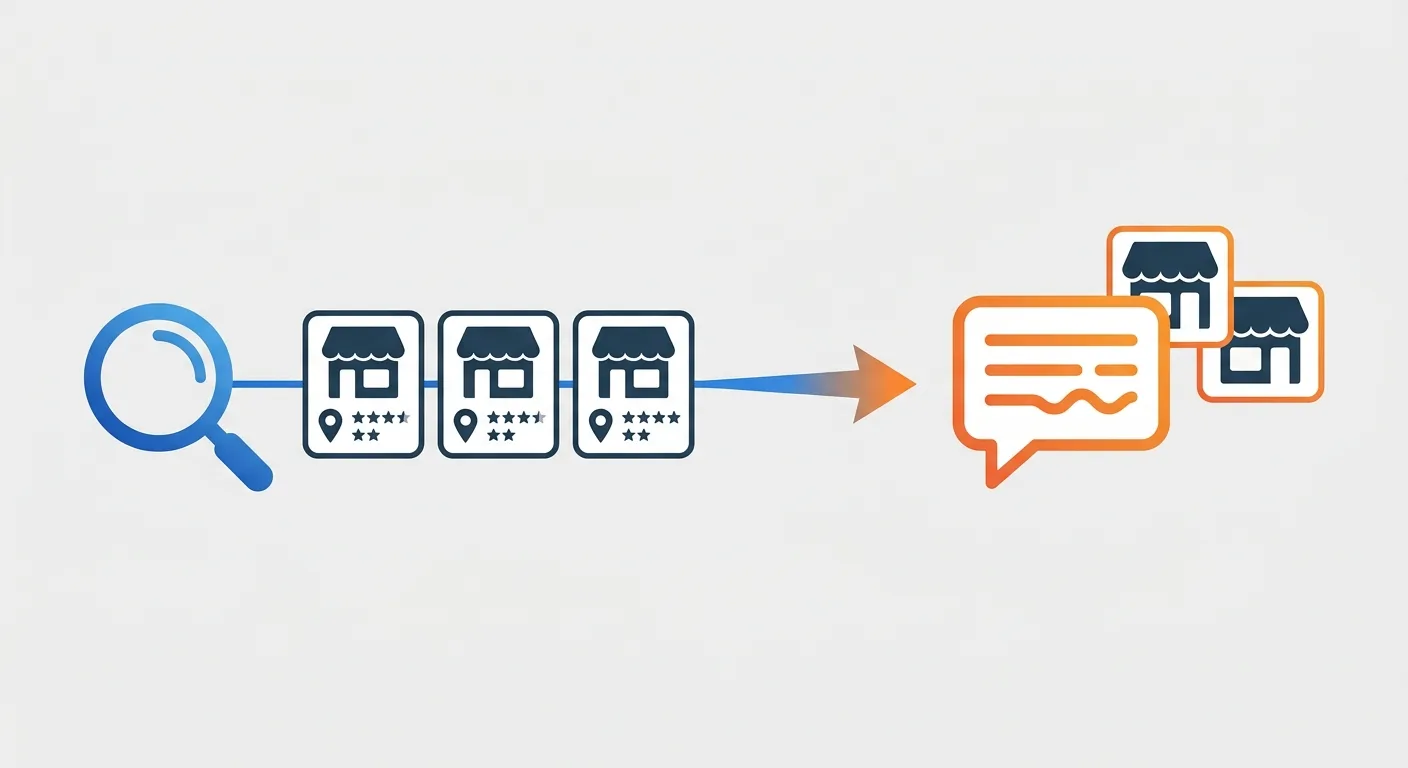 Caption: The path to finding a store is shifting from "a row of links you compare yourself" to "one AI answer that picks for you"—whether AI mentions you matters more and more.
The Local GEO Map: Reshaping Four Assets to Be AI-Citable
Break local GEO apart and it's really four assets, four sub-intents, each needing a layer of "make it AI-citable" reshaping. This section maps them together, and each block links to a deeper article you can drill into.
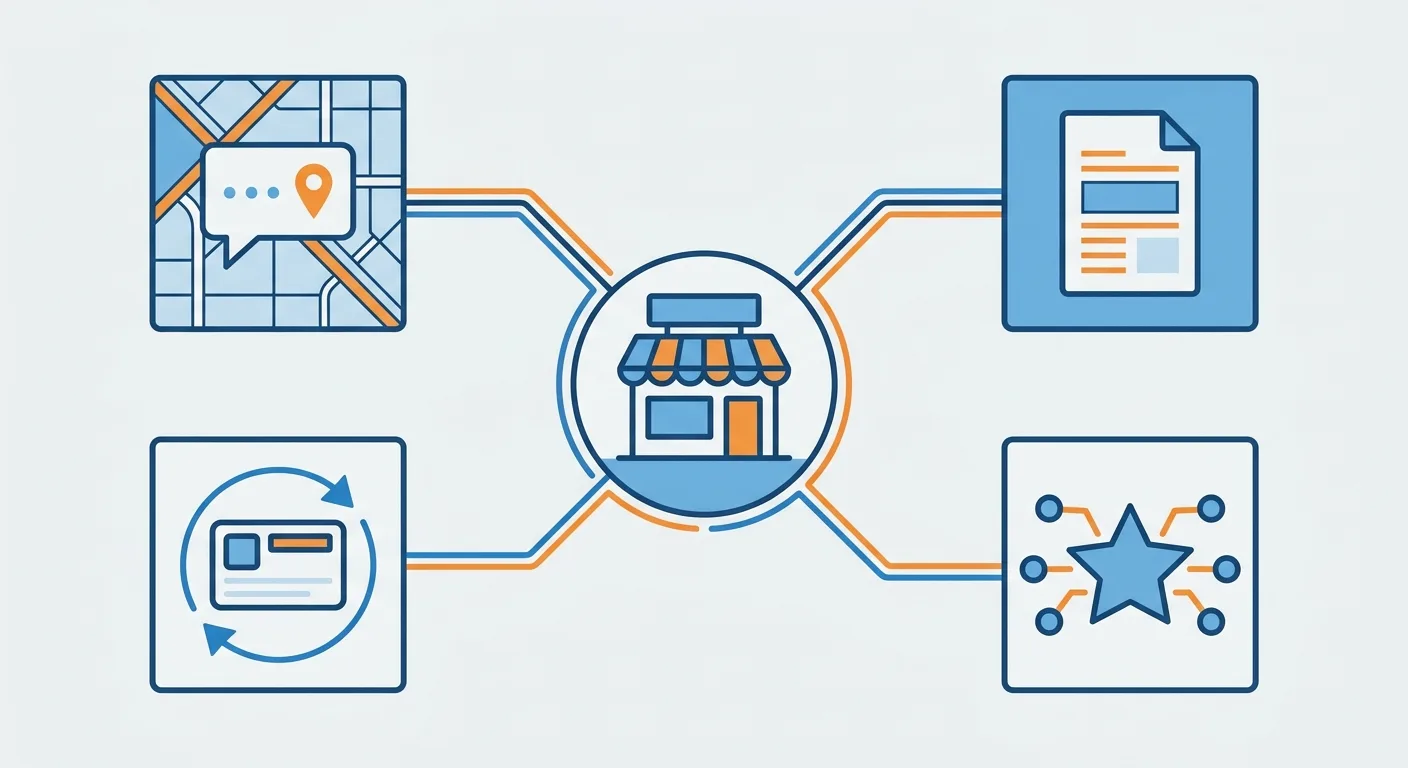 Caption: The four assets of local GEO—(1) the map pack replaced by AI answers (2) location pages getting cited (3) dynamically managed profiles (4) reviews and citations as trust signals.
Sub-Intent One: When the Map Pack Is Replaced by AI Answers, You Fight to "Get Cited"
When a user's local question is answered directly by AI, you're no longer fighting only for the top three in the map pack—you're fighting to become one of the sources that answer cites.
That means paying attention to things traditional local SEO barely cared about: AI citation favors clear, self-contained passages; it favors fresh information with explicit update times; and it favors businesses whose data is consistent and free of contradictions. The full analysis of this block, and the practical response for local businesses, is in the satellite article Are AI Overviews replacing the local pack?. And for when AI simply treats the query as general information without naming any local business, see when AI skips local businesses.
Sub-Intent Two: Write Location/Branch Pages in a Form AI Can Cite
For AI to cite your location page, the page has to actually contain something citable. Many stores' branch pages are "copy-paste and swap the place name"—a form that even traditional SEO penalizes, and one that gives AI almost nothing to cite.
Local GEO asks each location page to independently answer "what this location is, where it is, what it offers, and what makes it different," using a clear structure AI can read passage by passage. The satellite article how to write location/branch pages that get cited by AI breaks down what structured information to include and how to raise "citability." For the page's technical foundation, pair it with local business website SEO.
Sub-Intent Three: Shift the Business Profile from "Set It and Forget It" to Dynamic Management
In the local GEO era, the biggest change to the Google Business Profile isn't more fields—it's that "fill it in and leave it" is no longer enough. Freshness signals, review response speed, and regular posts and photos are becoming activity indicators AI references for local citation.
Worth noting: AI increasingly cites the data you filled into your Business Profile directly. Data shows Google's own pages (Business Profile cards and product knowledge panels) have become one of AI Mode's high-citation sources—meaning completing your categories, attributes, services, products, hours, and photos is no longer just local SEO, but a move to win AI citation. That data and its meaning are covered in Google is AI Mode's #2 cited domain. For the "what to keep doing after setup" dynamic-management checklist, see the satellite article the Google Business Profile maintenance checklist for the AI era; and if you haven't even created your profile yet, start with the complete Google Business Profile guide.
Sub-Intent Four: Reviews and Citations Are Becoming AI Trust Signals
When AI decides whether to cite a store, it references whether it's "trustworthy," and review and citation consistency is exactly that source of trust. I deliberately didn't spin this into a separate article, because it overlaps heavily with existing content—folding it into the pillar and linking out saves you time.
- Reviews: count, score, freshness, and your responses all influence AI's trust judgment. For how to manage them, see the Google review management guide.
- Citation consistency: if your name, address, and phone conflict across directories, AI easily gets it wrong or just declines to cite you. For how to build and audit them, see the local citations guide.
- When AI gets your info wrong: AI sometimes uses stale data or conflicting sources to say you've closed, get your address wrong, or invent services out of thin air. For how to check and fix this, see how to check when AI gets your store info wrong.
Want to reshape all four assets at once?
Each of the four assets has its own pitfalls, and feeling your way through one by one takes time. AI SEO Hacker offers local GEO content and asset reshaping. Get a free LINE review of your current state and a prioritized action order.
👉 Free LINE Consultation: @006ljkda
What Local Businesses Can Do Now: The Order from Local SEO to Local GEO
Local GEO isn't a rebuild from scratch—it's an added layer of AI-citable reshaping on top of your existing local SEO foundation. For local businesses, the pragmatic order is "fill the traditional foundation first, then add AI-citation value."
Here's an action order you can follow (a reminder: this is practical advice under trend extrapolation; Taiwan has no comparable measurement data yet, so treat it as direction, not a guarantee):
- Fill the traditional local SEO foundation first: set up and verify your Google Business Profile, keep NAP consistent, and get baseline reviews and citations in place. The full playbook is in the complete local SEO guide and the local keyword research guide.
- Shift the Business Profile from static to dynamic: post regularly, refresh photos, respond to reviews quickly—keep activity signals happening instead of building it once and walking away.
- Reshape location pages to be citable: one independent page per location, clearly structured, able to independently answer "what this location is," avoiding copy-paste-and-swap-the-name.
- Audit how AI currently describes you: actually search your store on Google AI Overviews, AI Mode, ChatGPT, Gemini, and Perplexity, see whether it gets you right or wrong, and fix the source data when it's wrong.
- Connect your local assets to your overall GEO strategy: local is just one block. For the overall generative engine optimization framework, see the complete GEO guide, and for enterprise-level planning, see Taiwan enterprise GEO strategy.
 Caption: Five steps from local SEO to local GEO—(1) fill the foundation (2) manage the profile dynamically (3) reshape location pages (4) audit what AI says about you (5) connect to overall GEO strategy.
Frequently Asked Questions
Are local GEO and local SEO two different things? Do I have to choose one?
Not a choice between them. Local GEO uses the same assets as local SEO (Business Profile, location pages, reviews, citations)—it just adds a layer of "make it readable and citable by AI." The right order is to fill the local SEO foundation first, then add AI-citation value on top. The two reinforce each other.
Does the "68% AI Overviews vs 39% local pack" figure apply to Taiwan?
Not as a description of Taiwan's current reality. That's from a Whitespark study published in May 2025, with a sample of only 540 queries across 6 industries in just 3 US cities, and it's over a year old. It works as directional evidence that "AI shows up more and more in local search," but it can't be dressed up as a general ratio for Taiwan or globally. Taiwan has no comparable public measurement data yet.
I'm a single store with no branches—do I still need local GEO?
Yes, and it's simpler for you. With one location, you only maintain one profile, one set of location info, and one batch of reviews and citations. Keep them complete, fresh, and consistent, and you raise your odds of being cited by AI. Multi-branch businesses instead have to handle keeping each location's content independent and avoiding self-competition.
Which asset should local GEO start with?
Start with the Google Business Profile—it has the highest return. It's one of AI's most frequently cited local data sources, and the cost of completing fields and shifting to dynamic management (regular posts, refreshed photos, review responses) is relatively low. Once the profile is solid, extend to location pages and review citations.
How do I know whether AI currently mentions me or gets me wrong?
The most direct way is to ask it yourself. Search your store name and "location + service" on Google AI Overviews, AI Mode, ChatGPT, Gemini, and Perplexity, and see whether AI mentions you and whether the info is right. If it's wrong, fix the source data (Business Profile, official site, directories). For detailed self-check steps, see how to check when AI gets your store info wrong.
Reconfiguring Existing Local Assets for AI: The Next Step in Local GEO
At its core, local GEO is a pragmatic thing: you don't need to chase new tools, and you don't need to abandon effective local SEO. You reconfigure the four assets you already have for a new reader—AI.
- When the map pack is replaced by AI answers, what you fight for shifts from "ranking" to "being cited."
- Location pages should be written to be independently citable, no longer copy-paste-and-swap-the-name.
- The Business Profile should shift from "set it and forget it" to continuously updated dynamic management.
- Reviews and citations become the signals AI uses to judge whether you're trustworthy.
Taiwan's measurement data is still on its way, so the best posture now is to "claim your position early and build a solid foundation"—as AI citing local businesses becomes more common, the stores that reshaped their assets one step earlier get mentioned in the answers first.
 Caption: Placing local assets, piece by piece, into AI's answer—that's what local GEO is about.
Want your store recommended by AI?
Not sure which of the four assets to reshape first, or how AI currently describes you? AI SEO Hacker offers a local GEO current-state review and content reshaping. Get a free LINE health check and the most efficient priority order.
👉 Free LINE Consultation: @006ljkda
Further Reading
- Complete local SEO guide—the operational foundation of traditional local SEO
- GEO vs SEO—understand the overall difference between GEO and SEO first
- Are AI Overviews replacing the local pack?—a deep dive on sub-intent one
- How to write location/branch pages that get cited by AI—a deep dive on sub-intent two
- The Google Business Profile maintenance checklist for the AI era—a deep dive on sub-intent three
- Complete GEO (generative engine optimization) guide—the overall GEO strategy framework
- Taiwan enterprise GEO strategy—enterprise-level planning
References
- Whitespark, "The Prevalence of AI Overviews in Local Search" (2025-05-12, a study of 540 queries across 3 US cities): https://whitespark.ca/blog/case-study-the-prevalence-of-ai-overviews-in-local-search/
- Search Engine Journal, "AI Overviews Now Answer Most Local Searches — How To Get Your Business Cited" (2026-07-22): https://www.searchenginejournal.com/ai-overviews-now-answer-most-local-searches-how-to-get-your-business-cited/580757/
- Search Engine Journal, July 2026 analysis on "the death of the static Google Business Profile"—freshness signals, review response speed, and regular posts and photos becoming reference factors for AI local citation (Adam Heitzman)