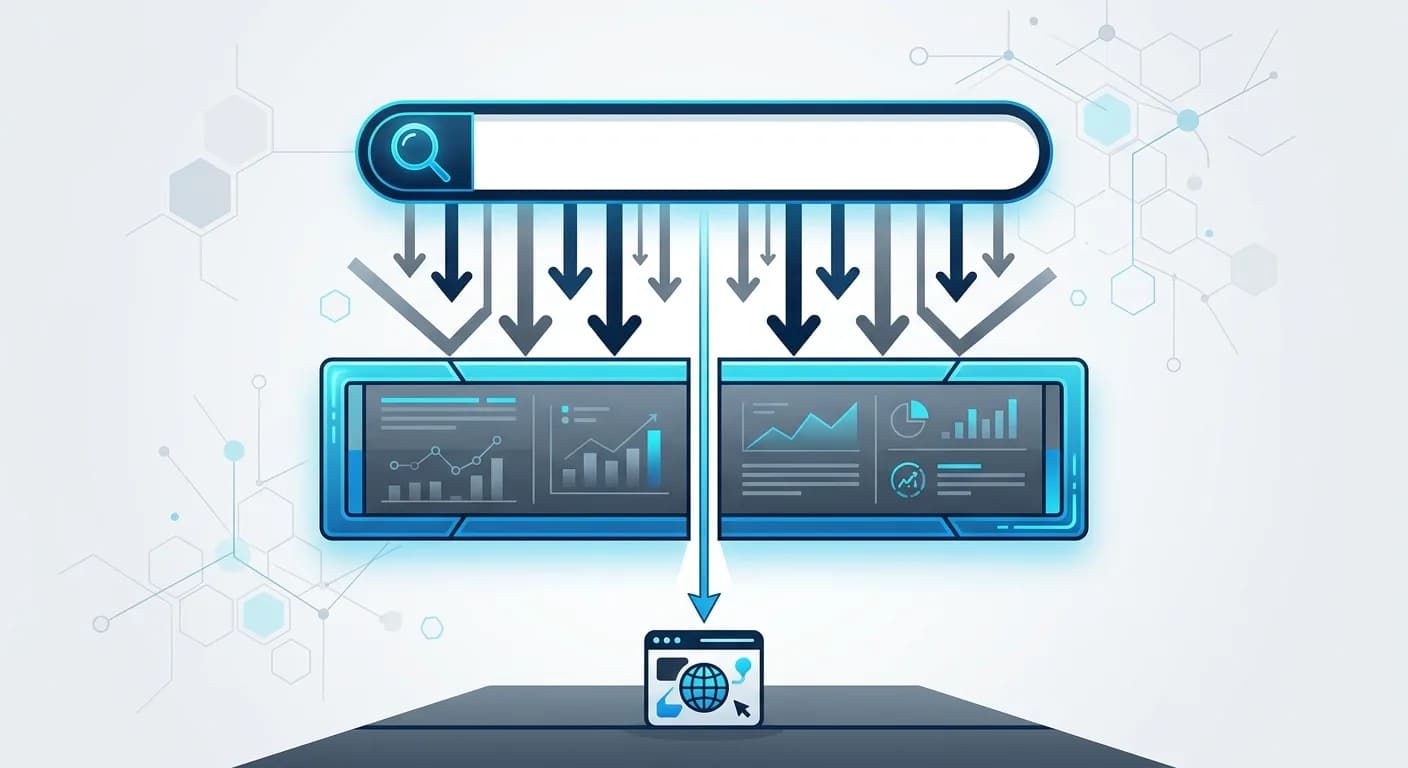
Your rankings haven't dropped, but your clicks keep sliding. Confusing, right?
The problem may not be your website. It's the block of AI summary now sitting on the search results page — users read the answer and leave without ever clicking through. This is what people call zero-click search, or Google Zero.
This article is a map. First I'll help you read the numbers correctly so you can see how serious zero-click really is. Then I'll walk you through four pillars you can actually fight back with. Finally, I'll compress it all into an action list you can start on today.
💡 Not sure how much traffic AI is eating from you? We'll measure it once and turn it into a chart you can actually read. 👉 Chat with us on LINE
Key takeaway: Zero-click isn't a scary headline — it's a structural change. Clickstream data from January to April 2026 in the US shows that 68.01% of Google searches ended with zero clicks (SparkToro, 2026). What small businesses should do isn't panic — it's swap in a new strategy map: read the numbers, measure by exposure instead of clicks, rewrite content so AI can copy your brand name, then route that AI exposure to LINE to convert.
What Is Zero-Click Search, and Why Is Everyone Talking About Google Zero in 2026?
Zero-click search means the user finishes a search, gets the answer right on the results page, and leaves without clicking anything. AI summaries — Google's AI Overviews and AI Mode — lay the answer across the top of the page, and this becomes the norm.
It blew up in 2026 because several datasets measured it at once. But here's the trap: the numbers floating around online have messy definitions, and plenty of second-hand blogs blend figures from different studies together. Let's separate the three most-cited numbers first, so you won't get fooled by any report you read later.
68%, 93%, and 58 Each Measure a Completely Different Thing
68% is the zero-click rate across all Google searches. Clickstream data from January to April 2026 in the US shows that out of every 100 Google searches, 68.01 produced no click of any kind — not even on Google's own properties or ads (SparkToro, 2026). Interestingly, only 0.34% of searches in that same dataset actually used AI Mode. That tells you something: click loss started well before AI Mode went mainstream. Featured snippets, knowledge panels, and direct answers were already eating your clicks — AI just accelerated it and made it obvious.
93% is the zero-click rate inside the AI Mode interface specifically. If you only look at that conversational search surface, it's more extreme — Semrush's July 2025 analysis (Semrush) found about 93% (a 92–94% range in the original) of queries in AI Mode produce no external click. Mind the definition: this number belongs to AI Mode alone and can't stand in for all searches.
58% is the click-through drop for the first result, and it measures AI Overviews. Ahrefs tested 300,000 keywords: when a search result shows AI Overviews, the previously first-ranked organic result has a click-through rate 58% lower on average (Ahrefs, 2026). Hold this definition tight — it's the first position's CTR, not the overall average; it measures AI Overviews, not AI Mode; and it compares December 2023 against December 2025 (the older study, published April 2025, found 34.5% over a one-year window; the new one compares a two-year window). The full background is in our breakdown of the Ahrefs AI search study.
See the difference? 68% says "how many searches send no click at all," 58% says "how much click the first result has lost," and 93% says "how fast clicks evaporate inside the new interface." All three are correct, but mixing them gives you the wrong conclusion. If you see someone write "75% of AI Mode searches are zero-click," no first-party study backs that number — don't trust it.
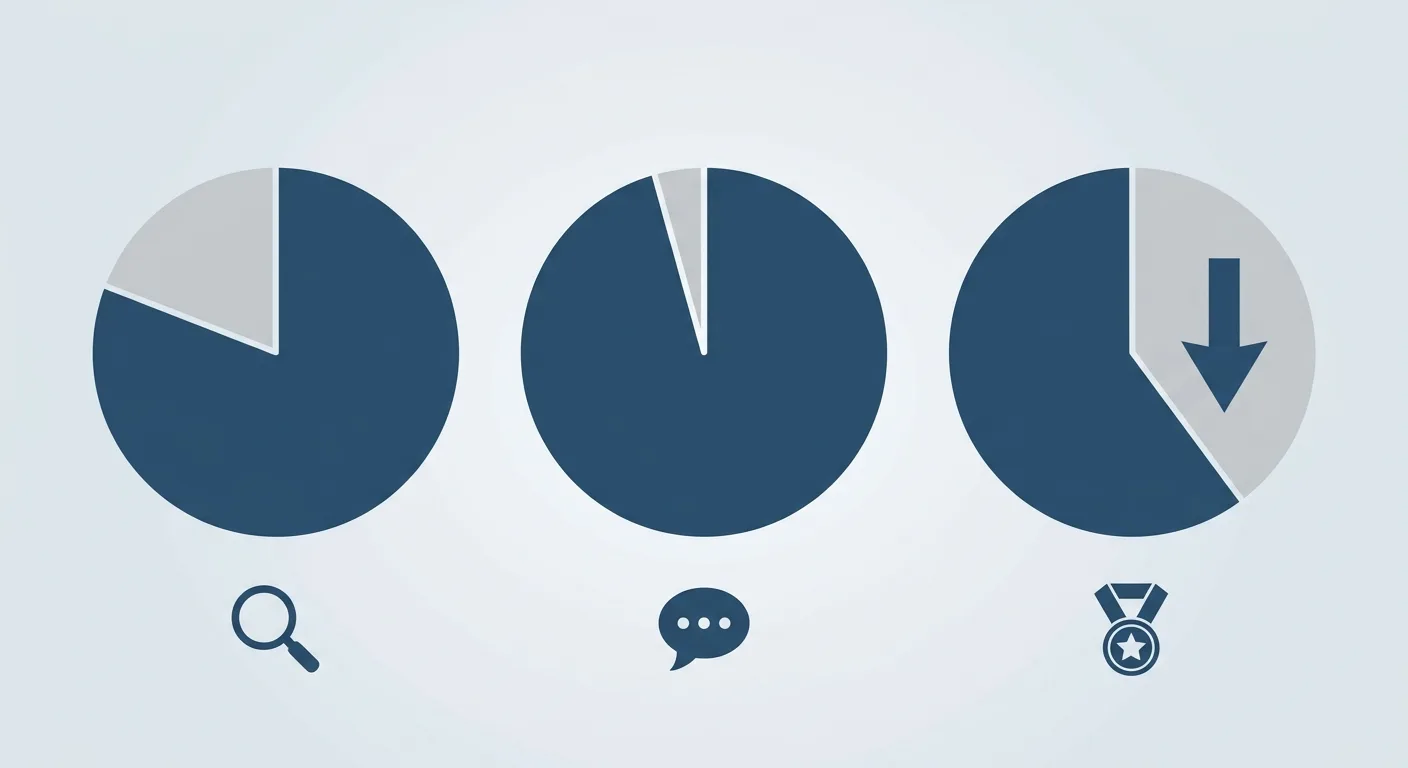 Caption: The three numbers measure different things — (1) all Google searches, 68% zero-click (SparkToro); (2) inside AI Mode, ~93% zero external click (Semrush); (3) with AI Overviews present, the first result's CTR is 58% lower (Ahrefs). Never mix the definitions.
The Real Impact on Small Businesses: Your Ranking Didn't Drop — Your Clicks Got Intercepted by AI
The conclusion first: your ranking may not have moved at all, yet your traffic is falling. The rules shifted from "rank near the top and people click" to "rank near the top, but AI already gave the answer."
We used to track traffic for clients on a simple logic — rank a keyword on page one, clicks come in, conversions get a chance. Now there's a layer of AI summary in the middle. A user asks "how much is a diving course" or "why is my AC not cooling," AI gives the answer up top, they're satisfied, and they leave. Your site is literally the source of that answer, yet you don't collect a single click.
This hurts Taiwanese small businesses especially, for two reasons. First, you don't have a big brand's budget to buy ads and backfill the traffic gap. Second, a lot of small-business content is answer-shaped by nature — tutorials, FAQs, spec sheets — and that's exactly what AI summaries love to swallow whole. The harder you work on helpful, educational content, the easier it is for AI to lift your answer without giving you the click.
So is SEO dead? No. Its value position changed. We cover this shift in more detail in How AI Is Changing SEO and The Difference Between GEO and SEO. In short: ranking still matters, but you have to fight on a new front too — getting cited by AI. You can't get the click, but if AI mentions your brand name in its answer, that's the new visibility.
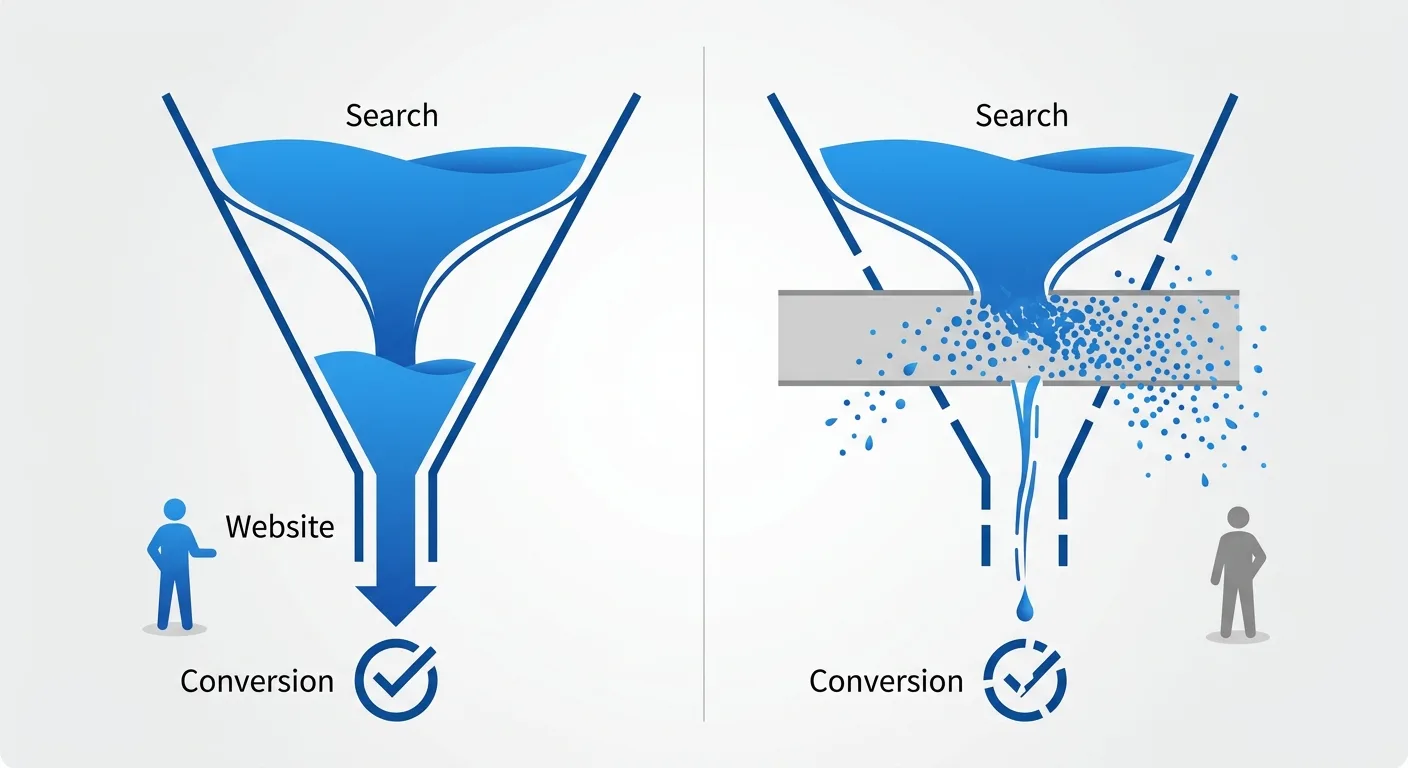 Caption: Left, the old funnel (search → click → website → conversion, all smooth); right, the zero-click funnel (AI summary intercepts mid-way, most flow disappears there, only a thin stream reaches the site).
The Four Pillars for the Zero-Click Era: One Strategy Map
Facing zero-click, spraying and praying gets you nowhere. I've organized it into four pillars. Each one maps to an action you can start right away, and each has a deeper article to read next. Together, they're the full route you should take in the zero-click era.
Pillar One: Read the Numbers First, Don't Let a Single Headline Scare You
Step one isn't touching your website — it's reading the numbers correctly. Zero-click reports are everywhere. Google says "AI sends billions of clicks a week," while a study over here says clicks collapsed. Who do you believe?
The answer: don't take either at face value, and track the numbers you can verify yourself. When your boss brings a "Google says billions of clicks" headline and asks why your own GSC doesn't match, that gap has four structural causes — how to explain each one is laid out in Google Says Billions of Clicks but Your GSC Doesn't Match: The 2026 Gap Explained. And the thing eating your clicks — what AI Overviews and AI Mode actually look like, and which Taiwan queries get intercepted — is covered in AI Overviews and AI Mode in Taiwan.
The point of reading the numbers is just one thing: don't scare yourself with a giant total you can't win against or verify. Watch your own trend instead — that's where you have leverage.
Pillar Two: Measure by Exposure and Citations, Not Just Clicks
Once the numbers are read right, swap out your ruler. The old ruler measured clicks; the new one measures exposure and citations.
Why? Because in the zero-click era, "being seen by AI" happens before "being clicked into." When your content enters the AI answer and your brand gets mentioned, that's a real piece of visibility — even if it drives no click right then. So performance reporting splits into two layers: first prove "we made it into the AI answer" (exposure), then prove "some of it actually clicked through" (referral visits).
How do you measure it concretely? Google's Search Console generative AI performance report, launched in June 2026, shows how much your content is exposed in AI features — our take is in the complete guide to the Search Console AI performance report. Visits from non-Google platforms like ChatGPT and Perplexity sit in your GA4 referral report; how to filter them out is in AI Search Traffic Analysis. And the discipline of "watch the trend, not the single month" is covered most fully in How to Measure GEO Performance.
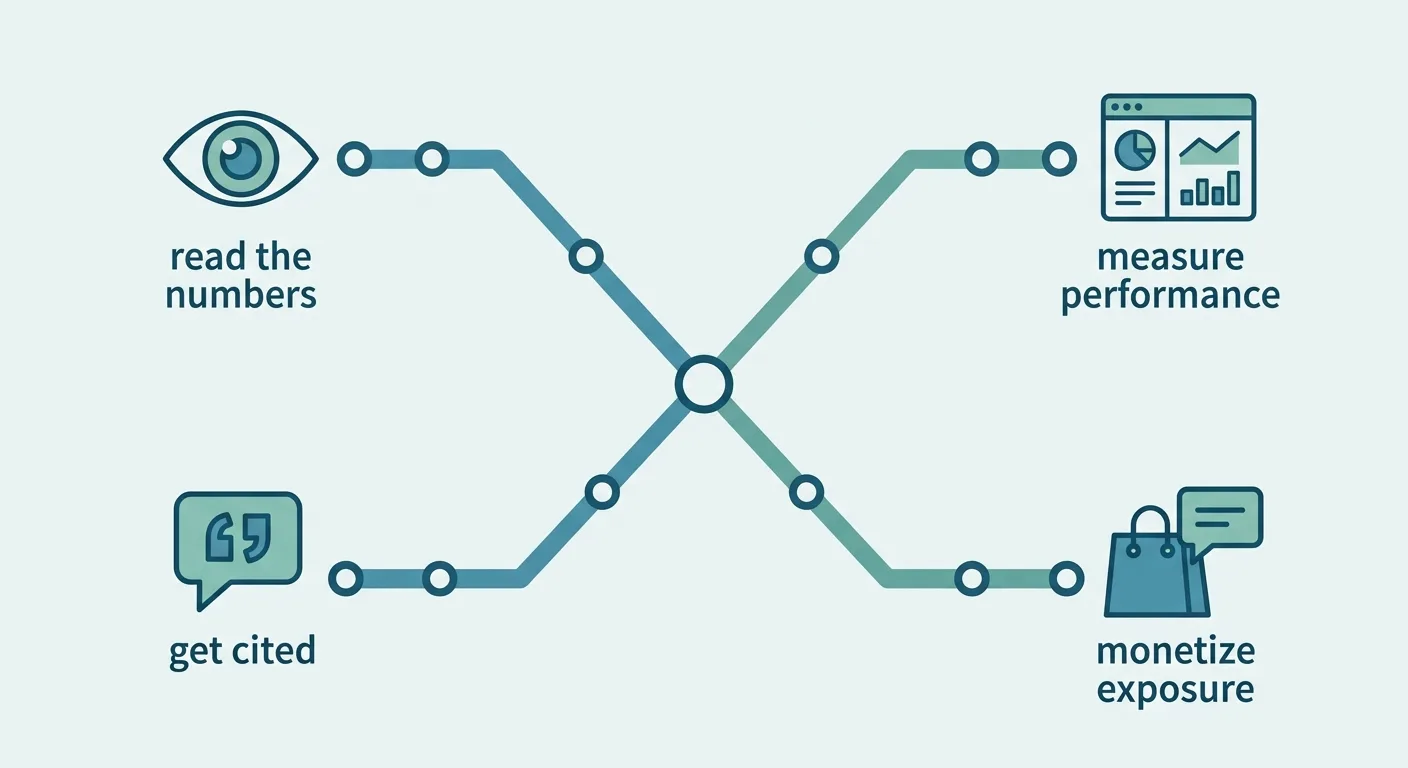 Caption: The four pillars of the zero-click era — (1) read the numbers, (2) measure exposure and citations, (3) get your content cited by AI, (4) monetize the AI exposure. All four running in parallel makes it complete.
Rankings steady, but clicks falling?
Don't know how much traffic AI is eating, or which pillar to start with? AI SEO Hacker specializes in content and data interpretation for the AI era — we measure the zero-click impact into a chart and sort your priorities.
Pillar Three: Rewrite Content So AI Can Copy Your Brand Name
You can't win the click back, so win the citation instead. This is the most counterintuitive — and most important — move in the zero-click era.
The logic: an AI summary pulls a few sources and synthesizes an answer. If your content is written so AI can copy it verbatim, and you bind your brand name to a fact in the same sentence, then AI is more likely to mention you when it answers. Even if the user never clicks in, they saw your name in the answer — that's a free piece of brand exposure.
How do you write it? Three things: put the conclusion at the start of each paragraph (AI tends to grab paragraph openers), make every paragraph independently understandable (no relative references like "as mentioned above"), and put your brand name and the key fact in the same sentence. The full "make AI able to copy you" method is broken down step by step in Content Strategy to Get Cited by AI in the Zero-Click Era.
Pillar Four: Monetize AI Exposure — Change the Endpoint from Your Website to LINE
The last pillar, and the one that most directly touches revenue. No matter how much AI exposure you get, without a path to monetize it, it's still empty for a small business.
The key mindset shift: stop treating "drive to the website" as the only endpoint. In the zero-click era, a user might see you in an AI answer, remember your brand name, then later search your brand directly or add your LINE Official Account. So the monetization path needs a redesign — use AI exposure to grow "branded search," and change the endpoint from a cold website page to a LINE account or Google Business Profile where you can chat and close in real time. How to lay this alternative path is in Zero-Click Monetization for Small Businesses and A GEO Strategy Overview for Taiwanese Small Businesses.
 Caption: The zero-click monetization path — AI mentions the brand → user remembers the branded term → the endpoint shifts to closing on a LINE Official Account. The website is no longer the only destination.
The Zero-Click Action List: Seven Things You Can Do Today
After four pillars, in case you go home unsure where to start, I've compressed it into a seven-item list. Start with the easiest — each one can move a notch within a week.
- Set up two measurement tools first. Open the GSC generative AI performance report and configure a GA4 referral source filter. This is the foundation for every judgment — without it, you don't even know how much you've lost.
- Watch the trend, not the single month. AI traffic has a small base, so a single month means nothing. Watch the exposure share across three consecutive months; trending up is the right direction.
- Audit the pages AI eats most. Answer-shaped pages whose ranking held but clicks clearly dropped are the intercept zone for AI summaries — handle them first.
- Move key pages' conclusions to the paragraph start. State the conclusion in the first sentence of each paragraph so AI can grab — and copy — your key line.
- Bind your brand name into fact sentences. Don't split the fact and the brand name across two paragraphs. Put them in the same sentence, so AI carries your name along when it cites.
- Reset the monetization endpoint. On content with high citation potential, change the CTA from "read more" to "chat on LINE," shortening the distance from exposure to close.
- Review once a month. Five minutes, three cells: GSC exposure, GA4 visits, month-over-month change. Use your own trend chart to answer the boss's "is the investment working."
You don't have to finish all seven at once. But the moment you start, you shift from "passively losing traffic to AI" to "actively claiming position in the zero-click era."
FAQ
What does zero-click search mean?
Zero-click search means the user gets the answer on the search results page and leaves without clicking anything at all (not even Google's own properties or ads). US data from January to April 2026 shows 68.01% of Google searches ended zero-click (SparkToro, 2026). The main cause is AI summaries, featured snippets, and knowledge panels laying the answer across the page so users don't need to click through to the source.
Does zero-click mean SEO is useless now?
No. SEO's value position changed — it didn't disappear. Ranking still affects whether you have a chance to be chosen as a source by an AI summary; it's just that "rank up and people click" no longer holds. The zero-click era adds a new front: getting cited by AI. Even without a click, your brand name appearing in the AI answer is a piece of visibility. Full discussion in How AI Is Changing SEO.
Is the "75% AI Mode zero-click" number credible?
No. No first-party study supports it; it only appears in second-hand GEO blogs. There are two usable first-party definitions, and they differ: all Google searches at ~68% zero-click (SparkToro, 2026); and inside the AI Mode interface, ~93% of queries with zero external click (Semrush, 2025). Always state which definition you mean — don't write 75%.
How much do AI Overviews cut clicks?
Ahrefs tested 300,000 keywords: when AI Overviews appear, the previously first-ranked organic result has a 58% lower average click-through rate (Ahrefs, 2026). Note this is the first position's CTR drop, not the overall average, and it measures AI Overviews, not AI Mode. The older version of the study, published April 2025, found 34.5% (over a one-year window versus two years in the new one) — it's worsening fast.
What should a small business prioritize in the zero-click era?
Set up measurement first (GSC generative AI report plus GA4 referral), then move key pages' conclusions to the start and bind your brand name into fact sentences so AI can copy them, and finally shift the monetization endpoint from your website to a LINE Official Account. The full four-pillar method is in A GEO Strategy Overview for Taiwanese Small Businesses and Zero-Click Monetization for Small Businesses.
Treat Zero-Click as the New Rule, Not Bad News
Three takeaways. First, zero-click is a structural change — 68% of US searches are already zero-click, and it started before AI Mode went mainstream, so don't treat it as a passing headline. Second, keep the definitions straight: 68%, 93%, and 58% each measure something different, and mixing them only yields wrong conclusions. Third, the counterattack has a map: read the numbers, measure by exposure, get cited by AI, and route the exposure to LINE to convert — all four in parallel makes it complete.
The rules changed, but that doesn't mean you lost. What changed is the game. Hold your own trend line tight, follow these four pillars, and you can actually claim position at the lowest cost while the map is still unsettled. Start with the first thing today: open your GSC AI report and see exactly how much got eaten.

🎯 Take Action Now
Still stuck with steady rankings but falling traffic thanks to zero-click? AI SEO Hacker measures the traffic AI ate into a chart you can actually read, and hands you the priority order across all four pillars.
👉 Chat with us on LINE | Fill out the inquiry form
Further Reading
- Google Says AI Search Sends Billions of Clicks, but Your GSC Doesn't Match? A 2026 Breakdown
- AI Overviews and AI Mode in Taiwan: What the Thing Eating Your Clicks Actually Looks Like
- Content Strategy to Get Cited by AI in the Zero-Click Era
- Zero-Click Monetization for Small Businesses: Route AI Exposure to LINE
- How to Measure GEO Performance: A Complete Guide to AI Search Visibility Metrics
- The Complete Guide to the Search Console AI Performance Report
- A GEO Strategy Overview for Taiwanese Small Businesses
![Should You Opt Out of Google AI Search? The UK Mandate Explained — and What to Do Instead [2026]](/_next/image?url=%2Fblog%2Fimages%2Fgeo%2Fgoogle-ai-search-opt-out-01.webp&w=3840&q=75)